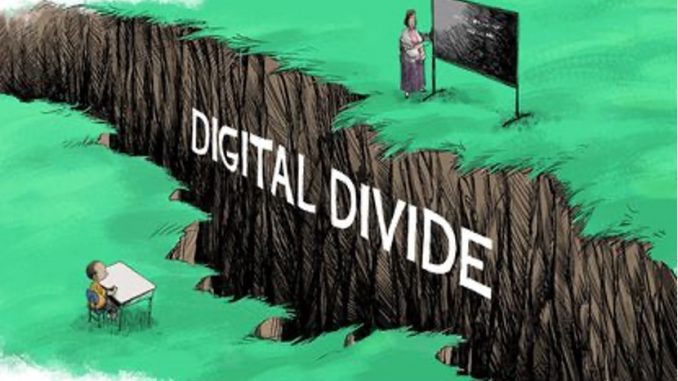
How to eliminate the Digital Divide More Prominent in Epidemic Time
INTRODUCTION
With the rapidly development of new media and advanced network technology in modern society, the internet community has delivered a profound impact on the whole social groups. When the users enjoy the convenience and beneficial that current information network transformed, the gap between different levels and living status of citizens in social life and their different perceptions of network will eventually determine a new genre of inequality which is the digital divide. It is one of the social manifestations can also be described as the gap between usage and access to information. There are some elements that reflect the digital divide which are socioeconomic status, digital product leakage, regional differences, gender differences, age differences, family structure differences, and literacy level. However, with the development of the technology environment, the digital divide will become a social issue that needs people to pay more attention to. For instance, the digital divide is related to the ability of the different social groups to participate in the information society. Besides, when the information has more opportunities in people’s daily life, such as trade, education, culture, entertainment, and communication. The digital divide will exclude the majority of the poor people from information technology that prevents them to get new information that cannot reduce inequities between rich and poor people.
This blog will mention after artificial intelligence and automation and the internet of things are more adopted into government debt system and social welfare, there are new challenges for users. In order to examine the new gaps, the Australian government started using AI and IoT in automated debt collection and the National disability system. Park and Humphry (2019) also introduced in the automated system, data exclusion and digital inclusion will lead to the failure in the end, they explain the social and digital inequalities; Big data and new divide; AI and automation, and methodology to support the argument. Besides, I will discuss the Chinese senior living situation under the digital divide and the government’s solution in China.
Robodebt
There is an example can illustrate the digital exclusion will determine the digital digital divide. Australian government using Robodebt in automated debt collection. The Australian federal government will refund 470,000 residents in error on late payment penalties. Their total amount is AU $ 720 million (US $ 480 million). The fines were written by the robot. The system was introduced last year to recover surplus social benefits as part of a previously launched Centrelink community support campaign (Park & Humphry, 2019). The new system was organized by the Australian Internal Revenue Service. She automatically contacted those residents who owed more than $ 1000 to the state (SBS News, 2020). However, every fifth letter was based on false information, as the tax authorities misjudged the defaulter’s income. According to 7News (2021), the robotdebt helps the government to calculate welfare by combine the annual payment information and reported income details to match the original data. This behavior is to correct the previous data to claw back the overpaid welfare payment. Moreover, the Robodebt investigated the Centrelink whether have wrong payment before (Carney, 2019).
The system used an algorithm to estimate the average income of a person for the year. However, this is a weak decision, given that some may have been eligible for social benefits due to low income for several months (SBS News, 2020). Due to incorrect calculations, such recipients were retroactively denied the right to benefits and charged them with debts. However, the outcome is not good at predicting, the robodebt have not fully analyzed the data, the discrepancy is still not solved. At the same time, during innovation the robodect, the experts have not considered the people who do not have a stable living environment or the group of people who do not have digital devices to apply the debt. Therefore, these citizens considered as guilty, the basic data has an exclusion that will lead to the digital divide eventually. Due to the digital exclusion that existed, the automated calculation by the robodebt accelerated the lack of services and determining new barriers to the government. Eventually, McCubbing (2021) mentioned, the Federal Court ruled the robodebt project is unlawful.

Empowering people with disabilities is a top priority for Australia, including through the implementation of the National Disability Insurance Program and through the above analysis. However, bridging the gap between indigenous people in Australia and the rest of Australia in the areas of health, education and employment also remains a priority, as well as work towards the recognition of indigenous people in Australia as the first peoples of Australia in the Australian Constitution. The government is also committed to efforts to improve gender equality and reduce violence against women. In Australia there are currently 25000 individuals with disabilities, nonetheless, the Australian government is attempting to facilitate these people with the utmost care and help at least in the sphere of social welfare. Considering the fact that this figure is forecasted to grow to 46000, Australia’s government has decided to facilitate these people with a system that would improve their experience and facilitate them with their needs in a faster, healthier way promoting better attitude and eliminating the human factor (Park & Humphry, 2019). Thus, the intelligent avatar interfact (iAI) Nadia appeared.
Nadia
The created chat bot is able to observe the interlocutor through the webcam and recognize his emotions by the face. The developers call this ability of their innovation emotional intelligence, which is able to communicate with a person on a more sensual level (Probyn, 2017). Like other similar bots, Nadia learns from personal experience and understands human emotions better each time. When the tone or expression on the other person’s face changes, Nadia quickly picks up the change and adjusts to the other person. The novelty has the voice of actress Cate Blanchett and was created by a startup company for the Australian authorities with the aim of improving service for people with disabilities (Park & Humphry, 2019). It helps users connect with the National Disability Insurance and navigate the information they need.
The main purpose of innovating Nadia is to assist disabled citizens to gain support and ancillary services. Nadia using digital technology to analyze the specific data to communicate with people and assist a certain group of people. According to Barbaschow (2017), The National Disability Insurance Agency announced that Nadia will assist the National Disability Insurance Scheme to provided better services for the disabled citizen, Nadia could communicate with people and provide useful information and help for disabled people and it can collect the questions and information to build up a database gradually (William, 2017). However, when people innovate Nadia, they considered the data inclusion, but Nadia cannot analyze and learn the data by itself which determined the difficulty in cooperating with disabilities. due to Nadia’s work for social welfare that there is no tolerance to make a mistake, so this situation led to this artificial intelligence creature has not been implemented.
The author uses these two cases to explained when digital exclusion exists will determined social exclusion. This phenomenon will eventually produce a digital divide. Due to the digital exclusion contributed by big data and artificial intelligence, once the mistake occurs at the data collection, the relationship between data and people who collected are inequal no matter how to calculate the results. People cannot predict which group of data will be analyzed and which is important. Therefore, due to the original data is inequal and incomprehensive, the result will lead to data exclusion. Moreover, after using big data to collect the information, the academic experts will do the research. However, this group of people who are belong to high-income or high-education group that cannot considered all levels of people in the social. The result may lead to social exclusion. The introduction of AI solutions in daily life is a significant step forward. And despite the issues with algorithms, like robodebt has demonstrated, tweaking the program, and fixing it will make it all the better for the users to live and function

In addition, there is another example that can reflects the data exclusion will lead to a digital divide. In China, in order to prevent COVID-19 spread, the government announced the travel code that shows personal information and current health status. When we use our cell phones, they continuously transmit radio signals to capture with carrier base stations and Internet companies, and it is by sifting through these signals that carriers and Internet companies track our journeys. The travel code tracking is more concerned with data reliability and stability; thus, the majority of the travel code collect our information from our cell phone. It is essential to prove when people to go to the public area or another city. We have become accustomed to the efficient and convenient life brought by modern technology, and the information we obtain is accurately put into everyone’s cell phone through the calculation of big data, giving us an illusion of “the world around us”. However, the government has not considered the group of people who are living in a rural area and senior who is unable to apply the travel code. When everyone takes the health code for granted, an old man in Harbin was refused a bus ride because he didn’t have a health code and was reprimanded for being “disrespectful to the elderly” for being late in getting off the bus. The designers have not considered all the groups of people that lead to social exclusion. For many seniors, smart technology and digital services are like an invisible barrier that keeps them out of the door of convenience and speed. Fortunately, the government notices the insufficient and established special access for these people.
Nowadays, The Internet has become a fundamental tool for people’s work and life, and the online world has become increasingly all-encompassing, allowing people to gain knowledge, improve productivity, and indulge in online games. After the issue of IT accessibility becomes less prominent, the difference of people’s purpose and way of using IT has become a new digital divide. The relevance of the digital divide theory is demonstrated on the differential capability of members of society to constitute the community wealth directly.
Conclusion
In conclusion, there is no doubt that the impact of the digital divide is widespread and profound. In the wave of digital transformation, the government is playing a regulatory role to improve to monitor the society and trying to minimize the gap of the digital divide. Initially, the governments should increase investment and incentivize the private sector to expand investment in telecommunications and Internet infrastructure and provide affordable Internet access to the poorest and most vulnerable communities to achieve balanced and inclusive digital development. Moreover, improving digital literacy and skills through education and training is key to achieving inclusion and equity. At the social level, it should also promote the accelerated application of digital technology, in the construction of infrastructure, raising the level of digital skills for different age and occupational groups, but also to improve the network penetration rate to construct a better community.
REFERENCE
- 7News (2021). Centrelink robodebt refund 2021 explained. Retrieved May 10,202, from https://7news.com.au/business/centrelink/centrelink-robodebt-refund-2021-explained-c-2802973
- Barbaschow, A. (2017). National Disability Agency looks outside Watson for Nadia AI bot. Retrieved June 1, 2017, from: https://www.zdnet.com/article/national-disability-agency-looks-outside-watson-for-nadia-ai-bot/
- Carney, T. (2019). Robodebt class action could deliver justice for tens of thousands of Australians instead of mere hundreds. Retrieved September 18, 2019, from: https://www.abc.net.au/news/2019-09-18/hundreds-have-already-beaten-centrelinks-robodebt/11523278
- Friedman, T.L. (2020). After the Pandemic, a Revolution in Education and Work Awaits. The New York Times. Retrieved from: https://www.nytimes.com/2020/10/20/opinion/covid-education-work.html?searchResultPosition=3
- McCubbing, G. (2021). ‘No accountability’: Robodebt victims oppose settlement. Retrieved May, 6, 2021 from: https://thenewdaily.com.au/news/national/2021/05/06/no-accountability-robodebt-victims-oppose-settlement/
- Park, S. & Humphry, J. (2019). Exclusion by design: intersections of social, digital and data exclusion. Information, Communication & Society, 22, 7.
- Probyn, A. (2017). NDIS’ virtual assistant Nadia, voiced by Cate Blanchett, stalls after recent census, robo-debt bungles. ABC News. https://www.abc.net.au/news/2017-09-21/government-stalls-ndis-virtual-assistant-voiced-by-cate-blanchet/8968074
- SBS News. (2020). Federal government to repay 470,000 wrongly issued robodebts worth $720 million. SBS. https://www.sbs.com.au/news/federal-government-to-repay-470-000-wrongly-issued-robodebts-worth-720-million
- Sora Park & Justine Humphry (2019) Exclusions by design: Intersections of social, digital, and data exclusion. Information, Communication, Society, 22(7), pp. 934-953.
- Williams, W. (2017) Cate Blanchett Voices ‘Game Changing’ NDIS Avatar. Retrieved February 20, 2017 from https://probonoaustralia.com.au/news/2017/02/cate-blanchett-voices-game-changing-ndis-avatar/
Be the first to comment