Ethical issues of artificial intelligence (AI) entering genetic science
SEO: Artificial intelligence (AI), ethical issues, gene-editing babies, AlphaFold
With the vigorous development of the Internet, big data and artificial intelligence and other new generations of information technology, the fourth industrial revolution with intelligence, networking and digitalization as the core is coming. Artificial intelligence is the main driving force of the fourth industrial revolution. As a product of the progress of the Times, artificial intelligence has had an earth-shaking impact on people’s lives. On top of the Internet’s big data and sophisticated machine algorithms, artificial intelligence improves the existing way of life, bringing convenience to people’s life from intelligent home, medicine, transportation, and other aspects. According to the BBC, artificial intelligence has become almost ubiquitous, permeating every aspect of life. It can be said that artificial intelligence is not only a revolution in the internet field, but also can be projected into almost all industries. As a general technology, artificial intelligence has become one of the important tools to support global economic and technology development. However, while benefiting human beings, the development of artificial intelligence has brought new problems and challenges to globalization and the international community. The ethical issue of artificial intelligence has become a hot topic of international scientific controversy. It is urgent to think about the ethical issue of artificial intelligence and to govern it effectively.
As Crawford (2021) said “Ignoring ethical issues is harmful. It perpetuates the wrong idea that scientific research is carried out in a vacuum and bears no responsibility for the ideas it disseminates”. This blog will take gene-editing babies and AlphaFold as examples, to discuss the ethical issues that have arisen and will arise when AI enters genetic science as AI is widely used in medicine. These ethical issues have a huge impact on Internet culture and governance.
Genome editing technology
Nowadays, the trend to bring artificial intelligence into health care is overwhelming, and it has huge commercial value. According to Robert Frost & Sullivan, a consultancy, AI systems will generate $6.8 billion in global healthcare revenues by 2021. The ability of artificial intelligence and machine learning to process large-scale calculations in the face of the massive data of the human genome has made genome sequencing and gene editing possible. Obviously, the addition of artificial intelligence will also enable gene-editing technology to take better action, thus revolutionizing the model of medicine. However, although the emergence of genome editing is the inevitable result of the whole society entering the era of artificial intelligence, ethical issues of artificial intelligence also arise. A typical example is the “genome-edited baby” incident in China in 2018, which caused a strong ethical controversy.

On 26 November 2018, He Jiankui, an associate professor at the Southern University of Science and Technology, announced the healthy birth of a pair of gene-edited babies named Lulu and Nana in China in November, twins with a gene modified to make them naturally resistant to HIV at birth. The same day, the National Health Commission responded to the “gene edited baby” incident and dealt with it in accordance with the law. The incident caused a stir on the Internet and around the world because artificial intelligence and gene editing technology combined to edit human embryos, which is banned by law. This behavior is suspected of altering the original gene pool of human beings and deviates from human ethics.
Violation of basic human rights
The birth of gene-edited babies is an ethical problem under the development of artificial intelligence, and it is a difficult problem to solve. Qiu (et al. 2010) believes that human life begins at the fertilized egg stage and should be respected. Destroying the fertilized egg is tantamount to destroying human life. This is an amoral tampering with the attributes of life. Besides, genetic babies theoretically become members of humanity, but no one can predict whether they will be healthy in the future or born with defects. AI was originally intended to give researchers a faster and better understanding of gene editing, so that when the technology matures, it can serve human health and cure diseases that have plagued mankind for a long time. But in the early days of artificial intelligence and gene editing, not only did people become experimental subjects, but their health could not be guaranteed. On top of that, altered sex cells can affect future generations, as the phenomenon spreads, alter the entire human gene pool. These ethical issues are all caused by the acceleration of the process of gene editing by the development of artificial intelligence. These issues are unsolvable moral dilemmas under the current technology. The only thing that researchers can do is to monitor gene-edited babies over time. Gene-edited babies will never live a normal life, they are deprived of normal life. However, how is it not another ethical issue that they are monitored as experiments from birth to death? All the ethical issues mentioned above are ethical issues that are considered and generated from humanitarianism based on basic human rights.
AlphaFold
The generation of gene-edited babies is not only against the law but also against the humanitarian spirit. It is not desirable and strictly prohibited. However, when artificial intelligence enters genetic science legally and reasonably, although it aims to benefit mankind, it will also cause ethical problems.
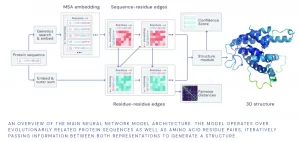
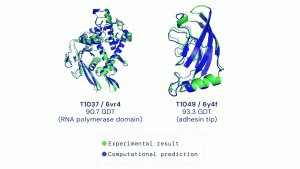
It is not new for humans to change their minds through technological development (Beltramini, 2018). Marx (1956) made a similar point in the Economic and Philosophic Manuscripts of 1844. Artificial intelligence intervention in genetic science has become an inevitable development of life science research. A case in point is Google’s latest AI – AlphaFold, which successfully predicts the three-dimensional structure of proteins, the basic molecule of life, based on gene sequences. To predict protein structure, help to understand the role of protein, understand how proteins exercise its biological function, especially have a thorough understanding of protein folding and misfolding. It will be of great help in elucidating the pathogenesis of many human diseases, such as diabetes, Parkinson’s disease, and Alzheimer’s disease, as well as developing treatments. This is very important for both biology and medicine. But deciphering the structure of proteins has always been a big problem. Manually simulating every possible protein structure is expected to take longer than the age of the universe. Although scientists have invested a lot of money and time in improving the resolution of protein structures, they have not yet figured out the ideal method before artificial intelligence. The AI system AlphaFold uses deep learning to calculate and predict the structure of proteins based on the amino acids they contain with much higher accuracy than existing prediction methods. The introduction of artificial intelligence into gene science has greatly promoted the development of gene science research. However, the ethical issues arising from the legal and reasonable entry of artificial intelligence into genetic science cannot be ignored.
The emergence of superhuman will create a Digital divide
When we go back to Hawking’s prediction of artificial intelligence and genetic science, we will be impressed by the vision of this scientific giant. In Stephen Hawking’s book “Brief Answers to the Big Questions”, he expressed the fear of artificial intelligence plus genetic science: a group of superhumans will throw off the rest of humanity and eventually take over the planet through genetic engineering. The gene-edited babies mentioned above are only in the early stages of artificial intelligence entering genetic science – powered by gene-editing technologies named CRISPER. Its purpose is limited to the repair of genetic defects – Gene babies were created to essentially fix the inability of humans to completely cure AIDS. By contrast, more comprehensive and absolute tampering with our physiology, such as improving human intelligence or the ability to live forever, would require much more time and technical support because of the larger and more complex genetic permutations involved.
If artificial intelligence modifies genes fully, laws may limit human genetic engineering, but some people cannot resist the temptation to improve human traits such as memory, disease resistance and longevity (Hawking, Redmayne, Thorne & Hawking, 2018). Zhang (2009) mentioned that modern communication tools create the illusion of an equal distribution of information and knowledge in the process of mass, balanced circulation of information. In fact, in terms of unequal social structures, the mass media, the internet, and artificial intelligence do not narrow but expand socially unequal relations. In other words, even if the public could learn about the full maturity of genetic modification technology on the internet in the future, the technology would be inaccessible to ordinary people. Social status, wealth, knowledge, etc. limit what they can do with their genes. And those elites with huge wealth and social status can turned themselves into superhumans by modifying their genes. “Once such superhumans emerge, those unimproved humans will face serious political problems and they will not be able to compete” (Hawking et al., 2018), but they will need to survive in a meritocracy. We must recognize AI as a political, economic, cultural, and scientific force. Competition over technology has always been linked to the struggle for greater economic mobility, political manipulation, and community building (Nelson, Tu, Hines, & Mehra, 2005). So, the emergence of superhumans will intensify social conflicts and social tensions, and even lead to wars.
Critical thinking
In the age of artificial intelligence, the Internet has become intelligent based on big data and algorithmic analysis. Artificial intelligence is used in healthcare, where AI is combined with genetic testing and in-depth examinations. Thousands of people will be examined in depth before they become ill, and life predictions will be given by AI. Propaganda about the virtues of AI is spreading widely on the internet, but it cannot be ignored that the ethical issues arising from AI’s entry into genetic science have had a huge impact on internet culture and governance. First, gene editing technology is not new, but to use it in real life for human embryo research would be to take a chance. Internet users cannot associate science with the commission of evil. So, when it was discovered that scientists had created gene-edited babies using a technology that violates basic human rights, it caused an uproar online. A cultural climate of criticism of scientists has developed on the Internet. Besides, with AlphaFold’s parsing of protein structures, it is possible that AI will make Hawking’s talk of superhuman a reality, but the ordinary public will not be able to get anywhere near the results of scientific research, let alone enhance themselves with genetic alteration techniques. Entirely dependent on the wider political and social structure, AI is a registry of power (Crawford, 2021). The elite sits at the top of the heap, and the digital gap created by artificial intelligence between ordinary people and the elite cannot be filled. As a result, there are questions and concerns on the internet about AI entering genetic science, as well as opposition and protests against superhuman. Two examples of AI’s entry into genetic science, which violated basic human rights and created a digital divide, have aroused concern and resistance from netizens. In the face of this situation, reasonable and effective governance is essential.
Conclusion and Governance
As Franklin (2004) wrote, “The viability of technology, like democracy, ultimately depends on the practice of justice and the imposition of limits on human power”. As a new technology that changes the times, artificial intelligence is also inseparable from the use of justice and the limitation of power. That is to say, we cannot do without scientific governance. Artificial intelligence into gene science needs to be brought into scientific management. Once governance is absent, or seriously lag, not only lead to ethical problems, more likely to endanger the future of mankind. In view of the ethical issues that gene-edited babies and AlphaFold may raise in the future, this blog through the study of the “Opinions on Strengthening the Ethical Governance of Science and Technology”, it considers that three scientific approaches to governance are proposed for reference.
First, researchers should have a deep understanding of the ethical requirements of AI in genetic science, as well as the “23 Asilomar Principles” of AI research and application and accept the corresponding ethical constraints and adjustments. Second, due to the closed nature of scientific research, if researchers fail to comply with ethical rules, public opinion is often only passively informed when the results of the experiments are published, as in the case of gene-edited babies, which requires the legislature to be more targeted in terms of institutional precautions, such as establish strict review of science and technology ethics, improve the emergency review mechanism of science and technology ethics emergencies. Finally, by reducing the ethical risks through improved technology, the ceiling effect may make the digital divide somewhat smaller as AI modifications of genes become perfect and general, accessible to all citizens and available to them as a matter of choice.
References
Beltramini, E. (2018). STEPHEN HAWKING AND MACHINE INTELLIGENCE. Cosmos and History, 14(3), 24–.
Crawford, K. (2021). The Atlas of AI: Power, Politics, and the Planetary Costs of Artificial Intelligence. Yale University Press. https://doi.org/10.2307/j.ctv1ghv45t
Franklin, U. M. (2004). The Real World of Technology. Rev. ed. Toronto, Ont.:
House of Anansi Press.
Hawking, S., Redmayne, E., Thorne, K. S., & Hawking, L. (2018). Brief answers to the big questions (First U.S. edition.). New York: Bantam Books, an imprint of Random House.
Marx, K. (1956). Economic and Philosophic Manuscripts of 1844, translated by Martin Milligan from the German text, revised by Dirk J. Struik, contained in Marx/Engels, Gesamtausgabe, Abt. 1, Bd. 3. London, Prometheus Books.
Nelson, A., Tu, T. L. N., Hines, A. H., & Mehra, B. (2005). Review of Technicolor: race, technology, and everyday life. Information, communication and society, 8(1), 115–116.
Qiu, X., et al. 2010. Reinvestigation on ethical issues in stem cell study and clinical use: Results and recommendations (In Chinese). Medicine & Philosophy 31 (3): 4.
Zhang, G.L. (2009). Principles of communication. Shanghai: Fudan University Press.
Images
https://msatechnosoft.in/blog/artificial-intelligence-goals-applications-agents/
https://www.scientificamerican.com/article/the-dark-side-of-crispr/
https://www.thesun.co.uk/tech/7827433/china-gene-edited-babies-hiv-aids/
https://www.languagemagazine.com/2017/06/14/new-digital-divide/
https://www.deepmind.com/blog/alphafold-a-solution-to-a-50-year-old-grand-challenge-in-biology