Introduction
As technology improves, digital media occupies an essential part of our lives. It changes people’s way of life, such as entertainment, work, and study; it further pushes the traditional media age into the digital age. It plays a decisive role in the development of the whole society. Digital media is broadly defined as any form of media sent over an electronic device, generally referring to some video games, websites, videos, and social media. Among them, social media platforms are the most popular. Venues on the Internet offer people a new way to learn about society, share their lives, and interact with others. The development of Internet-related fields has brought a lot of benefits and convenience to people’s lives. But at the same time, it also brings corresponding risks and negative impacts. Such as the leakage of user privacy. Privacy refers to isolating individuals’ or groups’ personal information or related information and selectively exposed in public. At the same time, this is also a fundamental human right of citizens, who have the right to publish private information or selectively hide it. (P. Romansky & S. Noninska, 2020) On the one hand, people upload personal information on media platforms to create new users, share their lives, and browse other people’s content. They have the right to choose which parts of the content can be accessed by others and control their access scope. Second, you can decide how and when that part of the content is disclosed. On the other hand, their information is highly likely to be leaked through digital platforms, and their privacy rights are compromised.
Therefore, this essay intends to discuss the challenges to user privacy on social media platforms in the digital age and the related measures of platforms. First, this paper analyses the challenges to user privacy through the example of a social media platform. For example, Facebook. Secondly, it will explore what the platform has done to address these challenges. Then, there is a further critique of whether social media platforms should continue encouraging people to use real-name authentication and what impact the move will have. Finally, give a conclusion.
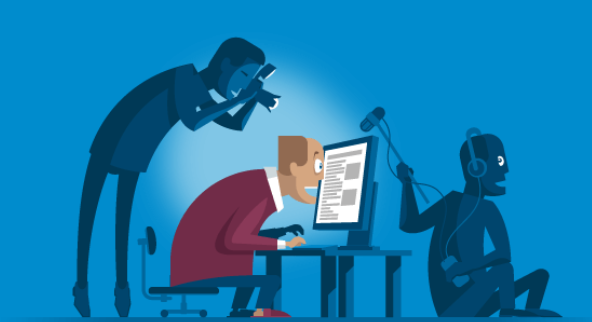
(Okwe, 2017)
Facebook and teens
Among the many social media, Facebook is one of the most popular social media platforms globally. Facebook creates a virtual online community that users can access through electronic devices and connect with people worldwide. In the community, they can not only update their personal information in real-time but also send messages and post-life photos to their friends. (Arifin & Ratna Atika, 2021) On the one hand, users can interact with their old friends; on the other hand, they can add new friends through keyword searches. For example, school, city, region, job and hobby. Research shows that more and more teens tend to analyze their personal information on social media platforms. (Long, 2013) According to the data, the various types of information published by young users on the forum have increased between 2006 and 2021. In 2006, 79% posted their photo, 49% posted the name of their school, and 61% wrote their place of residence. In 2021, that grew to 91% posting their photos, 71% posting their school’s name and 71% filling in their area of the home. As high as 92% posted their real names on their profiles. (ibid) Therefore, the paper will focus on a well-known Facebook example of personal information leakage.

(Long, 2013)
Social media platform and personal data breaches
The above data further proves that most users, even teenagers, choose to post their accurate information on Facebook. Such as real name, address, photo, and school name. This led to the famous Facebook user data breach. With the expansion and development of Facebook, it has been used only by students at Harvard University to be used in various fields worldwide, including Indonesia. (Arifin & Ratna Atika, 2021) Facebook usage is widespread and convenient in Indonesia. They often use this community platform to connect with colleagues, friends, and relatives.
During the 2016 US presidential election, Donald Trump used a political consulting firm called Cambridge Analytica. This company mainly targets the personal information of American users on Facebook and further improves Donald Trump’s winning rate by hacking and stealing these critical data. But in fact, Facebook users from Indonesia have also become victims of data leakage of personal information. The analytics research firm hacked into Facebook to steal their data so it could be used elsewhere. It includes various crucial personal information of the victim, such as birth time, place, address, gender, photo, work and living conditions. At the same time, Facebook account owners can learn their current political views through content and conversations posted by them. According to data shared on Facebook’s newsroom, Indonesia has recorded data that Cambridge Analytica stole from its Facebook account. (Hasan, 2018; Nugroho, 2018) These personal data will be used for various purposes, such as commercial and political interests. It’s arguably one of the worst cases of personal data theft in Facebook’s history. (Hasan, 2018)
According to research, data breaches and thefts fall into the following forms. (Panjaitan, Pranoto, Siregar, & Fahmi, 2005). First, hacking or stealing the personal data of Facebook users through illegal channels is a kind of cybercrime, in the form of violating the privacy of others and crimes against personal confidential information. Due to the continuous advancement of science and technology, many criminals will use high-tech means to obtain other people’s information and violate their privacy rights. Second, Facebook users lack knowledge about personal information protection. As users of digital and communication technologies, people have limited access to relevant application knowledge. Indonesians are social and exchanging personal information with new friends is the norm. So, they all fill out their data entirely on social networks and choose to display them on the platform so that people around the world can access them. The Internet is a globally connected network system that people worldwide can freely connect to and access. Therefore, the gradual globalization of the Internet is unavoidable in the international community. (Ismail, 2009) Some people with ulterior motives will obtain this information through the platform and use it or conduct malicious acts in the account owner’s name. In addition, the data owner’s negligence in management or operation can also lead to personal data leakage. Many people will provide their account numbers, passwords, and confidential information to trusted people. If the authorized person has malicious intentions, such behaviour will have serious consequences. Therefore, such actions are discouraged.

In the 2016 US presidential election, US President Donald Trump’s victory was also aided by Cambridge Analytica. (Nugroho, 2018)
Social media platforms and privacy concerns
As a result of a severe data breach, Facebook provided Cambridge Analytica with unauthorized access to the personally identifiable information of more than 87 million users. (Arifin & Ratna Atika, 2021) This incident has sparked debates about citizens’ privacy and the regulation of social media platforms to protect users’ personal information. People are starting to question Facebook’s approach to privacy. The model enumerates the triangular relationship between users, website operators (Facebook), and third-party online marketers. The model shows how personal user data is passed from the user to the ISP and then to a third party without permission.
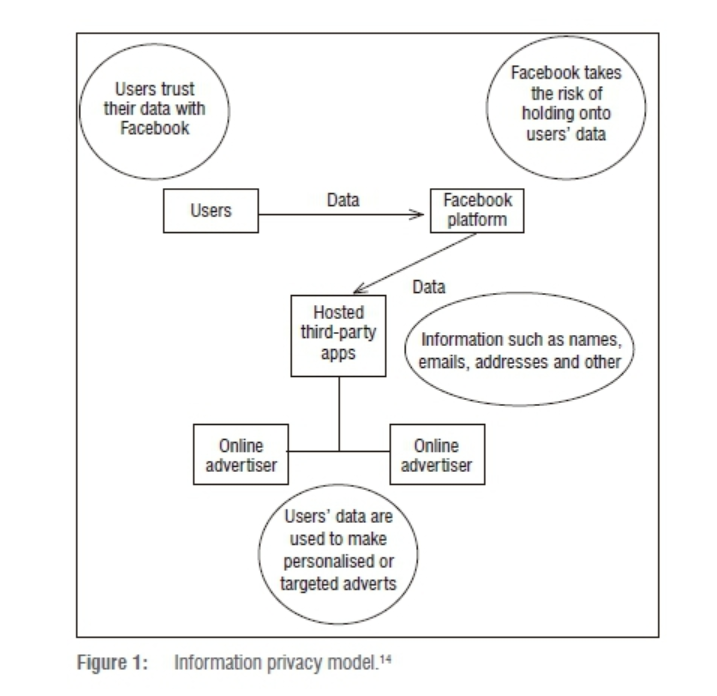
This model shows how website operators can violate the privacy of others by leaking their personal data. (Nyoni & Velempini, 2018)
Facebook has set up a comprehensive privacy policy to deal with the changes, including how users use, share, view, modify or delete data. (Nyoni & Velempini, 2018) Users can adjust pages on the platform and selectively display the content they want to show. Second, Facebook wants to get feedback on the policy from users to make effective adjustments. The privacy policy explanation is too dull and written in highly complicated terms. Therefore, many users do not understand what is stated in it, and they often do not use the relevant settings and choose to ignore them. In addition, to enhance security privacy awareness for employees, organizations and customers, Facebook regularly publishes videos on privacy topics. In this regard, they feature relevant educational videos in the News Feed. These videos demonstrate how to delete posts, explain what happens when an account is deleted, and how to manage ad data. Therefore, Face pointed out that maintaining privacy is their responsibility and requires the cooperation of many parties, which is a process that requires continuous improvement.
Social Media Platforms and Privacy Policy
Protecting personal data privacy has become a hot topic worldwide since Facebook’s data privacy scandal. Individual social media platforms will be more regulated regarding privacy and have different attitudes about whether users can choose to remain anonymous. As can be seen from table 1, Facebook, Twitter, Yelp and Snapchat have implemented a real-name policy, requiring users to use their real names when registering. (DeNardis & Hackl, 2015) Youtube allows users to create their own online identities freely. The policy sparked a heated public debate.
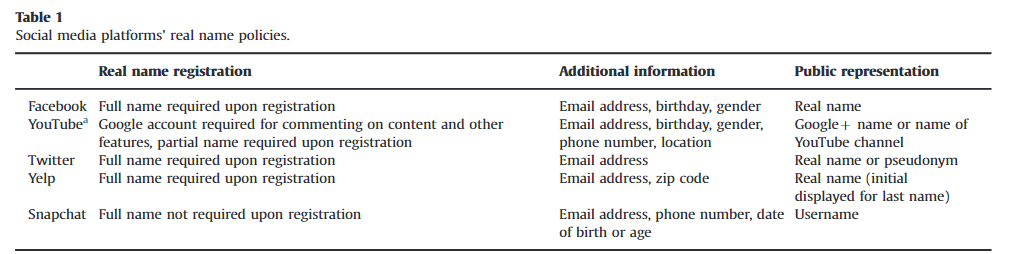
(DeNardis & Hackl, 2015)
On the one hand, implementing the real-name system policy can effectively reduce hate speech and fake news. Many people will post some remarks through social platforms on the Internet. When users can send or receive information that does not reveal personal data, regardless of unique characteristics such as gender, race, age, or appearance, people can participate on equal terms in discussions of public events and freedom of speech. At the same time, some users with malicious intentions will also take advantage of fictitious names, avatars, genders, and identities. According to the researchers, “anonymity fuels antisocial behaviour; unfairness fuels some inflammatory conversations; and the growing scale and complexity of Internet discourse makes it hard to beat.” (Rainie, Anderson & Albright, 2022) Therefore, when users create their accounts, they need to use their real names and identities, and to a certain extent, they will regulate their words and deeds.
On the other hand, many people oppose implementing the real-name system policy on social media platforms. They worry that the platform will illegally sell their personal information to third-party merchants through other channels. Include their name, gender, address, email, and telephone. Second, in their view, the measure conflicts with privacy and the values of free speech and display of identity. (DeNardis & Hackl, 2015) They worry that when they use their real names to participate in online activities, they are likely to encounter harassment from others. In 2014, the Facebook accounts of several cross-dressing users were terminated by Facebook because they were using an account name other than their real name. Facebook defines it as a “fake account” (Holpuch, 2014). The incident was met with strong resistance from the masses. Since then, Facebook has announced that it will revise the policy and relax the implementation of the real-name system policy. Additionally, it assures users that they only need to provide their “real-life name” and not their legal name when registering for an account. (Cox, 2014) Therefore, the real-name system policy is also a double-edged sword. It reduces hate speech and fake news and maintains a safe and healthy network environment; to a certain extent, it violates users’ privacy and freedom of speech rights. Social media platforms can use this as an intermediate point, balancing their relationship with their users. At the same time, it is constantly revised based on user feedback.
Conclusion
In conclusion, the digital revolution has brought about a giant leap in technology, but it has also compromised personal privacy. In the digital age, the definition of privacy itself has not changed, and it remains an essential part of people’s attention. At the same time, digital media has become an integral part of life, and people’s awareness of privacy protection and the need for personal data ownership has also increased. The development of social media is one of the most successful applications of digital technology—for example, Facebook. On the one hand, Facebook has attracted many users to sign up and use it; on the other hand, it has also received a lot of privacy speculation and debate. Their platforms’ privacy settings are strictly scrutinized to keep users’ data safe. Therefore, this will be a double-edged sword. The challenges to privacy in the digital age require the implementation of platform policies and people’s learning and cooperation. Only when the two are combined can a win-win situation be achieved.
Reference
Arifin, R., & Ratna Atika, T. (2021). FACEBOOK LEAKS: HOW DOES INDONESIAN
LAW REGULATE IT?. Ganesha Law Review, 3(1), 33-42. doi: 10.23887/glr.v3i1.320
Cox, C. (2014). Status update [Facebook page]. Retrieved 13.03.15 from 〈https://www.facebook.com/chris.cox/posts/10101301777354543〉.
DeNardis, L., & Hackl, A. (2015). Internet governance by social media
platforms. Telecommunications Policy, 39(9), 761-770. doi: 10.1016/j.telpol.2015.04.003
Holpuch, A. (2014). Facebook still freezing accounts despite apology to drag queens over
‘real names’. The Guardian. Retrieved 14.03.15 from
<http://www.theguardian.com/technology/2014/oct/17/facebook-still-freezing-accounts-
despite-apology-drag-queens-real-names〉.
Hasan, R, A. (2018). Cambridge Analytica Diduga Cemarkan Hillary Clinton dalam Pilpres
AS 2016. Liputan 6, 21 March 2018, retrieved from
https://www.liputan6.com/global/read/3393654/cambridge-analytica-diduga-cemarkan-
hillary-clinton-dalam-pilpres-as-2016
Ismail, D. E. (2009). Cyber Crime di Indonesia.Jurnal Inovasi,6(3), 242-247.
Isaak, J., & Hanna, M. (2018). User Data Privacy: Facebook, Cambridge Analytica, and
Privacy Protection. Computer, 51(8), 56-59. doi: 10.1109/mc.2018.3191268
Long, E. (2013). Review: Teens, Social Media and Privacy (2013). Journal Of Media
Literacy Education. doi: 10.23860/jmle-5-2-8
Nyoni, P., & Velempini, M. (2018). Privacy and user awareness on Facebook. South African
Journal Of Science, 114(5/6). doi: 10.17159/sajs.2018/20170103
Nugroho, B. P. (2018). Cambridge Analytica, Konsultan Politik Super yang Gunakan Big
Data. Detik News, 12 March 2018, retrieved from https://news.detik.com/berita/d-
3912026/cambridge-analytica-konsultan-politik-super-yang-gunakan-big-data
Okwe, C. (2017). How the Digital Age is Impacting Our Personal Privacy. Retrieved 9 April
2022, from https://medium.com/@cre8tivemediaservices/how-the-digital-age-is-
impacting-our-personal-privacy-695326dd1455
Romansky, R., & S. Noninska, I. (2020). Challenges of the digital age for privacy and
personal data protection. Mathematical Biosciences And Engineering, 17(5), 5288-5303.
doi: 10.3934/mbe.2020286
Rainie, L., Anderson, J., & Albright, J. (2022). The Future of Free Speech, Trolls, Anonymity
and Fake News Online. Retrieved 21 March 2022, from
https://www.pewresearch.org/internet/2017/03/29/the-future-of-free-speech-trolls-
anonymity-and-fake-news-online/