
As the 21st century has entered the era of information, the development of the Internet is getting faster and faster, and people are increasingly inseparable from the Internet whether it is work or daily life (Yamin, 2019). The Internet has brought great convenience to our lives, especially in the era of Covid-19 (De et al., 2020). The epidemic that has lasted for three years has made many things that were easy to accomplish in the past become out of reach. Therefore with the internet, this have been made possible. In the past, working from 9 to 5 was the daily routine of many office workers, but the epidemic prevented people from gathering on a large scale. People gradually changed their work patterns and adopted the form of working from home or a “hybrid” model. In the past, in supermarkets and shopping malls, people came and went In the past, there was a lot of passenger traffic, but after the epidemic, in order to reduce gatherings, everyone gradually changed their previous habits of offline shopping and offline grocery shopping, and gradually adapted to online shopping and online grocery shopping; students could not attend classes face-to-face, Therefore, the online course platform has developed rapidly. In the new era, “online” vocabulary such as “online class“, “online shopping”, “online meeting” and “online office” have become an indispensable part of our lives.
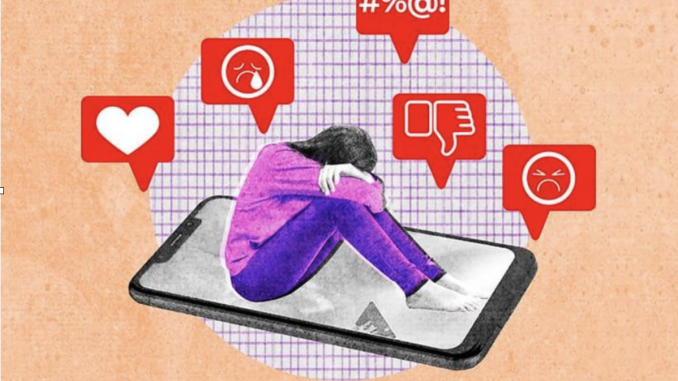
However, the Internet is also a double-edged sword. When it brings people countless conveniences and benefits, there are also many factors that plague everyone. Among them, online harassment has been paid more and more attention in recent years.
Online harassment, as the name suggests, is harassing behaviour that occurs through Internet communication platforms such as text messages, social networks, and email (Nadim & Fladmoe, 2019). Different from physical harassment, online harassment has greater concealment and more diverse forms. In fact, online harassment abounds in our lives. Many of the online harrassment have taken place around our lives. This includes opening our e-mail box every day with a large number of promotional or vicious spam emails, receiving malicious text messages such as gambling and loan sharks sent by fraudulent numbers, messages online that is in the form of attack, sexual abuse and discontent.

Compared with 2017, similar share of Americans have experienced any type of online harassment – but more severe encounters have become more common.
As the story of online harassment captures our headline for many years, it is seen that there have been an increase in online harassment cases in the recent years. According to the research that is being done by Pew Research Center, there are approximately 41% of the entire American online users whom have been faced with forms of online harassment (Vogels, 2021). With the six indicators that are involved, it shows that physical threats, stalking, sustained harassment, sexual harassment, offensive name-calling and purposeful embarrassment have all increased from 2014 to 2020. This comes in line with the increase in online users and the widespread usage of the internet. Also with the report showcased that there are more severe forms of harassment in the recent years which shows the urgent need that these issues needs to be addressed. Online harassment is a issue and problem which have penetrated the online and digital space.
The “Driver” for Online Harassment
Behind the boom in online harassment is the many form of “drivers” which comes with the digital era and also from various mechanism of the internet. These form of “driver” can include the following into the discussion
- The internet has allowed for the sending and receiving of information that is not being limited by space and time. This means that an individual will be able to receive, view and send out information almost instantaneously (Buchanan, 2020). Under this form of driver of the internet, an individual will be able to view information that is different from their own beliefs and culture. This therefore have driven for culture and mindset differences which results in the form of hate speeches and attacks. Also with the speed of information transmission, these users therefore be able to spread information at a faster pace which results in greater impact and scale of harassment.
- The internet allows for anonymity. This means that the users online will be able to comment and speak whatever they wish without having their real offline identity being known. During the registration on various social media, the user does not need to have their real name and identification (Tremewan, 2015). This means that they can take on any names and outlook as they wish. With this form of anonymity, the users will therefore be able to speak whatever they wish without having the worry of their identity being known. While offline harassment is illegal and that it may end up being a fine, lawsuit or even prison, the online harassment does not have such as worry for their real identity is being kept in the dark. This therefore drives for more unethical conducts and behaviours online.
- The users online are all active audience. This means that they no longer passively receive information but instead actively making sense of such information and also spreading them around (Seaman, 1992). Through the process of sense making, thoughts may clash and therefore harassment may occur.
The Impact on Younger Adults
While impacts have seen onto the society, online harassment has become a greater problem and issue for younger adults. There is a greater percentage of teens and young adults which have become the target of online harassment. In the recent world, around 95% of the teens have access to smartphones and more than 45% of the teens said that they are almost constantly online (Anderson & Jiang, 2018). This shows the high rate of penetration of internet and social media onto the life of younger adults. Amongst the rest of the social media, YouTube, Instagram and Snapchat are the most popular online platform amongst the teens in the current world. The social media therefore have the form of environment and landscape which encourage young users to be constantly using and interacting on such platforms.
While social media has become the key and central way for teens to build and maintain their relationships and circles (Suciu, 2021). This have increased the trouble of online harassment. Added by the various drivers that are causing online harassment, the high level of usage and social media landscape have increased the negative impacts for younger adults for online harassment.Young adults try to maintain and build their relationship online and are more keen to share online and create their online identity. This therefore leaves them to be in greater exposure to online harassment. While looking through the comments made by the younger adults online. It is seen that these online harassment actions have caused them many negative impacts.

“I was being called ugly because I posted a selfie of myself” Girl 17 years old
“ I was being harassed and people threatened to find me offline because of my sexuality” Boy 16 years old
“I am not sure what happened, but I received hate messages on my Instagram every now and then” Girl 15 years old
These are just some of the comments that was left on my previous blog post on my studies of online harassment. While it can be seen that these younger adults are faced with online harassment. These forms of negative impacts are then being translated to offline impacts such as physical threats, depression and also physical hurt.
Online Harassment with VR Technology
With the development of Virtual Reality (VR) technology, online harassment is taking a step further. VR technology is one of the most recent development and it is a simulated experience which is completely different from the real world. Connected to the internet and aided by a hardware which is usually a head-ware. This form of VR system therefore allows for users to be inside a virtual world. The experience online is then made more realistic through visual stimulation which allows enhanced experience and interaction of the users.
It is then argued that VR technology is the ultimate empathy machine which allows the stimulation of the emotional empathy of the individual (Barbot & Kaufman, 2020). The emotions of the individual is being connected and made sensible to the other party. This is therefore bringing online harassment to a whole new level. If the internet puts in the platform for greater online harassment then VR technology created the form of impact that is “real”.

Online harassment in virtual reality feels all too real – ‘it’s creepy beyond creepy’
One of the most well known cases of online harassment in VR is by Jordan Belammire when she was being virtually rubbed against her chest on a online VR game named QuiVR (Wong, 2016). She then reports that the experience is disturbing and it feels like it is real. The form of disguise from online have therefore translated into offline experience which makes the user feel the transformation from online to offline (FocusOnVR, 2019).
The struggles of dealing with online harassment is the same harassment that women have been dealing with, it’s just a new medium in which its happening – Anita Sarkeesian
With the advancement of technology and even development of the metaverse, what seems to be online no longer have the impact on online platforms only. It has transformed its impact towards offline and physical destruction and damage. As the internet and technology is making the transformation to become more realist and engaging, this therefore brings online harassment to become one of the hottest topic of discussion and issue to be solved due to its real and physical impact.
What should we do?
In the management of online harassment, there ought to be various stakeholders involved in the management of such unethical and illegal actions. The stakeholders should include the following.
- Government: While the social media platform are multinational companies which is hard for government to control and manage, the government should still have in place regulations and laws which forbids such actions. This form of law and regulation can make extension from the current law of the nation. The government therefore holds the critical and important role in the management of online harassment. The form of regulation and law that is being put in place by the government provides a law and regulation for the nation to follow.
- International Organisation and activism: With international organisations which are promoting such causes, this can mean that they can actively go against online harassment. While current example can include the #MeToo movement which stands against sexual harassment from online to offline. Other social movements can also be in place which shows the unity of people against online harassment. With these form of actions in place. This can therefore allow pressure onto the online community and pressure for actions to be done against such action.
- Multinational companies: Another important stakeholder is the owners of such social media platforms. These multinational companies therefore needs to work on their internal regulation and have stricter checks onto the action of online harassment. This form of internal checks can be algorithms which automatically blocks all hate speeches and harassment. It can also include stricter checks and regulations on the identity of the users so that they are afraid to engage in the actions of online harassment.
- Individual: To ensure that no online harassment is damaging the online community. Individual also plays an important role. These individuals should then have the mindset and be educated that these actions are illegal and unethical. Also with the mindset and consciousness, this allows for the individuals to acts as checks and balances on these international platforms. Once they see such actions, reports can be done which allows a cleaner and safer online community.
Reference List
Anderson, M. & Jiang, J. (2018). Teens, Social Media and Technology 2018. Available: https://www.pewresearch.org/internet/2018/05/31/teens-social-media-technology-2018/
Barbot, B., & Kaufman, J. (2020). What makes immersive virtual reality the ultimate empathy machine? Discerning the underlying mechanisms of change. Computer in Human Behaviour. 111.
Buchannan, T. (2020). Why do people spread false information online? The effects of message and viewer characteristics on self-reported likelihood of sharing social media disinformation. PlosOne
De, R., Pandey, N., & Pal, A. (2020). Impact of digital surge during Covid-19 pandemic: A viewpoint on research and practice. Int J Inf Manage. 55: 102171.
FocusOnVR. (2019). Using Virtual Reality to Make Sexual Harassment Training More Realistic and Effective. Available: https://aithority.com/guest-authors/using-virtual-reality-to-make-sexual-harassment-training-more-realistic-and-effective/
Nadim, M. & Fladmoe, A. (2019). Silencing Women? Gender and Online Harassment. Social Science Computer Review. 39 (2): 245-258.
Tremewan, J. (2015). Anonymity, Social Norms, and Online Harassment. 10.13140/RG.2.1.3211.8246
Seaman, W. (1992). Active audience theory: pointless populism. Media, Culture & Society. 14 92): 301-311.
Suciu, P. (2021). Cyberbullying Remains Rampant On Social Media. Available: https://www.forbes.com/sites/petersuciu/2021/09/29/cyberbullying-remains-rampant-on-social-media/?sh=30bd0fc043c6
Vogels, E. (2021). The State of Online Harassment. Available: https://www.pewresearch.org/internet/2021/01/13/the-state-of-online-harassment/
Yamin, M. (2019). Information technologies of 21st century and their impact on the society. International Journal of Information Technology. 11: 759-766.
Wong, J. (2016). Sexual harassment in virtual reality feels all too real – ‘it’s creepy beyond creepy’. Available: https://www.theguardian.com/technology/2016/oct/26/virtual-reality-sexual-harassment-online-groping-quivr