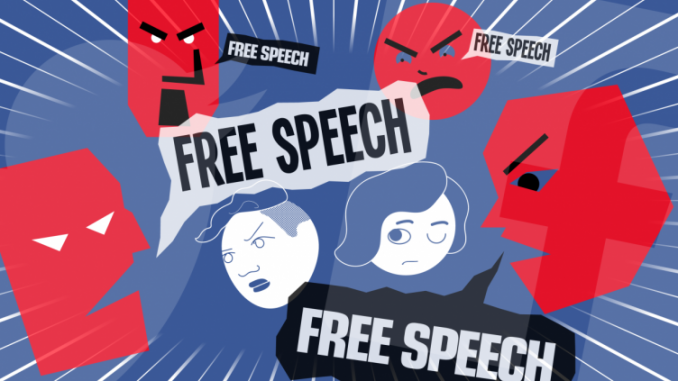
The presence of the internet provides a public sphere where people can express their thoughts and ideas freely and without restriction. With the advocacy of the freedom of expression, people also believe that it is their “fundamental right to hold opinions and to seek, receive and impart information and ideas of all kinds online” (Australian Human Rights Commission, 2022). While freedom of expression gives people more freedom to share and express their opinions and ideas on the internet, some people take the advantage of this freedom with their extremist idea and beliefs to hurt and attack people. This type of speech is known as online hate speech and can be defined as the speech that emerges online with the purpose of hurting an individual or a group of individuals based on their features or set of features such as gender, race, ethnicity, religion, sexual orientation and/or disability (Parekh, 2012, p40). It is evident that freedom of speech gives no permission to people to use hate speech against others. Theoretical views on hate speech propose that women are more easily to be the target of online harm in all different forms (Frenda et al., 2018). It is therefore important to explore the pervasiveness and severity of hate speech on the internet in general and to gain insight into the extent of violence against women on social media and the importance of users to act as a force to reduce the online harm, in addition to the protections from governments and platforms.
Online hate speech vs Free speech
Hate speech is currently a severe issue plaguing online social media, due to the growing hateful comments and posts that people are spreading on the internet. Over the last decade, the increasing use of social media has made possible new forms of efficient and rapid communication, with hate speech being expressed almost instantly online, and often anonymously. The topic of hate speech has recently received a lot of research attention with a few in-depth investigations focusing on the pervasiveness and severities of hate speech in online social media (Chetty and Alathur, 2018; Castano-Pulgarin et al., 2021). In the study of Gab, the results showed that hate speech spreads much faster and posts by hateful users received a larger audience and at a faster rate (Mathew et al., 2019). The repeated and frequent exposure to hate speech can further lead to desensitization to this form of verbal violence and subsequently lower the victim’s opinion and greater distance, thereby growing the outgroup prejudice (Mathew et al., 2019). Taking the Rohingya crisis in Myanmar as an example, the study proves that many people who helped spread hate on Facebook in this incident may have not even met a Rohingya in their lives. Their perceptions of the target communities were completely manipulated by the extreme rampant hate speech on Facebook (Stecklow, 2018). Instances such as this are extremely common nowadays in social media. It is also said that campaigns like this are usually successful due to their fast and frequent dissemination of hate content. In addition, researchers also found that the prevalence and severity of hate speech and crime often increase following “trigger” events, which may be local, national or international, often inspiring tensions and emotions against suspected offenders and groups associated with them (Awan and Zempi, 2017). Considering the incidents such as the Baltimore protests, the 2015 Paris attacks and the US Supreme Court ruling on Same-sex marriage, it is evident that there was a significant amount of hate and anti-hate speech following events that provoked widespread emotional responses. Besides, evidence shows that hate speech has a significant negative impact on the mentality of victims, and extreme statements can even lead to suicide. A study conducted by Saha et al., (2019) showed that the victims of hateful speech are more likely to experience psychological systems such as post-traumatic stress disorder. They also discovered that factor such as prejudice, intolerance and hatred that prevent a person from integrating into their social and academic environments can lead to stress and lowered self-esteem for these minorities (Saha et al., 2019). As a result, freedom of speech does not mean that people are free to say hateful things about others on the internet, there are limits to what can be said.
Gender Inequality – Hate Speech against women
Comparing to the early centuries, women have certainly gained more equal rights and freedom today. However, it cannot be denied that women are still experiencing a much higher rate of sexualized forms of abuse than men (Anderson and Vogels, 2020). While online hate speech is on the rise, there has been a marked increase in cyber-violence (misogyny) against women (Saha, 2018). A study by Frenda et al., (2018) detected misogynistic and sexist tweets against women to find evidence of gendered hate speech against women on the internet. They discovered that words relative to sexuality, human body, and femininity play an important role in all the corpora that are used to discriminate against women, as they are the apparent way to distinguish women from men. Frenda et al., (2018) further argued that patriarchal behaviour has moved online, in the form of sexist and misogynistic comments, posts and tweets. A study conducted by Women who Tech demonstrated that women are three times more likely to experience sexual harassment and violence online than men (Women who Tech, 2017). During the pandemic, online hate speech and online abuse in the US and UK has further risen by 20% (Baggs, 2021). The most extreme cases include death threats, where one woman’s abuse spilt over into real life, with haters showing up at her house and taking pictures of her children through the windows (Baggs, 2021). In general, gender inequality was and still is present in society and these social issues would continue to determine the production, commercialization, and distribution of the contents on the internet and the way users behave on the platforms. Thereby, appropriate prevention and regulations of hate speech online need to be implemented.

A picture of “Gender inequality” by Calarts
Case study of Kim-yeosa
In South Korea, hate speech and misogyny against women have existed for many decades but have been systematically ignored. According to the survey conducted by National Humanin 2021 on 1200 people aged 15 and older, the results showed that there are more than 8 out of 10 South Koreans have encountered malicious online comments against women on the internet (The Korea Times, 2021). The proportion of online hate speech against feminists, people from certain regions, and the elderly are 76.9%, 76.8% and 72.5% respectively (All news, 2021). A large majority of respondents believe that online hate speech in Korea is more severe and serious than in real life (All news, 2021). And this phenomenon of misogyny is dismissed and often denied in Korean patriarchal society. The case of Kim-yeosa reflects the problem and severity of hate speech against women in Korea. Kim-yeosa is a misogynistic term that refers to unqualified and irresponsible female drivers – often those older generations who “doesn’t abide by. Traffic rules and gets involved in car accidents” (Jeong and Cho, 2020). The term Kim-yeosa was coined in 1995 and the literal meaning has nothing to do with misogyny. However, the meaning was changed in 2006 due to a comedy show. At this stage, Kim-yeosa’s new concept is not extreme, but soft and humorous. After May 2016, it is the time when the issue of misogyny started becoming a public and social issue in Korea. Between 2016 and 2017, Jeong and Cho (2020) found a growing number (i.e. 121 out of 443) of newspaper companies applied the new meaning to their article. During this period, News media also incorporated feminist stances into the terminology. Through researching the platform of Naver between June 2016 and November 2017, it is worth noting that when the perpetrator of the wrongful driving was female, the gender was indicated in the headline or body of the news article (Jeong and Cho, 2020). Meanwhile, according to the police database, the number of wrong-way driving by male drivers in 2015 and 2016 was 9,648 and 8,557 respectively, which contrasts with the number of female drivers 2,141 and 2,027. While wrong-way driving was committed by men four times higher than women, the news reports only highlight the ones that were committed by female drivers, reinforcing the stereotype images of female drivers, i.e. Kim Yeosa. Besides, the pattern of online comments on the articles reveals several intriguing issues. Among the commenters, 73% were male and 27% were female, with the majority of commenters in their 30s (41%) followed by 40s (28%), 20 (18%) and 50s and over (12%) (Jeong and Cho, 2020). In addition, most of these comments focus on the fact that the wrong-way driver was a woman: several words referring to women, women and feminity appear more than 100 times, most of them for negative purposes (Jeong and Cho, 2020). Several of these commentators tend to generalize Korean women drivers as ignorant, weird and inferior, for example: “recently, ‘odd, traffic accident’ makes more sense with the fact that “women” were the drivers and that “has ‘to be a woman’ (Jeong and Cho, 2020. By looking through all these comments, researchers also found other misogynistic neologisms, such as Kimchi-nyeo which was used to denigrate and insult females. It is also worth noting that NAVER does not ban the use of these harmful terms and harmful posts against women, as they are not classified as hate speech or blasphemous (Jeong and Cho, 2020). Arguably, under the patriarchal hegemony, online hate speech is prevalent in the Korean mainstream new media and reproduces gender discrimination and gender bias in society. On the whole, there is a noticeable need to strengthen women’s status and capabilities in social media and in their societies. It is also crucial to highlight that Korea is not the only country that denigrates the image of females, misogyny and hate speech against women still exist in most countries around the world.

‘The Mrs Cliche” by Hyundai Motor
Social activism
Despite the efforts that governments and platforms are stepping up to diminish hate speech on social media, there are ways that users can contribute to redressing online hate speech, namely online activist organisations such as “No Hate Speech Movement”. This movement is launched by the Council of Europe in 2012 which aims to combat online racism and discrimination (i.e. hate speech) by mobilizing young people and youth organisations to recognize and take action to fight against these human rights violations (Council of Europe, 2022). This encouraged thousands of young people to join this movement and act against online hate speech. It is an online platform for everyone to post their personal thoughts or message about online hate speech, including self-made photos and videos. The official website has then become an instrument of self-expression, a public safe sphere where people can express their own opinions about hate speech. An analysis of “No Hate Speech Movement” by Zoolo and Loos (2017) considered the website of “No Hate Speech Movement” as a new form of digital communication in which the product is a combination of different genres (diary, commentary, news report) and discourses (official discourse, conversational discourse, news discourse). They also appreciated the campaign which does not limit their role to that of the spectator but invites them to get involved, the opportunity to comment, share stories and make suggestions. A recent organization – The Speak up Space can further in-depth present the importance of social activism (The Speak Up Space, 2020). This organization is set up by a victim that survived online hate speech and abuse (Baggs, 2021). She designed this space for people who are also victims of sexual harassment and violence to share their stories and find help and advice on the platform and now has already gathered thousands of members (Baggs, 2021). This manifests that an activist organization can bring positive energy to the victims, further healing the trauma and forming a better life. This, ultimately demonstrate how the internet can be used as a tool to gather people who have the same belief to form an active campaign to fight against online hate speech.

“No hate speech movement” by No Hate Speech Youth Campaign
Why does this matter?
Online hate speech has been associated with a global rise in violence towards marginalized groups, including women (Council on Foreign Relations, 2021). It is also evident that the internet nowadays is a great innovative way to mobilize protests by giving a sphere for affective and reproduced content and exposing people to different viewpoints where they can test the legitimacy of their personal beliefs. The internet also allows new forms of activism to thrive and open up more ways to stand up for their beliefs. Therefore, it would be a waste if people ignore the crucial role that the internet plays in today’s society. People should take this opportunity to combat the issues of online hate speech, sexual harassment, abuse and inequality on the internet by involving themselves in online activist organisations and movements.
References
Awan, I., & Zempi, I. (2017). ‘I will blow your face OFF’—VIRTUAL and physical world anti-muslim hate crime. The British Journal of Criminology, 57(2), 362-380.
Anderson, M., & Vogels, E. (2019). Young women often face sexual harassment online – including on dating sites and apps. Pew Research Center. https://www.pewresearch.org/fact-tank/2020/03/06/young-women-often-face-sexual-harassment-online-including-on-dating-sites-and-apps/
Baggs, M., (2021). Online bullying: ‘I’ve blocked nearly 10,000 abusive accounts’. BBC NEWS. https://www.bbc.com/news/newsbeat-55668872
Fulper, R., Ciampaglia, G. L., Ferrara, E., Ahn, Y., Flammini, A., Menczer, F., … & Rowe, K. (2014, June). Misogynistic language on Twitter and sexual violence. In Proceedings of the ACM Web Science Workshop on Computational Approaches to Social Modeling (ChASM) (pp. 57-64).
Jeong, H., & Cho, Y. (2020). Inventing the myth of “women cannot drive” and its online hate speech in South Korea1. Hate speech in Asia and Europe: Beyond hate and fear.
Laub (2019). Hate Speech on Social Media: Global Comparisons. Council on Foreign Relations. https://www.cfr.org/backgrounder/hate-speech-social-media-global-comparisons
Laub, ZZ., (2019). Hate Speech on Social Media: Global Comparisons. Council on Foreign Relations. https://www.cfr.org/backgrounder/hate-speech-social-media-global-comparisons
Mathew, B., Dutt, R., Goyal, P., & Mukherjee, A. (2019, June). Spread of hate speech in online social media. In Proceedings of the 10th ACM conference on web science (pp. 173-182).
Saha, P., Mathew, B., Goyal, P., & Mukherjee, A. (2018). Hateminers: detecting hate speech against women. arXiv preprint arXiv:1812.06700.
Stecklow, Steve. (2018). Why Facebook is losing the war on hate speech in Myanmar. Reuters Investigates. https://www.reuters.com/investigates/special-report/myanmar-facebook-hate/
Saha, K., Chandrasekharan, E., & De Choudhury, M. (2019, June). Prevalence and psychological effects of hateful speech in online college communities. In Proceedings of the 10th ACM conference on web science (pp. 255-264).
Women who Tech (2017), “Tech and start-up culture survey”, available at https://www.womenwhotech.com/resources/tech-andstartup-culture-survey
Zollo, S. A., & Loos, E. (2017). No Hate Speech Movement: evolving genres and discourses in the European online campaign to fight discrimination and racism. Observation (OBS*), 11(2).