ARIN6902_Blog post – Online harassment on social media
Yushu Hou (520270495)
Introduction
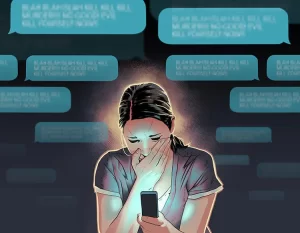
With the rapid development of the Internet, there are many different platforms as infrastructure to allow people to communicate in the communities created by the platforms. Communities are built to bring people of different nationalities, races, genders, and ages together with a common goal or interest. During communication, people can obtain as much information as possible from the Internet. The information they can possess is not only from publishers or authorities but may also be based on the experiences of divergent users. This environment of information exchange brings about a full awareness of different issues and perspectives in society, but it can also lead to many social and ethical problems. Among them, online harassment is a behaviour that every user who uses the Internet may suffer.
Online harassment involves various aspects, which are “political or religious beliefs, physical appearance, race or ethnicity, gender, and sexual orientation”. Online violence arises from the amplification of social media and even encourages many racially discriminatory interactions and events. This behavior is called ‘Platform Racism’ (Matamoros-Fernandez 2017, cited in Carlson and Frazer 2018). Moreover, social media are free speech platforms. They should act as an intermediary to mediate social conflicts and make users closer to society in order to protect the safety and privacy of users’ speech in the community. However, social media instead “contribute to racist dynamics through their affordances, policies, algorithms, and corporate decisions.” (Matamoros-Fernandez 2017). This allows users of social platforms to engage in online racism controversies, thereby increasing the potential for online harassment. In addition, online harassment can often lead to hate speech (Terry, 2021). Due to the amplification and speared of online abuse in the community and on the platform, the character of netizens and the mode of speech on the platform have gradually changed. The Australian government has made several efforts to tackle online harassment. But whether such efforts are effective is debatable. This essay will first present the online harassment that occurred to the women who participated in politics and journalism, and Australian indigenous people being harassed online. Especially on social media. It follows the solutions and challenges the Australian government has done to address online harassment and my thoughts.
Political Damage to Women
Social commentary on women’s participation in politics and journalism is a long-standing debate. On social media platforms, comments targeting women’s participation in these industries can become unscrupulous due to the mechanisms of anonymity. Some users are biased towards inappropriate remarks about female representatives of politically engaged public figures. Phillips (2015, cited in Matamoros-Fernandez 2017) claims that “Abusive users can use platforms’ affordances to harass their victims, either by means of creating and circulating hateful content or by hijacking social media sites’ technical infrastructure for their benefit”. The remarks about female representatives have an impact not only on the victims but also on the propensity to speak within the community. The authenticity mechanism of the platform has always been controversial. Some believe that anonymous speeches and the platform’s encouragement of anonymity promote online abuse (Barak 2005, cited in Matamoros-Fernandez 2017). Appropriate anonymity, which is supposed to protect user privacy and prevent racism (Lanier 2010, cited in Matamoros-Fernandez 2017), has now become a protective shield for the anonymous posting of abusive speech.

Victorian MP Fiona Pattern is concerned about the health risks her staff has received about discrimination against women and violent comments while dealing with her social media accounts. For this reason, she stopped updating her social media accounts. (White, 2022). She stated that the problem of online abuse could lead to a silencing effect on the Internet (White, 2022). People who express their own opinions on the Internet may be experiencing varying degrees of online harassment, and prolonged harassment will make users become silent online, and this silence will threaten the health of Australia’s democracy (White, 2022). According to Carlson and Frazer (2018), the cause of this political silence is the overburdened and fatigued exposure to racist content online. They learned to express dissatisfaction in their hearts rather than by engaging in discussions about racist content within their communities. This kind of silence effect is exactly the purpose of online abusers. Besides, 71% of female journalists have received online abuse for publishing stories about race, gender, politics, and human rights (White, 2022). In order to avoid such online harassment, they chose to quit the journalism industry or reduce their coverage of similar topics. Although the occurrence of the silence effect protects most women from being attacked on the Internet, from a democratic point of view, the diversity of racially controversial opinions in society gradually decreases and becomes more and more extreme.
From my perspective, while the platform can prevent harm from happening at the source to a certain extent, the silencing effect is unavoidable. One example I learned is that commenting function of Weibo can be turned off through user settings. To a certain extent, this prevents users from being affected by online harassment, but this is the one way to engage on social media. Other functions such as forwarding, private messages, and @ cannot prevent users from being harassed online.
Indigenous-based harassment
In addition to online harassment targeting women in politics and journalism, social media platforms are also rampant in harassment and abuse of indigenous peoples. Remote suburbs where Aboriginal people often experience a lag in information, slow access to help, and less access to social resources and support services (Brown et al., 2021). It is the rapid information transfer and communication of the internet that allows them to quickly acquire news and communication when using social media platforms. However, targeting Indigenous women in remote areas often experience a different kind of violence online. They cannot even identify, judge its legitimacy, and understand how to avoid online abuse. Focus on the cyber harassment on social media, they may be exposed to racist threatening comments posted by non-Indigenous people in open Facebook groups. From the perspective of indigenous people who use social media, this is not a neutral and safe place. Conversely, social media emphasizes different power hierarchies and promotes unequal power relations (Carlson and Frazer, 2018)
Alternatively, wealthy network techniques could enhance the ways abusers find victims. Brown et al. (2021) report that victims are always “discovered” and reconnected by the abuser, through Internet technology. The only method for them is to give up using social media accounts and even move to other states to avoid the abuser (Brown et al., 2021), which causes the above-mentioned silencing effect. To alleviate this kind of online harassment, it is a helpful way to avoid using the Internet and asking for help from family, friends, and close people (Carlson and Frazer, 2018). Beyond this, there is a requirement to educate women about digital literacy, including online safety and privacy (Brown et al., 2021). And the next part of the essay is about to discuss the measures of the Australian government to protect their citizens from online harassment, and its feasibility.

The Method of eSafety

The Australian government has introduced new Online Safety Laws which aim to protect adults and children when they access the internet and to help these people when they experience severe online harassment. The main way that eSafety helps Australian adults and children is by partnering with online platforms. After the content moderator filters out the harmful online content posted on the internet, eSafety will connect the platform and remove it as well as impose fines on the perpetrator or platform (eSafety Commissioner, 2021). Furthermore, content that causes harassment to victims is reviewed by eSafety, which can help victims contact the platform for removal and fines (eSafety Commissioner, 2021). Content that can be reported includes adult cyber abuse, cyberbullying, image-based abuse, and illegal and restricted content.
There are three situations in which a complaint can be involved, and personal safety can be maintained. eSafety Commissioner reports that first, complaints of harassment and abusive information to online platforms. Also, service providers can be reported to eSafety if there is no feedback from platforms and providers. Second, through the website of eSafety (eSafety.gov.au), they can report information and photos on the internet regarding personal privacy. This information and photos without the user’s own authorization will be deleted after contacting the platform. Another situation where a user can report illegal and restricted content found on the Internet to eSafety as a public online safety supervisor.
In the case of women in politics and journalism, women who are attacked by hate speech can collect all these harmful comments and report them to eSafety. On the face of it, those who publish the speech will be punished, such as fines. Fundamentally, however, reporting to eSafety is a time-consuming and ineffable act for a public figure. First, these public figures need staff or themselves to sort out all the online abuse. The participation of women in the case in publishing news and politics shows that the amount of online harassment they receive is enormous. It takes a lot of time to sift through and sort out. As well as secondary harm will be done to screeners when viewing and screening these remarks. Second, news events that have already happened spread quickly on the Internet. Even if netizens have not seen or commented on related online harassment remarks, they will be influenced by some echo chambers in the community. For example, they are subconsciously influenced by these misleading remarks by hearing opinions about malicious evaluations of events from the mouths of others.
In the indigenous context, eSafety can alert and educate indigenous peoples about what comments are harassing information. It shares how the Internet respects and protects individuals, including not sharing their own private information, respecting people’s boundaries on the Internet, sharing only authorized content, sharing the risks of using the Internet with community members, and promptly pointing out bad online violence (eSafety Commissioner, 2021). Although eSafety enables indigenous people to report what has been harmed on time, they cannot solve the part where the abuser later contacts the victim through network technology. This still causes victims to live under psychological stress and fear.
Besides, the silencing effect mentioned in both cases cannot be solved by eSafety. Silencing effects are behaviours that have an impact on humans by what has happened. Whereby, as long as people who have been suffering from the online abuse may choose to remain silent on subsequent comments and events. eSafety can only mitigate, not prevent, the online abuse people are suffering.
Another problem is that Matamoros-Fernandez (2017) reports that screenshots cannot be used as evidence to require the platform to control and delete them. Therefore, some users will take screenshots of other users’ hate speech uploaded before deletion for their own use without being punished. For example, Twitter allows such “tweet and delete” online harassment platforms to spread with impunity. eSafety is also possible to only hold the account holder responsible for the content that has not been deleted.
Expecting the method that eSafety Commissioner provided to avoid online harassment. People could communicate with close people; find a health center to talk to a counselor; reply in non-verbal ways, such as emojis, and so on (Bower, 2016).
Conclusion
To sum up, online harassment is inevitable for internet users. Society is particularly discriminatory against race and gender on the Internet. However, most online violence is masked by anonymity. This makes the government and service providers take the consideration of whether the real-name authentication of the network is necessary. Also, victims of online abuse often experience a silencing effect. Such a silencing effect may prevent Australian citizens from making impartial democratic decisions. Another challenge is that the privacy and online relationships of netizens are often leaked, which allows many past abusers to still contact their victims from the Internet. These injuries and potential cyber dangers can be addressed in a number of ways. First, people can avoid some online harassment with eSafety. Victims can report to the platform and eSafety by offending posts, videos, comments, and so on. While the reporting method is not comprehensive enough to avoid online harm, it is already the best solution in this situation. A safer way is to avoid sharing too much privacy and comments on the Internet. As much as possible, watch and report from the point of view of bystanders rather than participating in both parties of online harassment.
Reference list:
- Brown, C., Thomassin, A., Yu, E., Yap, M., & Murray, M., (2021, December 14). Technology-facilitated abuse of Aboriginal and Torres Strait Islander women is rife in regional and remote areas. The Conversation. https://theconversation.com/technology-facilitated-abuse-of-aboriginal-and-torres-strait-islander-women-is-rife-in-regional-and-remote-areas-171727
- Bower, G. (2016). How to Avoid Online Harassment. University Wire.
- Carlson, B. & Frazer, R. (2018) Social Media Mob: Being Indigenous Online. Sydney: Macquarie University.
- eSafety Commissioner (2022, January 23). Online Safety Campaign. eSafety Commissioner. https://www.esafety.gov.au/whats-on/online-safety
- Flew, Terry (2021) Regulating Platforms. Cambridge: Polity, pp. 91-96.
- Matamoros-Fernández, A. (2017). Platformed racism: the mediation and circulation of an Australian race-based controversy on Twitter, Facebook, and YouTube. Information, Communication & Society, 20(6), 930–946.
- White, N. (2022, February 13). How online abuse in Australia is shutting down crucial debates and damaging democracy. ABC News. https://www.abc.net.au/news/2022-02-13/online-abuse-australia-silencing-debate-damaging-democracy/100818564