Introduction
The rapid development of computers has led to the rise of big data. Big data quantifies people’s social behaviors into online data that can be tracked, monitored, analyzed and predicted, bringing people into the digital age (Flew, 2021). During the worldwide outbreak of COVID-19 pandemic, big data has been widely applied to public health in many countries (Kaya, 2020, p. 10). This blog focuses on the influences of big data on public health during COVID-19 pandemic, and argues that although big data technologies can improve the accuracy and efficiency of information processing, they will also pose great threats to people’s privacy, such as privacy breach, and cause harm to people in terms of safety and mental health.
In this blog, I will first introduce some relevant concepts, “the right to privacy”, “big data” and “big data technologies”. And then I will analyze two cases to mainly illustrate how the application of big data technologies causes great threats to privacy in the digital age during COVID-19 pandemic. I will also point out the advantages of big data technologies for containing the pandemic despite the threats to privacy. After that, I will offer some suggestions to the government, companies and individuals for reducing threats to privacy in this digital age. At last, I will provide a conclusion.
Concepts
To better understand the topic of this blog, let’s look at some relevant concepts first. “The right to privacy” is a human right of people to have control over their personal life and personal information, and protect their personal information from illegal interference, arbitrary intrusion, and misuse and disclosure without consent. The right to privacy is grounded in the cultural and legal contexts of local society, and may compete with other rights (Flew, 2021). “Big data” refers to the data sets that contain massive data in complex structures and are hard to process and analyze. “Big data technologies” refer to the specific software tools which can store, process, analyze and extract big data (Gharajeh, 2018, p. 331). In this digital age, big data technologies are widely applied in many countries and have posed threats to privacy.
Case Study
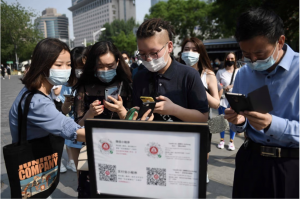
During the COVID-19 pandemic, China has widely applied contact tracing mini programs which apply big data technologies on WeChat or Alipay apps nationwide for epidemic prevention and control (Shen & Wang, 2021, p. 1). People scan QR codes at different places on mini programs to provide their health status and record their trips (Shen, 2020). The application of big data technologies has successfully helped the health authorities with making decisions by pandemic monitoring and analysis and has informed individuals of real-time information about the pandemic. Although the application of big data technologies has achieved success in COVID-19 control in China, some cases about privacy breach related to contact tracing mini programs have revealed that big data technologies can pose great threats to privacy, and these threats will cause harm to people’s safety or mental health.
Case 1

(Source: https://supchina.com/2020/12/09/chengdu-woman-faces-cyber-harassment-after-contracting-covid-19/)
An example is about a female COVID-19 patient experienced online harassment after the illegal privacy breach by a man. In order to inform citizens of the areas where the environmental samples might be tested COVID-19 positive and their potential possibilities to contact COVID-19 virus, the Chinese government applies real-name policy to contract tracing mini programs, partners with WeChat and Alipay to collect data from users and releases the patient’s trip records without mentioning the patient’s full name or other personal information. Ms. Zhao in Chengdu was tested COVID-19 positive and after her trip record was released anonymously online, more personal information of her, such as full name, ID number, phone number and home address, was illegally disclosed by a man (James, 2020). For more efficient and accurate COVID-19 containment, personal information is sometimes over-collected by contact tracing mini programs (Shen & Wang, 2021, p. 10). This man used the limited information published by government as clues, dug out more personal information about Ms. Zhao and illegally posted Ms. Zhao’s other privacy online. Not only on social media, Ms. Zhao but also received many harassments and attacks from phone calls and messages. This caused great harm to Ms. Zhao’s safety and mental health (James, 2020).
In this case, we can find that the collection of big data of users and the disclosure of part of their personal information can lead to the leak of other important privacy of COVID-19 patients. Consequently, patients may be subject to exponential harassment and violence in various forms due to the rapid spread of information on the Internet. Although only very limited part of Ms. Zhao’s information, such as her family name and trip record, was released by the government, the man in this case illegally disclosed more detailed information of Ms. Zhao afterwards. In this digital age, the innovation of technology enables people to easily find data about a certain individual appearing online under his or her real name (Ruesch & Märker, 2012, p. 112). Big data technologies enable the precise connections of decentralized personal information (Shen & Wang, 2021, pp. 6-10). In China, the real-name policy is widely employed, and users’ information is over-gathered during the collection of big data. Therefore, the exposure of limited personal information may become the clues to dig out other privacy and cause larger scale of privacy breach. According to the laws in China, people have the right to health (Shen & Wang, 2021, p. 1). Patients’ right to privacy competes against other citizens’ right to health in this case. Although the release of patients’ trip records is conducive for pandemic prevention and containment, it can also pose threats to the privacy of patients. Due to the influence of Confucianism, China is grounded in collectivist culture and Chinese people place social interests above individuals’ interests. Therefore, Chinese citizens are receptive to the actions of Chinese government that are beneficial for the greater good of society, such as the use and disclosure of limited personal data by the government for epidemic prevention and control (Liu & Zhao, 2021, pp. 743-747). Therefore, the government should try its best to protect citizens’ privacy while using big data technologies for pandemic containment. Besides, information can be spread fast and widely in the digital age. This can deteriorate the outcomes of privacy breach. In the time of COVID-19 pandemic, people are sensitive and emotional about the pandemic situations, thus, COVID-19 patients like Ms. Zhao are easily under harassment and violence from others if their personal information is disclosed widely online. This will do harm to patient’s mental health and personal safety.
Case 2
(Source: https://en.pingwest.com/a/8168)
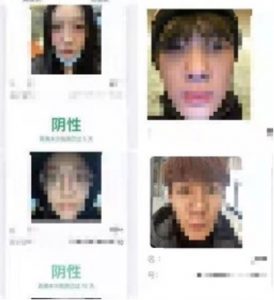
Another example is about the leak of photos and other important privacy of Chinese celebrities recorded by Health Kit. Health Kit is also well known as Jiankang Bao, a COVID-19 contact tracing mini program used in Beijing (The People’s Government of Beijing Municipality, n.d.). In the early days when Health Kit was widely put into use, there were some flaws of its system. People can get access to others’ information shown on Health Kit if they know other people’s ID numbers and full names. Since many Chinese celebrities’ ID numbers have been disclosed and traded online between some criminals, their privacy on Health Kit was easily checked by these criminals. Criminals sold celebrities’ personal information shown on Health Kit mainly to fans to earn money. Although the flaw was fixed by adding the requirement of real-time facial identification afterwards, privacy of those celebrities had already been leaked to a large scale (Wang, 2020).
In this case, privacy breach happened mainly due to the design flaw of Health Kit. In this digital age, many big companies have experienced hacking and privacy breach, such as Facebook, Yahoo and Alibaba (Flew, 2018; Hill & Swinhoe, 2021). Companies cannot completely guarantee the confidentiality of the database. Besides, Health Kit applies the centralized data storage, namely, all the data collected from users is stored and processed in the central server. According to the views of privacy advocates, centralized data storage is poor at resisting hacking and is more prone to excessive expansion of intervention (Kaya, 2020, p. 3). Therefore, the design flaws and internal weaknesses of Health Kit have aroused people’s concerns about the confidentiality of database applied by the contact tracing mini programs. In addition, users’ privacy is worth economic value. Companies can earn more profits by analyzing the data of users and promoting products based on users’ preferences (Flew, 2021). Individuals can earn money by selling the data of privacy like the criminals in case 2. As Health Kit partners with commercial companies to collect and analyze big data of users, there are concerns about companies’ later using the information collected by big data technologies during the pandemic for commercial activities after the end of pandemic. Users’ data is at risks of being traded and exploited without their knowledge and consent.
Based on the two cases above, although the big data technologies applied by contact tracing mini programs or apps have caused great threats to privacy, we cannot deny the advantages of big data technologies. Used for pandemic monitoring and data analysis, big data technologies enable public health authorities to predict the trend of the pandemic. Tracking the trips of patients can help to accurately identify the source and contacts of the COVID-19 virus and avoid further transmission. These advantages are conducive to ensuring the right to health of citizens. Big data technologies are double-edged swords. We had better take some measures to reduce the threats of big data technologies to privacy as well as making full use of its advantages during the COVID-19 pandemic.
Suggestions to Reduce Threats to Privacy in the Digital Age
To reduce the threats to privacy during COVID-19 pandemic, all sectors of society should take actions.
The government should issue relevant policies to strictly regulate the collection and processing of big data by commercial companies and impose costly penalties on those commercial companies that abuse big data and infringe on users’ privacy.
Commercial companies should explicitly state that they will not use big data collected during the pandemic for commercial activities in post-pandemic time. Besides, it is also significant for companies to continuously improve their confidentiality of the database. They had better monitor and test their systems to check whether there are flaws which may be vulnerable to hacking and may lead to privacy breach. It will be a good idea to learn from Apple, calling on social forces to jointly find flaws in the system to prevent privacy breach. Apple once offered up to 200,000 US dollars for people who can discover security flaws in Apple systems and products. This measure enabled people not working at Apple but good at cybersecurity to help Apple find and eliminate vulnerabilities. It is difficult for staffs in the company to find out all the flaws of their systems. This method can also prevent illegal trade of privacy by those hackers (Kharpal, 2016).
Individuals should take the initiative to learn more knowledge of privacy and raise awareness of personal privacy protection. For instance, individuals had better not post content involving obvious personal information on social media or use apps and websites without carefully reading the terms and conditions for users.
Conclusion
In this digital age, especially during the COVID-19 pandemic, the wide collection of big data and the wide application of big data technologies have benefited people in many ways including information processing and pandemic containment, however, have also posed great threats to privacy of people. Based on the case study, the main reasons that cause threats to privacy are the overuse of real-name policy, excessive collection of information, flaws of systems and the lack of transparency of data use. As one of the most conspicuous threats to privacy, privacy breach can cause harm to people in terms of safety and mental health. Especially in the time of COVID-19 pandemic, people are sensitive about the epidemic conditions, privacy breach can draw various forms of harassment and violence to those COVID-19 patients. If multiple sectors of society can jointly contribute to protect the privacy of users, we can make full use of big data technologies to benefit our lives. This needs the cooperation between the government, commercial companies, and individuals. We had better view big data technologies from a critical perspective, not only aware of its advantages in this digital age but also paying attention to its threats to privacy.
(Word count: 2059 excluding references)
References
Flew, T. (2018). Platforms on Trial. InterMEDIA, 46(2), 24–29.
Flew, T. (2021). Regulating Platforms: Digital Media and Society Series. Polity Press.
Gharajeh, M. S. (2018). Biological Big Data Analytics. In P. Raj & G. C. Deka (Eds.), Advances in Computers: A Deep Dive into NoSQL Databases: The Use Cases and Applications. Elsevier.
Hill, M., & Swinhoe, D. (2021, July 16). The 15 biggest data breaches of the 21st century. CSO. https://www.csoonline.com/article/2130877/the-biggest-data-breaches-of-the-21st-century.html
James, G. (2020, December 9). Chengdu woman faces cyber-harassment after contracting COVID-19. SupChina. https://supchina.com/2020/12/09/chengdu-woman-faces-cyber-harassment-after-contracting-covid-19/
Kaya, E. K. (2020). SAFETY AND PRIVACY IN THE TIME OF COVID-19: CONTACT TRACING APPLICATIONS. Centre for Economics and Foreign Policy Studies. JSTOR. https://www.jstor.org/stable/resrep26089?seq=1
Kharpal, A. (2016, August 5). Apple is offering up to $200,000 for hackers to find flaws in its products. CNBC. https://www.cnbc.com/2016/08/05/apple-is-offering-up-to-200000-for-hackers-to-find-flaws-in-its-products.html
Liu, J., & Zhao, H. (2021). Privacy lost: Appropriating surveillance technology in China’s fight against COVID-19. Business Horizons, 743–756. https://doi.org/10.1016/j.bushor.2021.07.004
Obando, S. (2020, April 29). How can CRE professionals ensure data security amid lockdowns? Wealthmanagement. https://www.wealthmanagement.com/proptech/how-can-cre-professionals-ensure-data-security-amid-lockdowns
Ruesch, M. A., & Märker, O. (2012). Real name policy in E-participation. Conference for E-Democracy and Open Government, 109–123.
Shen, T., & Wang, C. (2021). Big Data Technology Applications and the Right to Health in China during the COVID-19 Pandemic. International Journal of Environmental Research and Public Health, 18(14), 1–15. https://doi.org/10.3390/ijerph18147325
Shen, X. (2020, October 10). No smartphone, no health code, no problem. A railway station in China offers relief to seniors. South China Morning Post. https://www.scmp.com/abacus/tech/article/3104856/no-smartphone-no-health-code-no-problem-railway-station-china-offers?module=perpetual_scroll_0&pgtype=article&campaign=3104856
The People’s Government of Beijing Municipality. (n.d.). Health Kit. The People’s Government of Beijing Municipality. Retrieved April 6, 2022, from http://english.beijing.gov.cn/specials/healthkit/
Wang, B. (2020, December 28). Celebrities’ Photos, Other Info Leaked Due to Privacy Flaw in Beijing’s Health Code. PingWest. https://en.pingwest.com/a/8168