Introduction:
A Pew Research Center survey of U.S. adults in September finds that 41% of Americans have personally experienced some form of online harassment in at least one of the six key ways that includes physical threats, stalking, sustained harassment, sexual harassment, offensive name calling and purposeful embarrassed. Those who have been the target of online abuse are more likely today than in 2017 to report that their most recent experience involved more varied types and more severe forms of online abuse (Vogels, 2021). Therefore, at a time when each of us is heavily involved in our online life, ensuring our online identity and mental health has become one of the most important factors. People are very concerned about privacy and freedom of speech in social media. At the same time, the behavior of Internet companies such as Facebook to push hateful and inflammatory information to users not only causes trust problems between online platforms and users, but also may increase the probability of occurrence of online harassment phenomenon. The purpose of this blog is to explore how prevalent online harassment has become in the current online environment and context, and the consequences it can have can be very serious. The nature of the web can fuel harassment and become a platform for misogyny, discrimination, and more. At the same time, the damage may be underestimated due to its recreational nature. This blog will also analyze the suicide of a Serbian influencer to demonstrate the consequences of online harassment. Finally, this blog will also discuss the current platform regulation of online harassment and possible ways to improve it.
Background
The way people socialize and access information has changed a lot these days. Electronic products including mobile phones, computers, and tablets have become an indispensable part of people’s lives. Streaming content is becoming a core part of adult viewing. The survey shows that internet users are more likely to see hateful content while surfing the web than in 2017. However, most people do nothing about it (Ofcom, 2019). On one hand, social media obey very traditional rules of social organisation. On the other, however, social media also inhere a significant shift away from traditional hierarchical and proximity based social groups to a ‘looser, more fragmented and diverse’ notion of the social (Lindgren, 2017). Conflict may be amplified on social media, and people’s social attributes and authenticity are sometimes weakened in virtual environments. Therefore, online harassment has become such a issue in people’s social lives.
Online harassment means repeated online expression via digital devices and platforms (mobile phones, email, social media, messaging platforms) targeted at a particular person that causes the targeted individual substantial emotional distress and/or the fear of harm. This might include, among other things, repeated or persistent calling or messaging, repeated abusive emails and posts on social media, targeting the individual in a threatening manner (Phippen & Bond, 2020).
Features of Online Environment
The specificity of the online environment may also exacerbate the frequency and severity of online harassment, indulging misogyny, discrimination and racial hatred. The first is the anonymity of the online environment. Different from daily life, even if users on social media use part of their real names and real photos as profiles, they do not worry too much that their performance and speech on the Internet will interfere too much in their real life. If that happened, they just need to change to a different id or simply change their name. People are more likely to post hate speech online and not pay attention to the sense of boundaries and politeness in interacting with people in their daily lives.
Secondly, the network environment will reduce the authenticity of people. In a virtual environment, people’s facial expressions and reactions are not or difficult to be presented in real time. This causes the attacker to ignore another user’s vulnerability and characteristics as a person, and to the attackers, cyber harassment appears to be less aggressive and less harmful (Brown, 2018).
The third is the network algorithm calculates the user’s preferences and recommends similar content to them, the user will have less chance to understand the whole picture of the event and will be continuously pushed contents with the same point of view (Phippen & Bond, 2020). The user’s opinion will be more solidified, thus deepening his hatred or pathological fascination with a certain group.
Moreover, network is characterized by the strong connectivity of today’s social media platforms. Users are not just using a single social platform. Because the characteristics of each platform and the information them carried are different. This will cause a certain information or online harassment from other users to not stop at a single platform. Even if the information is deleted on one platform, there is a high probability that it will appear on another platform. Online harassment will have a larger scope (Rieger et al., 2021).
Another characteristic of online platforms is globalization. In such a context, cultural factors and self-identity may be obscured or hidden. This also results in discussions or events that are not limited to a certain region or country. People from all over the world with different viewpoints will also join. It is difficult for a platform to formulate a universal rule that binds everyone, especially when the meaning of harassment is subtle and different languages are used.
Case study of online harassment
Serbian influencer Kika (real name: Kiristina Dukic), 21, committed suicide at home after posting her last post on social platforms. As one of the most popular game anchors, she had more than 1 million fans at the time, and it seemed that there was no reason to end her life. The reason for her suicide was that in a few years, she had been bullied by millions of people, which made her overwhelmed and finally chose an extreme way. In the process, another Serbian game streamer, Baka Prase, has harassed her on social media and caused large-scale online violence (Dollimore, 2021).
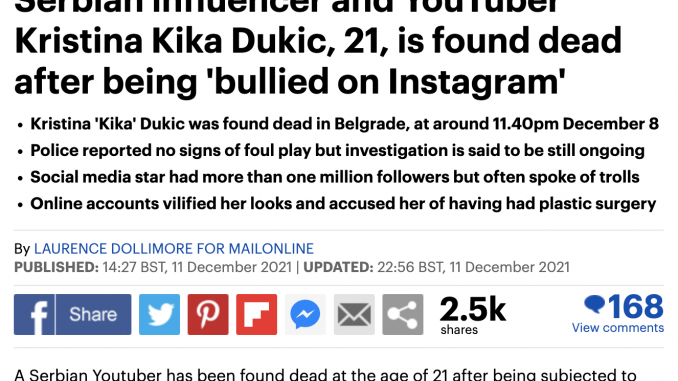
Baka and his followers, or rather many internet users, using the wrong stereotypes of women, implying that Kika as a girl, doesn’t know how to play games at all. He made some reaction videos in which he mocked Kika’s game-playing skills and said she was too pretty, implying that her success was achieved through good looks. At the same time, he also photoshopped Kika’s erotic pictures on the Internet, and mocked Kika in his own videos. In addition to this, Baka also produced a song insulting Kika, which garnered 8 million hits. Fans of Baka are also incited to go to Kika’s live streams, videos, and comment sections on social media for abuse. We can find that Kika is materialized and symbolized in this process. Few people think about how Kika, as a human being with emotions and thoughts, has to bear these harassment. The characteristics of the Internet also make these attacks and harassment difficult to ignore. Baka’s behavior has attracted some misogynists in the community, increasing their attacks on female game streamers.
Baka condemned the attacks on Kika by other internet users after her death, but such actions will not be held accountable. What Baka did, including spreading rumors, was carried out in the virtual environment of the Internet. After Kika’s death, Baka deleted the video he made earlier and claimed they had reconciled. He was taken by Serbian police but was not charged for any comments posted online before.
As mentioned in the case study, harassment of people online may not be managed in a timely manner, and it can be difficult to define the associated behavior.
Online harassment is easily considered more harmless because of the entertainment nature of online platforms. There are many cases of cyber violence. It has been proved that when a person becomes a symbol on the Internet and becomes an object that can be entertained by anyone, people will be more inclined to think that the trolling of this person is more acceptable. People may join such actions for many reasons such as psychological stress or trying to fit in with the group. Such seemingly mild day-to-day attacks are easier to ignore and thus have worse effects and more serious consequences (Jones, Troot & Wright et al., 2020). This is also illustrated by Baka’s reaction videos and parodies made to Kika. In the context of jokes and so-called humor, people may overlook the harm caused by these actions.
Current Governance
According to research, existing social media platforms or online communities have issued corresponding formal or informal documents stating that they do not welcome online harassment. However, most platform policies do not define what constitutes harassment. Instagram and Twitter described some specific acts of harassment, including “repeated unwelcome contact” and “threatening behavior.” Research on most platforms shows that they only refer to harassment or harassment-related words in their policies to define the behavior (Pater, Kim, Mynatt & Fiesler, 2016). Another problem with the governance of another platform is that there is no unified standard for punishment measures among online platforms. Depending on the severity of user behavior, the platform’s measures include: sending warnings, removing accounts or content; and cooperating with third-party organizations, law enforcement, or national governments for governance. Unlike when people harass offline, the law determines penalties based on many details and severity. No platform has developed a detailed response to harassment of different nature or with different serious consequences.
Twitter also launched the Blockbots function, which was developed by volunteers to support the personalized experience of users. This function allows customers to block some harassment from other users and manage blacklists (Geiger,2016). However, such measures are clearly not comprehensive enough. As mentioned in the previous example, Kika’s harassment spanned many different platforms, and Baka’s harassment of her was sometimes not even covert but overt. The erotic pictures he made in the image of Kika have subtext and hints, but if you just look at the pictures, it does not meet the standard of nudity or pornography. How such conduct is defined or punished is difficult and controversial. How platforms govern these behaviors or define the boundaries of harassment is still up for discuss.
Conclusion:
Harassment is a serious problem in online platforms and social media. At a time when modern life and online life are particularly closely integrated, this behavior has a great impact. Online harassment tends to have a larger impact and is more likely to form misogynistic or discriminatory communities due to the specificity of online platforms. At the same time, harassment of others on the Internet lacks a unified norm and governance. Indirect consequences of cyber attacks against others are also difficult to be held accountable for in the same way as offline actions. Online platforms have some existing countermeasures to this problem such as bots and algorithms, but due to differences in region, culture and language, it is difficult to be detected and screened by programs when online harassment is combined with these factors. At the same time, due to the globalization of online platforms, online harassment may escalate into large-scale behaviors, and it is difficult to deal with these behaviors in a timely and accurate manner.
As researchers further refine the algorithm’s accuracy in identifying harassment, users within the community may be considered for contributing to informal harassment policies based on their cultural background and various factors. Suggestions made by users who are familiar with local cultural symbols and the language of the Internet are more likely to be adopted. All in all, online harassment requires the joint action of governments, platforms and users to minimize the occurrence of tragedies.
Reference lists:
Brown, A. (2017). What is so special about online (as compared to offline) hate speech?. Ethnicities, 18(3), 297-326. doi: 10.1177/1468796817709846
Dollimore, L. (2022). Serbian influencer, 21, found dead after being ‘bullied on Instagram’. Retrieved 7 April 2022, from https://www.dailymail.co.uk/news/article-10299347/Serbian-YouTuber-Kristina-Kika-Dukic-21-dead-bullied-Instagram.html
Geiger, R. (2016). Bot-based collective blocklists in Twitter: the counterpublic moderation of harassment in a networked public space. Information, Communication &Amp; Society, 19(6), 787-803. doi: 10.1080/1369118x.2016.1153700
Jones, C., Trott, V., & Wright, S. (2019). Sluts and soyboys: MGTOW and the production of misogynistic online harassment. New Media &Amp; Society, 22(10), 1903-1921. doi: 10.1177/1461444819887141
Lindgren, S. (2017). Digital Media & Society. London: Sage.
Ofcom. (2019). Adults: Media use and attitudes report 2019 (pp. 1-22). Retrieved from https://www.ofcom.org.uk/__data/assets/pdf_file/0021/149124/adults-media-use-and-attitudes-report.pdf
Pater, J., Kim, M., Mynatt, E., & Fiesler, C. (2016). Characterizations of Online Harassment. Proceedings Of The 19Th International Conference On Supporting Group Work. https://dio.org.10.1145/2957276.2957297
Phippen, A., & Bond, E. (2020). Online Harassment and Hate Crime in HEIs – report from FOI. University of Suffolk. Retrieved from https://www.uos.ac.uk/sites/www.uos.ac.uk/files/FOI-Report-Final-Jan-2020-rgb.pdf
Rieger, D., Kümpel, A. S., Wich, M., Kiening, T., & Groh, G. (2021). Assessing the Extent and Types of Hate Speech in Fringe Communities: A Case Study of Alt-Right Communities on 8chan, 4chan, and Reddit. Social Media + Society. https://doi.org/10.1177/20563051211052906
Vogels, E. A. (2021). The state of online harassment. Pew Research Center, 13