“Enter username…”
*types*
“Enter password…”
*types*
I was 7 years old when I first had my mobile phone. It was a Blackberry 8530 model, which was released in 2009. My aunt gave it to me for emergency purposes whenever I am in school or outside our home. I was 9 years old when I made my first social media account — a friendster one. I designed it according to my likes and interests and I added my friends and family solely. I was 10 years old when I had my first facebook account. I remember excitedly coming back home from school to water my crops on Farmville and give my pets a shower at the Pet Society. Again, the people I only allowed in my account were family, friends, and some schoolmates. I was 12 years old when I finally made a twitter account. However, it was different this time because I allowed strangers in my small space. I got exposed to a lot of things, including things that a minor should not be seeing. Ultimately, it was in high school when I experienced online harassment. I got severely stalked and cyberbullied during my junior year. It was detrimental not only for my mental health, but also for my physical health since I lost sleep and did not entertain meal times at all. I was 14. How can a 14-year old handle all of the unpleasant words they were throwing at her online? Who should be punished for people who have experienced online harassment? How can companies make online spaces safe for users, specifically to minors?
In this post, I contend that companies should impose stricter regulations by identifying and detecting what constitutes online harassment, for parents to urge internet content monitoring towards their children, and for the government to institute legislative laws to combat and alleviate online harassment targeting internet users.
Online harassment has been identified as some sort of targeted abuse done in internet spaces. It comes in different forms such as stalking, cyberbullying, sexual harassment, sustained harassment, and more. Most of the time it is done to cause psychological harm to the victim before it translates to actual physical abuse in real life. According to the survey done by Pew Research Center conducted last 2017, about 41% among American adults were found to be subjected to online harassment. These people believe that this is a serious matter, however, companies are having difficulty in balancing free speech and safety issues online.
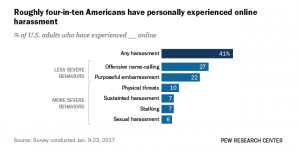
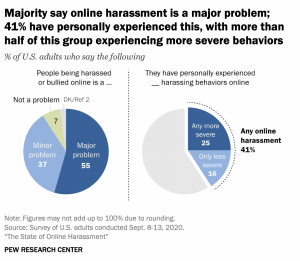
Clear Meaning?
Over the years, most companies have taken measures in combating online harassment. The first step they commonly do is to define what constitutes harassment on their platforms. In order to successfully combat online harassment, an explicit meaning of it should be established first. In a study, it was discovered that no platforms have explicitly identified what is “harassment.” According to Pater et al. (2016), “…Instagram and Twitter were the only platforms that describe specific behaviors or activities that are taken into account when determining if something is harassment.” I suggest that the first step to take into account in preventing and alleviating online harassment is to clearly define what it is. The reason why these platforms fail to combat such serious issues is because they do not have a clear definition on what they are trying to regulate on their spaces.
Moreover, aside from establishing a definition on their policies, companies should also encourage their users in seeking help if harassment has been experienced. Some companies who did provide criteria on what harassment is have been empowering their users to fight against online harassment through “…documents [that] provide links to major bullying hotlines and help centers like Connect Safely, Stop Bullying, and the National Crime Prevention Center on Cyberbullying, as well as eating disorder hotlines” (Pater et al., 2016). These courses of action show that these platforms care about their users’ well-being which will make them feel safer to speak up. To sum up, platforms should put in place their own meaning of harassment to successfully lessen such behaviors targeting their users. This will also help their users to be more mindful in engaging to such risk behaviors and will be more informed on what to avoid on the internet. Let us be real, users are the first people to protect themselves more than anyone else.

Why do parents need to monitor their kids’ internet usage?
In the modern internet age, where a lot of our daily routines and habits depend on social media websites and applications, children and teenagers are no exception in participating in such spaces. Nowadays, parents these days do not only provide iPads and tablets for educational purposes, but they also allow their kids to have access to smartphones for emergency purposes. One prime example is my niece. Two weeks ago, I went back to the Philippines to accompany my mom, and I was surprised when I saw my 5-year old niece holding a smartphone. I had to ask whose phone was it and all I ever got was, “it’s mine, auntie.” I was surprised and troubled at the same time that I had to ask my cousin what were the precautions that she imposed on my niece for using a smartphone at such a young age. Besides educational apps and games, no popular (twitter, facebook, instagram, etc.) applications are installed on her phone, and her screen time is limited to four hours a day only. It is important for parents to be responsible over their children’s behavior on the internet. Moore et al. (2010) says that “As the number of persons that a youth interacts with online increases, their chances of coming into contact with someone who develops a level of dislike or anger for them also increases”. Aside from this point, these children could potentially be the abusers to other users as well. Due to the increase in anonymity online, a lot of youth engage themselves in inflicting harm to other users, thinking that they will never be caught since they are all behind their computer and mobile screens. Moreover, children and adolescents’ cognitive minds are not yet fully developed which “…influences rational thinking and consequently increases the likelihood of engaging in risk-taking behavior (Lwin, Li, Ang, 2012).
To put forward, it is recommended for parents to play a critical role in intervening towards their children’s internet behavior and exposure. Based on past and current studies, there are no guaranteed set effective measures and programs to protect the youth in online harms besides educating them at home and in schools on how engaging in risk behavior online could impact their psychological health. Parents should be open to their kids on what are the dangers that they could potentially encounter online and advice on how to avoid these. Lastly, along with content and screen time regulation, the best action to consider is for parents to build a trusting relationship with their children. Most children engaging in risk behaviors online are the ones who can’t find safe spaces at home.
The rule of the legislative over the internet
Oftentimes, the internet is viewed as a space that does not need its own regulations and laws. Self-regulation was actually encouraged before by asking users to protect themselves when engaging online. Many researchers have argued that imposing strict regulations on it may disturb its natural environmental behavior. However, in my opinion there should be some laws that provide protection for internet users on their daily usage. I understand why no one wanted some rules in using the internet in the past, however, this environment has been being used as a commercial playground for both companies and users. Geach and Harambolous (2009) says, “If commercial activity is to continue and people are to continue to make use of the many benefits that the Internet brings then criminal regulation is needed, otherwise there is a danger that people will turn their backs on the Internet through fear of crime”. The current physical harassment laws have to be extended online which I agree to an extent, however, legislative laws have to be updated to keep up with the current trends. What do I mean by this? If stricter policies are to be imposed for our online activities, there has to be brand new legislative laws for it since most of the current laws are outdated and do not mirror the current behavior happening online.
First, there should be a clear meaning of what constitutes harassment online. This is the same point that I made above as to why companies should establish what covers harassment in their spaces. I agree with Geach and Harambolous (2009) that “although different acts might cause different levels of alarm or distress, the outcome is the same—harassment. Even where specific online acts have no offline equivalent the same argument applies in that the overall outcome is still harassment”, however, it is still beneficial to define these different acts and levels, so it would be easier for law enforcers to define specific punishments that constitutes each level. Besides that point, it will also be advantageous for the companies since they could adapt these legislative definitions on their formal and informal policy documents. Lastly, current research suggests that there are current laws mandated to protect online users which are still blurry and inaccessible to the public. Once legislative laws are imposed, the government should join the internet companies in empowering their users to seek help whenever they encounter harassment online. Altogether, if the internet continues to run commercial activities, strict regulations and laws shall be imposed for the protection of the users against harmful behavior, specifically online harassment.
Conclusion
The internet has been an entertaining and empowering environment for many users, including the youth, adults, professionals, and more. Over the years, it became an avenue for many to communicate with other people across seas, get their first jobs, drive their business to skyrocket, and etc. On the other hand, it also became a playground for wrongful behavior. Under the guise of anonymity, a lot of users are quick to engage with such risk behaviors, to the point of harming other people on the internet. The most common one is online harassment, which comes in different forms, but has one intention, and that is to cause psychological harm to another person. In recent years, as the digital age has been coming in full force, many children and young adults are being targeted in such behavior. In order to combat this situation, I proposed that necessary steps should be enforced in order to protect them when using the internet.
First, for the companies to fight against online harassment, they should be able to establish a clear definition of the behavior. Most internet companies have not been explicit on what constitutes harassment on their terms of service since a lot of them do have a hard time to balance between safety issues and free speech. Moreover, they want to maximize their profits, so they want to ensure to please all their users, so they continue using and availing their services. Secondly, research suggests that some companies and users advocate for self-regulation, which does not work for children and adolescents. Since we are talking about minors, parents should be responsible in taking action in protecting their kids and their mental health in using the internet. They should be actively educating them with what they will be encountering and the consequences in engaging with risk-behaviors online. It is also helpful to moderate their content interaction and screen time usage to protect not only their mental health, but also their physical health. Lastly, since the internet has been used for commercial use, for both rising businesses and users, legislative laws should be imposed to protect users and punish those who want to harm others. A clear definition on what is online harassment shall be established and has to be different from the definition and cases of offline harassment. In this case, it will be easier for law enforcers to form penalties on different forms and levels of online harassment. We still have a long way to go, but I believe that every user deserves a safe space online.
References
Duggan, M. (2020, September 18). Online harassment 2017. Retrieved April 7, 2022, from https://www.pewresearch.org/internet/2017/07/11/online-harassment-2017/
Flew, Terry (2021) Regulating Platforms. Cambridge: Polity, pp. 91-96.
For release January 13, 2021 the state of online harassment. (n.d.). Retrieved April 8, 2022, from https://www.pewresearch.org/internet/wp-content/uploads/sites/9/2021/01/PI_2021.01.13_Online-Harassment_FINAL-1.pdf
Geach, N., & Haralambous, N. (2009). Regulating Harassment: Is the law fit for the social networking age?. The Journal of Criminal Law, 73(3), 241-257.
Lwin, M. O., Li, B., & Ang, R. P. (2012). Stop bugging me: An examination of adolescents’ protection behavior against online harassment. Journal of adolescence, 35(1), 31-41.
Matatoros-Fernandez, A. (2017). Platformed racism: the mediation and circulation of an Australian race-based controversy on Twitter, Facebook and YouTube, Information, Communication & Society 20(6), pp. 930-946.
Moore, R., Guntupalli, N. T., & Lee, T. (2010). Parental regulation and online activities: examining factors that influence a youth’s potential to become a victim of online harassment. International Journal of Cyber Criminology, 4(1/2), 685.
Pater, J. A., Kim, M. K., Mynatt, E. D., & Fiesler, C. (2016, November). Characterizations of online harassment: Comparing policies across social media platforms. In Proceedings of the 19th international conference on supporting group work (pp. 369-374).