Introduction
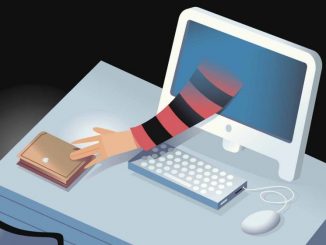
As we move into the so-called “digital age,” we have at our disposal a bewildering array of tools and ways for gathering data, and we are all gradually becoming “transparent people” in the face of this new technology. The right to privacy can be taken for granted at times. A reasonable argument might be made, of course, that in return for your personal information, you obtain a free product. For instance, people give their privacy information in exchange for free wifi service in the mall. But is that really the case?
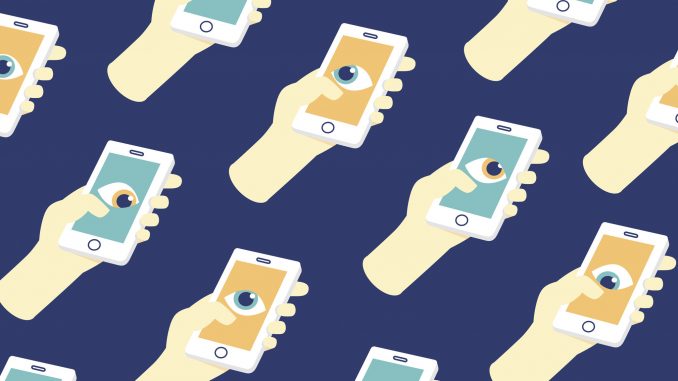
Privacy has developed into a social concern in the digital economy. With the proliferation of smartphones and other mobile devices, GPS positioning has become ubiquitous; even if you do not open the cell phone positioning software, others can still determine your location. Additionally, numerous mobile applications that have nothing to do with geographic location function can steal your cell phone information and geographic location at any time, without your permission, to achieve your tracking and placement.
Numerous Internet service providers are likewise analyzing your internet behavior. Your family’s relationship can be assessed by the many categories of products you buy when using a shared computer for online shopping, and your search and purchasing patterns can be analyzed to forecast the year’s most popular apparel, fabric, and accessories.
In the face of the information technology revolution, the ability of individuals to protect their privacy is insufficient.
An increasing body of empirical study and discussion has focused on the threats to people’s private information online. This blog will address the question of “who should own user-generated web data”. Weibo, China’s most popular social media site, will be used as a case study in this blog post to explore whether the Chinese digital world respects users’ privacy, and the growing awareness of privacy among Chinese internet users.
Threats to Data ownership
According to Cambridge Dictionary, a person’s right to privacy refers to their ability to keep private concerns and relationships private. The current digital age extends the definition of privacy as a “privacy in the digital environment (e-privacy)” (R. Romansky,2017).
Personal information about users is being gathered and processed by media platforms as technology continues to advance. It is becoming increasingly common for companies to collect and keep data generated by these technologies in order to provide a more seamless consumer experience (Banerjee et al., 2011; Halevi and Moed, 2012; Rajagopal, 2011). So, who owns the data that has been gathered? The debate over whether users or the platform own their personal data is worth studying.
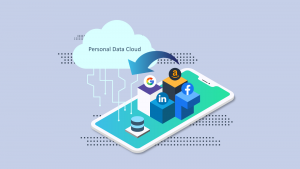
© Paulius Jurcys & Kyung Bae Kim
“Although people say they care very much about privacy, they behave as if they did not” (Francis and Francis, 2017, p. 46)
Most people in the United States are concerned about their privacy when pollsters inquire about it. People, on the other hand, say and do different things (Sullivan, 2006). Only 7% of Americans, according to a new survey by The Ponemon Institute, have changed any of their habits in an effort to protect their privacy. Central network providers benefit from people’s inaction to protect their privacy by being able to freely exploit their personal information.
For example, let’s say you buy a dress online on Amazon. You make a purchase, and the platform takes care of the rest, which is a huge time saver for you. In addition to your name, contact information, delivery address, digital information account, and choice for apparel, you also leave a lot of confidential data on this platform, which you may not know about.
What do these websites do with your information? By pooling data from thousands, if not tens of thousands, of people in your immediate vicinity and analyzing and evaluating it using technology data models. In the long run, massive data sets can give these platforms with rich material that enables them to target different advertisements to your region’s client base and deliver services that meet your wants, so subconsciously increasing the platform’s revenues.
Bezos, the CEO of Amazon has stated publicly that Amazon is not an e-commerce company, but rather a data technology company. As you can see, while this data may be irrelevant to you, a significant amount of data gathered over time can be quite beneficial to the online platforms. Those Internet firms like Google and Amazon see your data as gold, and they don’t have to pay a penny for it.
The data is collected from users but is not shared with them, and the platform earns a substantial profit from this manner. This phenomenon is clearly unjust to users.
Users’ information is currently held on a number of profitable central servers in the market (Facebook, Twitter, Weibo, WeChat, etc.). Users’ data cannot be genuinely private until the government and society adopt a legal structure to break this centralized problem.
Weibo’s controversial policy on “publicize all users’ IPs”
“The terms of service agreements of each major platform have a clause that sets out the basic rule: your access to the platform can be terminated at any time and for no reason. From this basic rule everything else stems.” (Suzor, 2019, p. 11). Major internet platforms now have too much control over their users and content, resulting in a huge privacy leakage concern.
Weibo, as one of the mainstream media platforms in China, experimented opening up the display of some of its users’ IP addresses in early March (this policy has since been implemented), such that when users use Weibo, their personal home page will display their IP addresses, down to the provincial level.
This practice has sparked considerable debate among netizens, with some believing it can help alleviate some of the backstabbing “regional discrimination” and online rumors, while others question whether obtaining and displaying users’ IP information without their consent constitutes a suspected violation of citizens’ privacy.
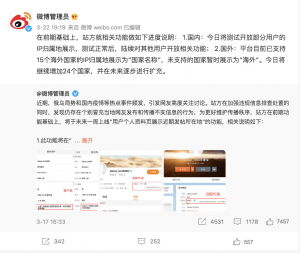
Image source @微博管理员
Weibo’s official governance team explains why and how the publization of intellectual property will work.
The rationale for this feature’s introduction is that following the Russian-Ukrainian war, the tendency of numerous comments beneath linked news and communications became too visible. Certain individuals were staunch supporters of the United States, while others purposefully sowed confusion and even hurled indiscriminate insults at the Russian government. This phenomenon raises the question: Are anti-Chinese forces operating outside the nation, aided by the United States, purposely masquerading themselves as Chinese netizens in order to maliciously ferment the incident?
As the findings of the revelation of IP addresses have shown, outsiders were the only ones making inflammatory claims about the Russian-Ukrainian war in order to provoke public sentiment. It is evident that disclosing personal IP addresses enables government management to exert effective and practicable control over public opinion, and anti-China forces from overseas will have to think carefully about agitating public opinion in the future. However, the legality of disclosing users’ IP addresses without their consent is up for debate.
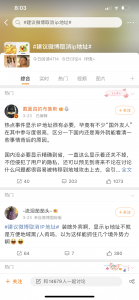
image source from screenshot
Users established a hashtag feed to express their opposition to the policy, which they believe violates users’ privacy and would result in online harm.
The complete broadcast of IP on Weibo may end up being nothing more than a witch-orgy.
Although the intended goal of Weibo was to prevent anti-Chinese groups operating outside of China from inciting the populace, as time passed, people began to focus their attention on others. Now, hostility is being thrown at the aspiring blogger simply for having an IP address outside of China. The scenario presently appears to be that as long as the user is identified as being outside the nation, he is not permitted to make any politically charged comments, since he is considered an anti-China force operating outside the country.
You believe this is a victory for the right, but it is actually a loss for everyone.
With the disclosure of information regarding IP geolocation, people will become more zealous in their labeling of contentious events or individuals. The process of discussion, debate, and mutual understanding is eliminated, and labeling is utilized directly in place of thinking and differentiating between the opponent and ourselves.
With knowing your IP address, others will make arbitrary decisions on you. Whatever you say on politics, regardless of its logic, as long as your IP address is displayed as being outside of China, you will be branded an anti-China force. Even if you are just an ordinary student who is pursuing knowledge in other countries.
Labeling’s inertia is akin to a trace of poison that unintentionally restricts our minds. Online debates will only become more sloganeering and devoid of reasoning in the future.
It’s not just a suspected violation of privacy but also a security risk, according to many netizens who believe that the IP address, the content of blog posts, and microblogging images can be used to analyze the location and behavioral preferences of users and may even encourage online hate.
Privacy and Privilege
Within communities, privacy varies significantly according to context, subject status, and the dynamics of any given interaction. In short, power plays an ever-present role(Marwick & Boyd, 2018). Marwick and Boyd also stated that general people have a different perception of privacy than individuals who have some semblance of privilege within a given society (2018).

image source: © IoT For AlI
Intriguingly, once Weibo compelled the public to divulge their private IP addresses, it was discovered that celebrities and politicians could opt out of having their IP addresses disclosed. Weibo noted that this was done to safeguard their privacy and avoid any unneeded difficulty.
Weibo’s habit of dividing users into multi categories has sparked a lot of controversy. It is not only a case of Weibo abusing users’ privacy; to some extent, Weibo is attempting to establish a hierarchy.
Conclusion
As with a scale and a double-edged sword, the government and mainstream platforms should confidently use digital data to contribute to mankind while also regulating and guiding it lawfully to ensure that it serves all of humanity.
The objective of this blog is to examine how users’ personal information is unfairly used in the digital era and how they are impacted by such violations. Globally, central internet service providers aggregate and gather people’s personal information in exchange for enormous profits, which is blatantly unfair to users. In China, a case study of the Chinese online digital environment (Weibo platform) demonstrates that users’ privacy is not completely safeguarded and is potentially at risk of data leaking. Based on this circumstance, the Chinese government and law enforcement must build on current legislation to improve regulation of platforms and significant data corporations in order to limit national privacy concerns and breaches.
The fact that users should be always alert to the concealed threat of being listened to by network service providers in their daily lives, as well as the fact that they should submit as little personal private information on the Internet as possible, is a type of self-protection.
China’s network information security governance still has a long way to go. Schools and governments need to educate the public about the dangers of leaking personal information online and the necessity of protecting one’s privacy online, since many Chinese are unaware of the dangers of leaking personal information online. More Chinese citizens must grasp the significance of network privacy issues and demand that the government and network authorities implement more precise policies to preserve digital privacy before people’s online privacy rights can be improved.
Reference
Marwick, A. and Boyd, D. (2018). Understanding Privacy at the Margins: Introduction (Vol. 12, pp. 1157–1165). essay, University of Southern California, Annenberg School for Communication & Journalism, Annenberg Press.
Miller, C. C. (2014, November 12). Americans say they want privacy, but act as if they don’t. The New York Times. Retrieved April 7, 2022, from https://www.nytimes.com/2014/11/13/upshot/americans-say-they-want-privacy-but-act-as-if-they-dont.html
Privacy. Cambridge Dictionary. (n.d.). Retrieved April 7, 2022, from https://dictionary.cambridge.org/dictionary/english/privacy
- Romansky, A survey of digital world opportunities and challenges for user’s privacy, Int. J. Inform. Technol. Secur., 9 (2017), 97-112.
Sullivan, B. (2006, October 16). Privacy under attack, but does anybody care? NBCNews.com. Retrieved April 7, 2022, from https://www.nbcnews.com/id/wbna15221095
Suzor, N. (2019) Lawless: The Secret Rules that Govern our Lives. Cambridge, UK: Cambridge University Press.
The Economist Newspaper. (n.d.). Many Chinese suffer discrimination based on their regional origin. The Economist. Retrieved April 7, 2022, from https://www.economist.com/china/2019/04/11/many-chinese-suffer-discrimination-based-on-their-regional-origin
Image source
Jurcys, P., & Kim, K. B. (2020). Towards Data Science. Retrieved April 7, 2022, from https://towardsdatascience.com/personal-data-ownership-f3b62e6ed07d.
The New York Times Americans Say They Want Privacy, but Act as if They Don’t – The New York Times. (2014). The New York Times. Retrieved April 7, 2022, from https://www.nytimes.com/2014/11/13/upshot/americans-say-they-want-privacy-but-act-as-if-they-dont.html.
© IoT For Al. (2019). Privacy as a Privilege: The Flip Side of Tech Advances. Retrieved April 7, 2022, from https://www.iotforall.com/privacy-as-privilege-flipside-tech-advances.