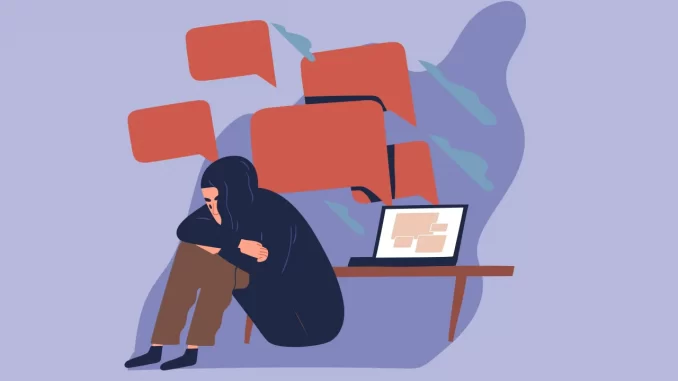
While the development of Web 2.0, the Internet enables more users to express their ideologies and share their experiences. Those ideas can be divided into benign and malicious, and online harassment is an example of abusing others through digital platforms. The definition of online harassment is similar to cyber-bullying. The latter is usually described to children with legal consequences; online harassment indicates the adult victim’s feeling of being in danger and threat (Lindsay & Krysik, 2011). The victim has always been offensive based on their ideologies, racial and physical appearance (Flew, 2021) with aggressive name-calling, purposeful embarrassment, continually harassment, etc. (Vogels, 2021). Due to the increasing number of relevant cases, platforms and governments from various countries launched regulatory measures. The recent case of TikTok reveals an outstanding example of protecting the victim from online harassment. In other words, unlimited free speeches need to be governed by platforms and the government to prevent the spread of online harassment.
Case Study – Online Harassment on TikTok
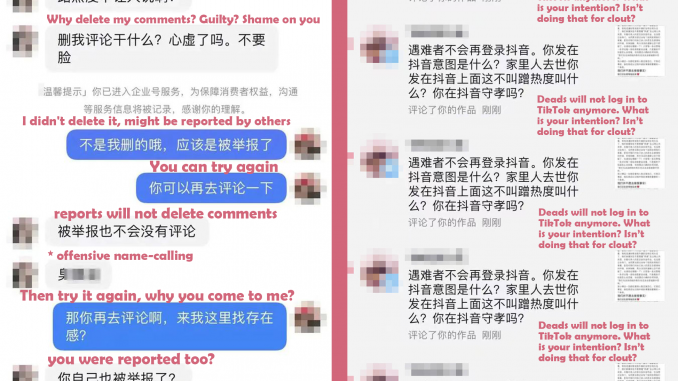
A Chinese plane, MU5735, crashed on March 21, 2022. Little Moon, a Family member of one of the deceased, posted a series of videos and words on the dead’s TikTok account to express her nostalgia for her family. Although most people demonstrate their grief in the commenting area, three users attacked Little Moon by sending the harassment message continually.
In the screenshots that Little Moon provided, offenders assumed that Little Moon aimed to gain popularity from the plane crash accident. They kept accusing her by commenting with the same paragraph. Little Moon also received offensive name-calling from the private messages due to her nostalgia videos. Based on that aggressive harassment, Little Moon stopped sharing any videos and posts. While she worried about being attacked by others or exposing her personal information online, she wrote an apology letter to represent her regret and asked to stop the harassment (The Paper, 2022).
This action attracted the attention of the platform TikTok. As a digital media platform, it banned the offenders’ accounts and released an announcement of preventing further harassment of Little Moon. In the public statement, TikTok also revealed the related legal provision and tried to raise this online harassment into the legal dimension.
Internet’s Nature Resulting in Online Harassment
Free Speech Online
The research represents that the Internet’s original intention is to allow everyone to express their ideologies (Barlow, 1996). Especially social media, which invented many features to enable users to interact and communicate (hashtag, forum, etc.). In other words, the nature of social media is providing a space for users to ignore the constraints of real society. They do not need to worry about the boundaries between religious or social classes but focus on communication. However, users always carry different cultural backgrounds and ideologies. Exchanging ideas in actual words will result in debate, and the internet area strengthens the possibility of divarication. While sending messages and abusing others is an approach to expressing self-thinking, online harassment is inevitable on the digital platform when users exchange ideas.
For instance, Carlson and Frazer (2018) introduced an example of the ‘Sorry Business’. It indicates the phenomenon of users holding different views on whether to mourn others online. Some users like to share their past families’ photos on the social platform, highlighting the feeling that they are still alive. Even if the families cannot interact with them in the real world, they can still interact with their social media accounts. However, it does not be permitted in traditional Indigenous culture. The cultural values of death have clashed, which usually causes further problems.
Related to Case Study
In the case of TikTok, similar cultural values are conflicted. As a short video platform, TikTok aims to connect people by sharing videos (Ge et al., 2019). The user’s attitudes and mentality are expressed in the video while recording their actual actions in the real world. The video is also much more persuasive than the words as it always amplifies a simple point, which increases the possibility of attracting audiences (Ge et al., 2019). It is also easier to arouse contradiction with others when the collision between two ideologies happens.
Harassment becomes an approach for the users to vent in TikTok cases. The Little Moon is expressing her sadness through the social media platform. Likewise, the offenders also represent their assumptions about Little Moon. While the nature of the platform allows everyone to express ideas freely, the actions of victims and perpetrators are both permitted. In contrast, TikTok’s action of banning accounts violates the initial aims. That is, online harassment is quite likely to happen in a digital environment due to the nature of free speech, but the regulators are difficult to involve.

Though, online harassment is a problem that cannot be ignored by many internet users (Vogels, 2021). To understand this topic more profoundly, it is worth considering the influences of online harassment on platforms and users, and whether to solve that problem.
Platforms V.S. Online Harassments
According to the CEO of Cloudflare, ‘Literally I woke up one morning in a bad mood and decided someone shouldn’t be allowed on the internet. No one should have that power’ (Flew, 2021, p. 104). Depriving one’s right from speaking on the internet is a challenged measure. It violates not only the principle of free internet but also human rights. Balancing free speech and governing online harassment would be difficult in eliminating online harm. Those challenges result in rare platforms effectively solving the problems with online harassment, even if they might have abilities. Then, what might arouse their willingness to governance the online harassment?
Reputation Effects on Platforms
According to the research (ICF Consulting Services Limited, 2019), the platforms could obtain a positive reputation by trying to moderate the harassment of information against the human right of free speech. Different platforms are taking action to ensure the safety of users based on their unique value of the forum. If users’ experiences are affected by online harassment or conflict with their platform values, their reputation declines. In other words, online harassments affect the user’s experiences with the internet and decline the platforms’ reputations.
The platforms might suspend one’s account when the user is detected as harmful to others to prevent negative influences from happening. Although they violated human rights and free speech, they focused on the general public’s right of enjoying a pleasant digital platform environment. This action allows them to gain the public’s trust since they protect the majority’s experiences on social media platforms.
At the end of TikTok’s public announcement, ‘I hope you will be friendly, speak rationally, and work with the platform together to maintain a clean and positive community atmosphere’ (TikTok, 2022, para. 5). They demonstrate the platform’s value and arouse the problems to a moral level, placing the platform and general public in the same position, highlighting their shared empathy for the plane crash accident. Such approaches demonstrate the determination to protect more users’ right to enjoy Web 2.0, and also their reputation to other users.
Government’s Actions
Aside from platforms, some governments are also involved in moderating online harassment. According to research (Linklaters, 2021), the governments of Australia, Germany and France state that they should set up rules with specific details against excessive freedom online. Although the government always does not fix the problems directly, the legislation has become a supplementary means for regulating.
When Facing Platforms
The government is forcing the platform to regulate online harassment. TikTok has talked about the ‘QingLang’ movement in their public announcement. It is a method that the Chinese government have operated to moderate internet content. The government contacted the different platforms and mentioned the importance of the ‘online environment’, pointing to the issues that need regulation (Xu & Zi, 2022). Online harassment is one example. To moderate harassment in the commenting sections, QingLang already commended the platforms for suspending 159,000 accounts engaged in such activities (Tao & Liu, 2021).
Back to the case of TikTok and Little Moon, although the government did not intentionally request TikTok to suspend the perpetrator’s account, TikTok implemented and mentioned the ‘QingLang’ movement in the announcement. It further proves how the Government measurement of online harassment influences the platforms to moderate harassment cases.
When Facing Users
TikTok mentioned that ‘…attacking others and making insulting is immoral and also breaking the law. If the circumstances are serious, the platform will submit illegal clues to relevant departments’ in their public announcement (TikTok, 2022, para. 4). Criminal liability can be implemented for the users who are harassing others through digital platforms.
While QingLang aims to punish the people who are abusing and interrupting others through the internet, the Chinese government highlights how legitimism in the real world is also working in the digital platform (Xu & Zi, 2022). The disappearance of anonymity on social media increases the authenticity of being punished in reality (Matamoros-Fernánde, 2017). It creates a deterrent effect on the general users. They have to consider their actions seriously as what they need to do in reality, which means the free speech Internet does not apply to the users anymore. The frightening process allows the users to look after their behaviour, further preventing online harassment of others.
Difficulties in Futures
While the users, platforms and government have noticed the problems of online harassment, more constitutions have been published in recent years. For instance, the QingLang movement in China, Online Safety and Media Regulation Bill in Irish, NetzDG in German, etc. (Linklaters, 2021). It has certain rules about what kind of online harassment or hate speech should be regulated. Though, the other difficulties still need to figure out.
Collision with Free Speech
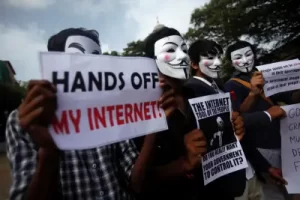
The problems with free speech still exist even if the governments and platforms would take action against online harassment. Although governments and platforms’ goal is to create a safe internet environment, the general users might only consider their human rights. The protest parade about free speech happened worldwide (Abutaleb & Sharp, 2016). How to meet the dual needs of users for security and freedom is still a problem.
Discovering Related Cases
TikTok noticed Little Moon’s case since the whole society was focused on the plane accident. However, the cases of online harassment are increasing. Almost 40% of American states that they have experienced online harassment (Vogels, 2021). It is impossible for the platforms and governments to discover all cases.
Matamoros-Fernánde (2017) suggests that both users and algorithms could support the platform to report online harm cases. However, they have advantages and disadvantages, respectively. Algorithms are calculations based on the data that human-provided to them (Just & Latzer, 2016). Though, the platforms cannot prove if the data are neutral and updated. Also, who is responsible for the mistakes or misunderstandings of the data? Compared to the algorithm, the user reporters are not reliable either. If the platforms deal with every report and suspend all the accounts, deleting by mistake easily happens since there is no evidence supporting the user’s statement. It is another trouble of who is going to make the final decision.
Possible Outcomes
The internet’s nature of free speech, the platform’s role as a regulator, the government’s supplementary measurements, and future difficulties are significant when considering online harassment. However, TikTok’s action of suspending accounts in Little Moon’s case represents a solution to eliminating online harassment. The government also has the ability to force platforms to moderate the content by users. Although they have violent the free speech of human rights, their action of suspending accounts provides a calm digital environment with a reputation. This case has proved how the government and platforms are corporating. Although the free speech of the perpetrators is affected, it saved the majority of users’ experiences in web 2.0, further creating the possibility for online harassment solutions.
References
Abutaleb, Y. & Sharp, A. (2016). Restrictions on internet free speech are getting tighter all over the world. Retrieved from the INSIDER website: https://www.businessinsider.com/r-proposals-to-curb-online-speech-viewed-as-threat-to-open-internet-2016-6
Barlow, J.P. (1996). A declaration of the independence of cyberspace. Retrieved from the Electronic Frontier Foundation website: https://www.eff.org/cyberspace-independence
Carlson, B. & Frazer, R. (2018). Social media mob: being Indigenous online. Sydney, Australia: Macquarie University
Flew, T. (2021). Regulating platforms. Cambridge, UK: Polity Press.
Ge, J., Sui, Y., Zhou, X., & Li, G. (2021). Effect of short video ads on sales through social media: the role of advertisement content generators. International Journal of Advertising, 40(6), 870–896. https://doi.org/10.1080/02650487.2020.1848986
ICF Consulting Services Limited. (2019). Research into online platforms’ operating models and management of online harms. Retrieved from https://www.gov.uk/government/publications/research-into-online-platforms-operating-models-and-management-of-online-harms
Just, N., & Latzer, M. (2017). Governance by algorithms: reality construction by algorithmic selection on the Internet. Media, Culture & Society, 39(2), 238–258. https://doi.org/10.1177/0163443716643157
Lash, R. (2014). What GamerGate can teach journalists about handling Twitter storms [Images]. Nieman Reports. Retrieved from https://niemanreports.org/articles/what-gamergate-can-teach-journalists-about-handling-twitter-storms/
Lindsay, M. & Krysik, J. (2012). Online harassment among college students: a replication incorporating new Internet trends. Information, Communication & Society, 15 (5), 703-719, doi:10.1080/1369118X.2012.674959
Linklaters. (2021). Online harms: a comparative analysis. Retrieved from https://www.linklaters.com/en/insights/thought-leadership/online-harms/online-harms
Matamoros-Fernández, A. (2017). Platformed racism: the mediation and circulation of an Australian race-based controversy on Twitter, Facebook and YouTube. Information, Communication & Society, 20(6), 930–946. https://doi.org/10.1080/1369118X.2017.1293130
Munter, J. (2018). Online platforms challenge free speech through editorial decisions [Images]. News Media Alliance. Retrieved from https://www.newsmediaalliance.org/platforms-free-speech-online/
Tao, L., & Liu, A. (2021). China Cracks Down on Digital Fandoms: Behind the “QingLang” Operation. Retrieved from https://www.glimpsefromtheglobe.com/regions/asia-and-the-pacific/china-cracks-down-on-digital-fandoms-behind-the-qinglang-operation/
The Paper. (2022). The relatives of the passengers of the crashed flight posted a nostalgic video online, and were attacked by some netizens and forced to apologise. Retrieved from
TikTok Safety Center. (2022). Governance Announcement on Crackdown on Internet Violations by the Crash of China Eastern Airlines. Retrieved April 1, 2022, from https://bit.ly/TikTokAnnouncement
Vogels, E. A. (2021). The state of online harassment. Retrieved from the Pew Research Center website: https://www.pewresearch.org/internet/2021/01/13/the-state-of-online-harassment/
Xu, B., & Zi, Q. (2022). Remediate cyber violence and create a clean space. Retrieved from The National People’s Congress of the People’s Republic of China website: http://www.npc.gov.cn/npc/c30834/202203/8161e06bec384d5db0c7642a03569b16.shtml