Introduction
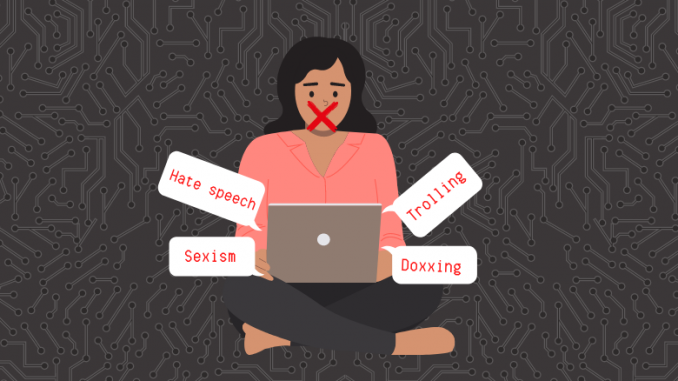
The 21st century is the age of the internet, and in the context of globalization, the internet and digitalization continue to evolve and people live in a society full of social media. Over the past decade or so, social media technologies have gradually become a central part of our daily lives (Carlson & Frazer, 2018). There has been a gradual shift from traditional letter writing, phone calls, and texting to communication and sharing through social media. For young people, they (we) have grown up in a world full of social media and have become accustomed to it. Because of the development of social media, people’s lives are becoming more and more dependent on the internet and social media. But with that, more and more problems arise. Social media is a platform for people to speak and share freely, and people use different identities to express themselves online. In the context of freedom of expression, some users may make bad comments, attacking others on different races, genders, religions, disabilities and so on. In this blog, we will discuss online hate speech, harassment and gender discrimination on the internet. In the Internet, malicious messages have an uncontrolled spread and persistence that can affect a wide range of users (Frenda, Ghanem, Montes-Y-Gómez & Rosso, 2019). So do women suffer more severely from online hate speech under gender differences? I think the answer is yes. Despite the fact that in modern society, gender equality has been promoted, the idea of gender inequality still exists in the consciousness of a part of the population based on all the history about gender discrimination. Online hate speech through social media platforms can spread amplify the problem of gender discrimination. When using social media on a daily basis, one can notice the increasing prominence of female power, from the previous stereotypes of women to the current feminism, so what is the presence of women in the online hate speech? In addition to amplifying the issue of gender discrimination through online hate speech by social media platforms, there will also be an issue of online harassment. In gender discrimination the publication of hate speech is accompanied by harassing language. Online harassment and hate speech not only hurt the people involved, but also the audience.
What is online hate speech and online harassment?
With the development of social media, it has many advantages, which not only facilitates people’s daily life but also makes information transfer faster. Social media platforms are built and pursued by human beings, embedding human choices and reflecting human values (Roberts, 2019). In such an environment, people can share with different IDs in social media, the rise of free speech on the Internet, and people’s speech on the Internet is more bold. As a result, online hate speech and online harassment take place. Online hate speech can be understood as having a hostile character. Second, hate speech is thought to do these things: silence, malice, slander, humiliate, intimidate, incite violence, discriminate, defame, demean, persecute, threaten, etc. (Richardson‐Self, 2018). Online harassment and intimidation through text messages, phone calls or social media severely limit the rights people have online, especially for vulnerable and marginalized groups, including women and sexual Members of minority groups (Golbeck, 2018). Online hate speech is often accompanied by online harassment. Next, we will analyze online hate speech and online harassment based on gender discrimination.
Stereotypes of women
What is a stereotype? “A stereotype is a commonly held, simplistic, essentialist belief about a specific group of people.” (Bordalo, Coffman, Gennaioli & Shleifer, 2016). In a simple word, it is a general yet deep social perception of a specific group of people (e.g., gender, gender identity, race and ethnicity, religion, nationality, age, socioeconomic status, language, etc.). Stereotypes are deeply rooted in social institutions and the wider culture. In an age where social media is so well developed, the spread of stereotypes is getting an  even bigger push. TikTok is a recently very popular social media platform where people can share short videos of themselves and viewers can give feedback on the content by likes and comments. When I use TikTok, I will find that there will be many different “hot” videos(the videos witch are very popular), which are initiated in the form of hashtags, and many users will follow the trend to share the content related to it. For example, during this time, China’s TikTok had a hot spot about appearance anxiety. The emergence of this hot spot caused quite a stir. Because there are many makeup bloggers on TikTok in China who will share makeup content on this platform, their starting point is to share content and let audiences learn about makeup skills, but at this time there is the emergence of online hate speech, they think these makeup bloggers are using women’s empathy to promote appearance anxiety, making women think that small eyes or a flat nose is ugly, and only big eyes and a high nose are beautiful. I think these commenters also have stereotypes about women, because the makeup bloggers are adhering to the idea of allowing audiences to make their own facial features more prominent through makeup technology to achieve beautiful results, and such inappropriate commenters think that this is in the spread appearance anxiety. Therefore, the stereotype of women on social media has changed with the changes of the times. Through social media, a huge stereotype of women’s body, appearance, and dress has been formed. In TikTok, most of the social media celebrities are beautiful and in good shape, and the audience is more interested in them. Then, at this time, online hate speech also followed. In TikTok, after bloggers post their own videos, they can see different reactions from audiences through the comments, including abuse and praise. Especially in the comment area of some bloggers who are not so prominent in appearance, there will be hate speech attacking the blogger’s appearance, and harassing the blogger through sending messages.
Feminism and MeToo movement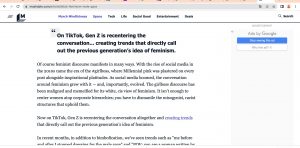
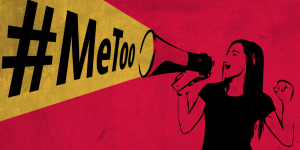
In TikTok, besides the fact that stereotypes of women can lead to hate speech or cyber harassment, there is another topic that has become very popular in recent years, which is feminism. Why has the popularity of feminism led to hate speech and online harassment of others on social media platforms? Obviously this is a historical problem. It has always been a patriarchal society in China, which means that men have the dominant power in the society (Lindberg, 2021), but as the society progresses and develops, the idea of gender equality gradually returns to people’s lives. In modern society, women’s power is no longer looked down upon, and even many jobs will require female roles to the point of getting better results. Social media is an important tool to reflect social issues, so the emergence of feminism will undoubtedly have an impact on some men. Just because gender equality is valued does not mean that gender equality has been achieved. It is difficult to achieve uniformity in different countries with different political, economic and cultural contexts. TikTok, one of the most popular social media networks of our time, has over 60% of its users being women (Statist, 2021). When I use TikTok, I often look at the comments section after viewing a video, and I can see a lot of hate speech through the comments. For example, if a video is about how difficult it is for women to be mothers, there are many derogatory comments about women (e.g., every woman is like this, why are you the only one complaining, etc.) in the comments section. Some people even harass and abuse the person who posted the content in private messages, which is wrong and to some extent against the law. Online harassment is different from offline sexual harassment, as there are more forms of online harassment, such as sending pornographic messages, voices, pictures, etc., as well as humiliation, which will undoubtedly create great psychological pressure and negative emotions for the harassed person. The famous MeToo Movement is a campaign against sexism and sexual harassment. Through social media, this campaign has received attention from all over the world. Similarly, social media celebrities also support the campaign on their own social media platforms to fight against gender harassment both online and offline.
Free speech and hate speech
Free speech is the focus of social media, and users can publish their speech content through social media platforms. Unlike in the real world, people cannot speak freely because of their identities. In social media, people can hide their true identities and use their own fake online names to publish their speeches. Therefore, what he/she sees on social media is not the real s/he. Because of this change of identity, people think that there is no need to be responsible for free speech. Many people will vent their unhappiness in the real world on social media networks, and even abuse and slander others on the Internet. So here it will make people wonder, how to distinguish between oppressive speech and hate speech? In Richardson-Self’s article, he analyzes this. Hate speech is violently oppressive, while oppressive speech is not (Richardson‐Self, 2018). Back to the topic, is hate speech and harassment of women free speech online? I think it’s a vicious product of free speech. Advances in social media networks have allowed us to connect, share, speak freely, and increase our awareness of self-protection. But it also provides more fertile ground for gender-based violence against women and girls. Young girls are particularly vulnerable to hate speech and sexual harassment and bullying from their peers on social media. Although social media has algorithms designed to filter such speech, there is still a chance that criminals can escape such algorithms and attack women (Golbeck, 2018). Are hate speech and sexual harassment only for women in online social media? the answer is negative. Theoretically, the object of sexism can be male, female, or transgender, but in fact, this kind of discrimination and aggression is more inclined toward women (Frenda, Ghanem, Montes-Y-Gómez & Rosso, 2019), discrimination against women is also A female-hateful attitude can be understood as misogynistic. In conclusion, free speech does not imply hate speech and harassing language.
Conclusion
Social media has played an important role in the wave of the Internet. Social media is a platform for people to share and comment, and it should be peaceful and fair. Free speech is an important feature of social media, but free speech does not mean talking casually. Even though the social media network is a huge database, there is no real law like in the real society, but social media platforms also have rules and regulations for network management, everyone should be responsible for the content they post, and should not be held accountable to others because of freedom of speech conduct verbal attacks, post hate speech or even online harassment and violence. As the users of social media, we should be polite when using social media, and we should not make malicious remarks at will, nor should we harass or threaten others, so as to build a free and peaceful social network together.
References
Bordalo, P., Coffman, K., Gennaioli, N., & Shleifer, A. (2016). Stereotypes. The Quarterly Journal of Economics, 131(4), 1753–1794. https://doi.org/10.1093/qje/qjw029
Carlson, B. & Frazer, R. (2018). Social Media Mob: Being Indigenous Online. Macquarie University. https://research-management.mq.edu.au/ws/portalfiles/portal/85013179/MQU_SocialMediaMob_report_Carlson_Frazer.pdf
Frenda, S., Ghanem, B., Montes-Y-Gómez, M., & Rosso, P. (2019). Online hate speech against women: Automatic identification of misogyny and sexism on twitter. Journal of Intelligent & Fuzzy Systems, 36(5), 4743–4752. https://doi.org/10.3233/JIFS-179023
Golbeck, J. (2018). Online Harassment (1st ed. 2018.). Cham: Springer International Publishing. https://doi.org/10.1007/978-3-319-78583-7
Lindberg, F. (2021). Women’s Rights in China and Feminism on Chinese Social Media. Institute for Security and Development Policy. https://isdp.eu/content/uploads/2021/06/Lindberg.-2021.-Womens-Rights-in-China-and-Feminism-on-Chinese-Social-Media.-1.pdf
Richardson‐Self, L. (2018). Woman‐Hating: On Misogyny, Sexism, and Hate Speech. Hypatia, 33(2), 256–272. https://doi.org/10.1111/hypa.12398
Roberts, S.T. (2019). Behind the Screen : Content Moderation in the Shadows of Social Media . Yale University Press. https://doi.org/10.12987/9780300245318
Statista. (2021). Distribution of monthly active TikTok users in the United States as of March 2021, by gender, https://www.statista.com/statistics/1095201/tiktok-users-gender-usa/
Picture1: https://botpopuli.net/articulating-a-feminist-response-to-online-hate-speech-first-steps/
Picture2: https://mashable.com/article/tiktok-feminism-male-gaze
Picture3: from TikTok screenshot