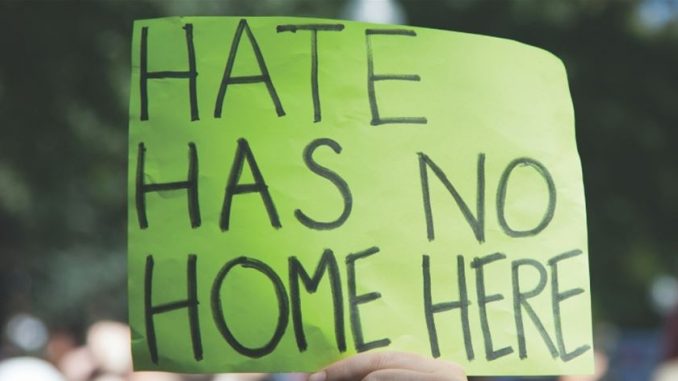
Online hate speech and racism: the origin, existence and governance.
Introduction
The rapid development and newly emerged technologies in internet areas such as online platforms, has made internet more accessible for many people nowadays, so that people could express their thoughts on social media platforms easily. This revolutionary change brought people countless benefits and conveniences, enabled users to communicate in an efficient and simple way. So what did online social media platforms bring us? When we are enjoying the convenience, is there anything that we did not notice, but really existed and brought so many negative influences?
As a online platform user myself, I love spending time on them and really appreciate the convenience produced. However, benefits and conveniences were not the only incidentals, the popularization of online social media platforms also produced massive online hate speeches due to various reasons. Racism speeches, as one kind of online hate speeches, were not new to those social media platform users. Neither it is not a new derivative term produced by the rise of internet technologies. The awareness of the existence of hate speeches and racism speeches by the society in real world brought strong and effective governance on this particular issue. However, managements against online racism or hate speeches did not reach a satisfactory level. There are various online hate speeches happening everyday, harassing people who are in particular race, religion and places.
As what Bronwyn Carlson and Ryan Frazer demonstrated in their research (Carson & Frazer, 2018), that racism as a form of semiotic and structural violence hidden behind anonymity and humor was familiar to social platform users.In another online hate speech study (Matamoros-Fernández, 2017), the author mentioned and argued that the protection of humor as one part of free speech, covered online hate speech. It is not strange to see people proceed hate speech or racism speech online by using irony and satire as cover. And this prompts discrimination, harassment and harms. When some people realize that regulations from real world on hate speeches can not be equally applied online, such behaviors will be executed even worse than in the real world. Based on the severe influences and impacts on both users and other people, it is important for both the tech-giants and governments to produce and introduce effective enough governance and even legislation to regulate online platform speech environment.
This blog will focus on revealing the origin and existence of online hate speech including why would online hate speech sweep over global internet. Also seek to prove that online hate (racism) speeches are as harmful or even more harmful compared to racism and hate speeches in real world. This blog will use Syrian refugees and their experiences of online racism and hate speeches as a case to further explained the term of online racism and hate speech.
This part will be demonstrated and explained by using a related research (Ozduzen, Korkut, Ozduzen, 2020) on the issue of Syrian refugees being unequally treated in Turkey. Another research (Viazminsky and Borho, 2022) about the hurts and damages on Syrian refugees in Germany caused by discrimination also supported the idea that hate and racism speeches are harmful to those victims.
Origin and existence
People are familiar with hate speeches and racism speeches in real lives, where extremists harass and attack people from other races. However, online hate speech or online racism speech as new terms appeared after the popularization of internet applications, did not raise people’s awareness of the importance of their damages caused to others. It is precisely because of the lack of attention paid by both the general public and technology companies, that made online racism speeches still be unapprehended. In a major study (Matamoros-Fernández, 2017), Ariadna described digital platforms as producers and amplifiers of racism speeches, and all the inequalities brought by the platform governance patterns. This is also argued by another researcher that as a product of libertarian ideologies, which led the development of internet in early time (Streeter, 2011). Various digital platforms as mediums worked as amplifiers because of its fast speed of spreading information, and also for the vast number of users of social media platforms. Should the platforms be blamed for their vague policies on racism speeches and all similar contents, which even intensifies the negative influences? If so, what are the lack of actions by them?
Social media platforms themselves do not have enough self-awareness that they are not simply acting as mediums of communications. Rather than that, all kinds of digital platforms are constructing an online mini society, where people from different cultural backgrounds, identities and races are integrating. As the real world, digital society or digital world has its dark side, which includes many negative influences on its “digital citizens”. Bronwyn Carlson and Ryan Frazer’s in their research, argued (Carlson & Frazer, 2018) that media platform is not a neutral place for ethnic majority groups, moreover, it will prompt the recurrence of social hierarchy. Where Ariadna also supported this idea in her study (Matamoros-Fernández, 2017) that the racial inequality on the internet was originated from the inequality of internet access, which is relating to powers and hierarchical.
Therefore, people from ethnic minority groups are vulnerable compared to others. The term “vulnerable” under such circumstances refers to the higher risks of being verbally harassed based on their races, color skins, cultural backgrounds and etc. It is not surprised to find out that “privileged people” or “privileged digital citizens” throwing hate speech or racism speech on ethnic minorities, and then hide under the cover of so-called “satire” and “humor”. As mentioned before in this blog, free speech, anonymity and the ambiguity of policies from the tech-giants created a Grey Zone for haters, and helped escaped numerous times from being accused or punished. And these negative sides are making online platform as an internet society to be extremely unfriendly and heartbreaking for “unprivileged people”.
Syrian refugees, cause and situation
Syrian crisis as one of the most serious humanitarian crisis know throughout the history of human-beings, begun due to the Syrian conflicts. This was triggered by the even call “Arab Spring”, which started with peaceful anti-government protests aiming to reflect on the government corruption and the economic stagnation. https://www.mercycorps.org/blog/quick-facts-syria-crisis#start-syria-crisis.
And turned into armed conflicts after the government violent suppression, caused the opposition between government army and Free Syrian Army. Up to more than half of the pre-war 22 million populations were forced to flee and escape from their homelands to seek for a safe place away from violence and war. It was estimated that over 6.7 million people were displaced in Syria and looked for places to keep their lives, and many of them escaped their country boarder to other countries. Among those countries which harbored Syrian refugees, Turkey was the home for over 3.6 million Syrian refugees till today. https://www.worldbank.org/en/news/feature/2021/06/22/10-years-on-turkey-continues-its-support-for-an-ever-growing-number-of-syrian-refugees.
In a book about Turkey and Syrian refugees (Bahadır Dinçer et al., 2013), the authors manifested their statistics on Syrian refugees entering Turkey that after two years since the first wave of Syrian refugees entered Turkey across the boarder, there were 600,000 refugees in Turkey, in which 200,000 of them lived in refugee camps, and 400,000 lived outside camps. And the number remained increasing at that time. As a country, Turkey demonstrated its hospitality and humanitarian care on the issue of Syrian refugees, offered a safe place for them. However, hospitality was not the only thing Syrian refugees received. Online hate and racism speeches attacked them as a group, those poor displaced people had to bear with the foul abuses coming from the internet via different social platforms.
Hate and racism speeches on platforms.

Image from : https://www.aljazeera.com/news/2020/12/3/twitter-expands-hate-speech-rules-to-include-race-ethnicity

In a major study (Ozduzen et al,, 2020) about racism speeches imposed on Syrian refugees in Turkey on social platforms, the authors raised the idea that digital spaces liberated and even strengthened racism in everyday life, by creating a ungoverned space that the anonymity and fast speed of information spreading prompted the spread of racism speeches. In the case of Syrian refugees in Turkey, racism was manifested as belittling Syrian refugees’ identities through publishing discriminating and hostile hate speeches. In another research (Korkut, 2014), the author argued that racism existed in Turkish society before this case, which was against people from different religious and racial backgrounds, like Kurd and Armenians. That in some extent verified the authenticity of the challenges met by Syrian refugees in Turkey in aspects of living conditions, education and employment.
“Our article argues that the racist everyday speech and action, resting on biological heredity, which postulates the superiority of certain races, strike back today partly through the conspicuity that the far-right has gained on and through platform societies. ” (Ozduzen et al, 2021, p. 3352)
As the minority group in Turkish society, the assumed racial inferiority imposed on Syrian refugees by the larger society, with the under-governed platform policies, made them became the target of the public criticism. While Syrian refugee groups in Turkey were harassed by online racism speeches via platforms like Twitter and Facebook, those who made those speeches were hiding using the policy loopholes to avoid being punished. The moral high ground built on free speeches basis, vague speech policies and lack of governance are making online space extremely exclusionary, which is on the opposite side of the internet development. Syrian refugees are not the only group that is experiencing the negative effects brought by social platforms. There are more groups are repulsed or attacked on different internet social media platforms, such as Asian groups, religiously minorities, colored groups and so on. What are people focusing and discussing could be the tip of an iceberg, more victims are still living under discrimination and inequalities.
Platform governance on hate (racism) speech


Online social media platforms and their operators should take the responsibility of governing platforms, regulating the speeches on each platform. A strict reviewing and supervising system should be built to restrict speeches relating to hate and racism. Detailed introduction and explanation was produced in a study (Sinpeng, Martin, Gelber and Shields, 2021) on Facebook’s speech policy in Asia Pacific area. This study introduced a suggested method, which was to setup page administrators as gatekeepers on hate speeches, and offer training for them. By empowering page administrators the power to delete suspected hate speech, the number of similar speeches will be decreased in a large extent. This approach is theoretically superior than relying on AI algorithms that is based on searching key words, and left loophole (using satire or humor as cover to spread racism speech) for potential racism speech producers. Human page administrator with trained skills and emotions will be able to discover potential racism speeches and make immediate reaction regarding to the platform policies. Although this idea might have ethic and financial difficulties, it still provided possible feasibility.
Conclusion
In conclusion, this blog first demonstrated and explained the term “online hate(racism) speech”, the origin, existence on online social media platforms and ways they usually appear. These were supported by Bronwyn Carlson and Ryan Frazer’s research and Ariadna Matamoros-Fernández’s study on online hate speeches. As an online version of real world racism speeches, online racism speeches used platforms as amplifiers under cover of anonymity, vague policies, free speech, satire and humor. However, the speed of spreading is unprecedentedly fast, and caused damage to victims, or “unprivileged people”. Digital spaces as an online society manifested hierarchical and power related systems, that directly or indirectly prompted the existence of online hate speech.
This blog also used the experiences of Syrian refugees in Turkey as case study to demonstrate what formed online hate (racism) speeches. Revealing the racism speeches happened or is still happening in Twitter as an online social media platform against Syrian refugee groups (also social minority group), and also the logic of such racism speeches based on religion or race determinism.
Then possible solutions on this particular issue of racism speeches on Facebook, this blog used a study (Sinpeng et al,. 2021) and the suggestions involved, which was to empowered setup page administrator, to supervise each speech content. However this approach might be problematic in ethic and financial perspective, and needed more further research to examine its feasibility.
Word count: 1952 words without references.
Student name: Yuwei Fu
Student ID: 480039013
Referencing list
Carlson, B., & Frazer, R. (2018). Social Media Mob: Being Indigenous Online (pp. 1-33). Macquarie University.
Dinçer, O. B., Federici, V., Ferris, E., Karaca, S., Kirişci, K., & Çarmıklı, E. Ö. (2013). Turkey and Syrian Refugees: The Limits of Hospitality. International Strategic Research Organization (USAK). http://www.jstor.org/stable/resrep02586
Korkut, U. (2014). The migration myth in the absence of immigrants: How does the conservative right in Hungary and Turkey grapple with immigration? Comparative European Politics (Houndmills, Basingstoke, England), 12(6), 620–636. https://doi.org/10.1057/cep.2014.23
Matamoros-Fernández, A. (2017). Platformed racism: the mediation and circulation of an Australian race-based controversy on Twitter, Facebook and YouTube. Information, Communication & Society, 20(6), 930–946. https://doi.org/10.1080/1369118X.2017.1293130
Ozduzen, O., Korkut, U., & Ozduzen, C. (2021). “Refugees are not welcome”: Digital racism, online place-making and the evolving categorization of Syrians in Turkey. New Media & Society, 23(11), 3349–3369. https://doi.org/10.1177/1461444820956341
Sinpeng, A., Martin, F. R., Gelber, K., & Shields, K. (2021). Facebook: Regulating Hate Speech in the Asia Pacific. Department of Media and Communications, The University of Sydney.
Streeter, T. (2011). The net effect : romanticism, capitalism, and the internet. New York: New York University Press.
https://www.mercycorps.org/blog/quick-facts-syria-crisis#how-war-affected
https://www.worldbank.org/en/news/feature/2021/06/22/10-years-on-turkey-continues-its-support-for-an-ever-growing-number-of-syrian-refugees
https://www.mercycorps.org/blog/quick-facts-syria-crisis#start-syria-crisis.