Introduction
The internet has provided a space for people to communicate, engage (Barker & Jurasz, 2019), express themselves, and create communities with social media and affordances from platforms (Matamoros-Fernandez, 2017), technologies (Grant et al., 2021) and software. Reaching and connecting with people has never been easier today, but it has also paved the way for several types of abusers (Murtagh, 2017) to take advantage of these affordances. Social media then also amplifies (Flew, 2021) online abuse, racism (Matamoros-Fernandez, 2017), and sexism (Poland, 2016) through hate speech (Flew, 2021) and trolling (Poland, 2016). Online abuse is described as any behaviour that is abusive or causes harm such as online hate speech (Murtagh, 2017). Terry Flew (2021) defined hate speech as expressions that encourage hate and negativity toward an individual or an identifiable group of people (Flew, 2021 p.76).
This blog article will focus on the online abuse that women, more specifically young or underaged women, experience through looking at cases of notable individuals in the entertainment industry. In the online landscape, women are more likely to be victims of harassment and sexualization (Poland, 2016). Female celebrities who started off as child actors or young singers have openly spoken about their experience with being sexualized at a young age (Gray, 2021) and how it affected them growing up. This blog aims to spread awareness and educate people about this global issue (Poland, 2016) and what the “social media giants” (Grant et al., 2021) are doing to regulate their policies, how the government is acting on these issues, and how online users play a huge role in contributing to the problem.
Gender-based Abuse Online
It is alarming to learn that 60% of all women experience various types of online sexual abuse and harm (Grant et al., 2021). This often leads to women censoring themselves (Murtagh, 2017) and threatens participation (Barker & Jurasz, 2019) and expression. “Female online activism” (Barker & Jurasz, 2019) is growing, especially now that more women are fighting for a safer space online (Murtagh, 2017). An organization called eSafety (Grant et.al., 2021) supports Australians who are experiencing abuse or harassment online. The organization reported that 70% of the online hate is on women/gender-based (Grant et.al., 2021). Why is that? Women are targets of abuse (Barker & Jurasz, 2019) and have been for centuries with sexism remaining to be an ongoing issue (Poland, 2016). Women are often “underrepresented” (Poland, 2016) in industries including film, media, and politics, but also are perceived by many as the more inferior sex because of their emotions (Barker & Jurasz, 2019). Injustices such as lower wages, unattainable beauty standards (Poland, 2016), and societal expectations are only a few of what women must deal with. Poland (2016) believes that it all boils down to a person’s beliefs as it reflects their behaviour both online and offline (Poland, 2016).
Women receive online abuse from both men and women. Misogyny is often displayed online easily through hurtful and “degrading” (Poland, 2016) comments and posts that lead women to feel unsafe and unprotected. Women have struggled with their confidence (Murtagh, 2017), and have developed eating disorders, insecurities, and feelings of inferiority (Poland, 2016). But that is all changing now as more women, and more people are supporting the movement for gender equality and the protection of women from abuse (Barker & Jurasz, 2019).
Notable Women and Their Experiences of Sexual Abuse
Women in media have been voicing out their experiences and helping other women not feel alone or scared to speak up against misogyny (Adegoke, 2019). This is a positive step moving forward, but it does not mean that abuse is far from being gone. Last February, the young actress Millie Bobby Brown who is known for her role in Netflix’s series Stranger Things, celebrated her 18th birthday. A few weeks prior, the actress’ fans noticed online forums counting down her birthday that was said to include photos and videos of Brown (Briggs, 2022). Online users who are mostly fans of Brown thought that it was “creepy,” “weird,” and “disgusting” as they talk about it on social media (Briggs, 2022). Online predators (Briggs, 2022) are what people tend to call those who create these forums and urge others to subscribe and join the predatory practice (Hanna, 2021). Brown addressed this on Instagram Live and expressed her frustration and disappointment (Doherty, 2021).
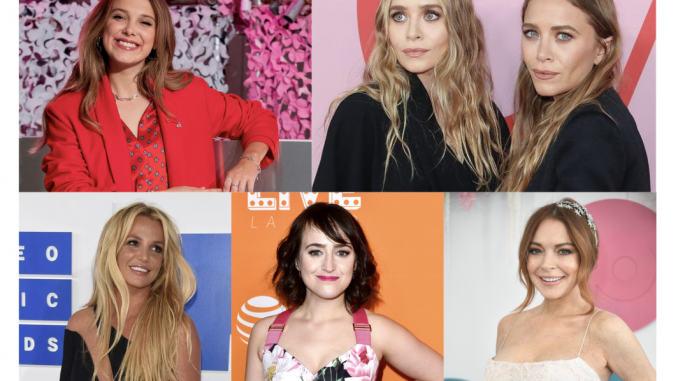
Millie Bobby Brown is one of the many victims of this “18th birthday countdown” trend from misogynistic individuals. Here are some of the many women who openly share their experiences and taking a stand into changing the narrative with online abuse and misogynistic behaviour:
- Mary-Kate and Ashley Olsen or the “Olsen Twins” have experienced many inappropriate remarks when they were about to turn 18 as they were no longer the child stars people knew from the TV show Full House (Briggs, 2022). Predators celebrated them finally being “legal” by editing their photos to make it appear more “sexually appealing.”
- Britney Spears shares stories about her early years as a singer and performer, and vividly recalls people sexualizing her through her outfits. She told a reporter that she was tricked into showing more skin in her famous Rolling Stone cover (Gray, 2021) with people on the set telling her to pull her clothes down and open a few more buttons while holding a stuffed toy. She remembers being uncomfortable but only realized the implication of that as she grew older (Gray, 2021).
- Mara Wilson played her famous lead role in Matilda when she was young and was not exempt from the attacks of predators. She remembers being featured on explicit websites, being edited onto erotic photos and videos, as well as receiving strange letters from grown men (Briggs, 2022). Experiencing this at such an early age could not have been easy and was not deserved.
- Lindsay Lohan is an actress who had done many roles since she was a child. Gossip outlets such as TMZ were ahead of her 18th birthday and making inappropriate remarks and cheers while poking fun at her magazine covers on aired episodes (Adegoke, 2019).
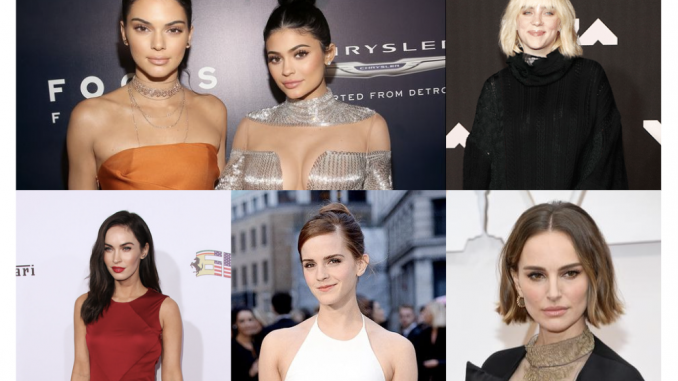
- Kendall & Kylie Jenner belong to the famous Kardashian-Jenner family and their reality show Keeping up with the Kardashians/ The Kardashians (2022). Reports about the musician Machine Gun Kelly saying that he would not even wait until Kendall Jenner was 18 were perceived by audiences as inappropriate and dangerous (Briggs, 2022). It gets worse as it is also rumored that companies made $1.8M to star in an adult video (Adegoke, 2019). Her sister, Kylie Jenner was also a victim of the glorification of turning legal as she was also said to have been offered money ($10M) to make an adult video.
- Billie Eillish is a successful singer after her SoundCloud hit Ocean Eyes skyrocketed her career and is also known for her excessively baggy ensembles. She does this to protect her from people who sexualize young girls and for them to focus on her music (Gray, 2021). Since last year, she has started to explore her style and many online predators had a lot to say that weas not only ignorant in tone but degraded the singer for suddenly changing the way she dresses (Ilsley, 2020). Billie Eillish shares her dismay to interviewers with whatever she does, saying that “I can’t win” (Ilsley, 2020).
- Megan Fox is another beautiful actress that has been a victim of sexualization since she was 15 years old (Gray, 2021). She has had a reputation for being difficult to work with, but later revealed that it was because of her experiences (Gray, 2021). At a young age, she could not do explicit scenes, but the people involved in that project found a loophole, and made her dance underneath a waterfall (Gray, 2021). The act itself was normal, but the intent of it was to sexualize her because her figure was fully seen once she was drenched. Megan Fox is also an online predator favorite as she has many sexualized content on Reddit, and possibly other forums and sites as well (Gray, 2021).
- Emma Watson is most known for her role as Hermione Granger in the Harry Potter movies. On the night she turned 18, photographers were swarming her and taking pictures up her skirt (Briggs, 2021). The event that was disappointing, to say the least, Watson spoke out and helped made this phenomenon illegal (Briggs, 2022). Watson is now a UN Women Goodwill Ambassador and has a helpline called #MeToo to help sexually assaulted women.
- Natalie Portman has done several well-known films, but the specific film that started her awareness of sexual abuse is Léon: The Professional where she received a “fan mail” that narrates a fantasy story about rape (Ilsley, 2020). She openly talks about the injustices of women and was a part of the 2018 Women’s March (Ilsley, 2020). She was also a victim of the 18th birthday countdown, but with her, it was a time when social media was not as big as it is now, so it was done and talked about on radio stations (Adegoke, 2019)
Was reading that overwhelmingly shocking and disappointing? The “Lolita Complex” (Gray, 2021) is a huge problem that is being extended online. Systems, platforms, and governments are struggling to handle this problem (Barker & Jurasz, 2019). All language and behavior presented online, that does not evoke equality, and infer harm and abuse should not be tolerated (Grant et al., 2021). It is fortunate that celebrities make use of their platforms to spread awareness and help with online hate, but is that enough? People should not tolerate abuse from anyone, and “weaponise” (Grant et al., 2021) technology and social media in an improper manner such as by demeaning women. Over the years, the media has been active in talking about issues such as these. The conversation has started, but who is making the moves for actual change?
What is being done to resolve this?
There are many limitations as to what is considered a crime, and how it should be addressed (Lloyd, 2018). Given the wide scope of the internet and the social media platforms it holds, it is important to understand how challenging it is to implement policies. The challenge is within the cases where online users are being sarcastic, playful, and do not intend any harm (Murtagh, 2017), but there is a fine line between innocent fun and trolling (Poland, 2016). People are good at justifying abuse online or making excuses because of the need for dominance, and the power that some people hold (Poland, 2016). Additionally, many of these online predators remain anonymous which is not only intimidating for their victims but is a good tactic to not be detected (Poland, 2016). These anonymous predators even use “stalkerware” (spyware) to monitor and control their victims (Grant et al., 2021). People tend to use humor to cover misogyny and racism online (Matamoros-Fernandez, 2017).
This has been brough up to several governing bodies including platform developers to implement safer policies for not only women, but to everyone online. Facebook has implemented stricter policies with their age restrictions to avoid the creation of several accounts including accounts for babies, that are against the platform’s policies (Doherty, 2020). The same goes for Tiktok and Youtube with their verification processes and to avoid parents taking advantage and monetising their children’s videos for profit (Doherty, 2020). Governments in several countries also implemented laws on cyberbullying, online harassment and so on. It is a good thing to note that people’s efforts to speak up and raise awareness on the issue are not overlooked, but it still needs work.
Conclusion
Governing social media platforms remains to be a challenge and a conversation for the ones who can implement policies that could change the situation. Protecting women from online abuse and sexualization is not just an issue that needs resolving online, but offline as well. We should protect and nurture young individuals instead of sexualizing them (Hanna, 2021). Where have our morals gone? Genuine concern and action should be taken for us to have a safer space online.
References
Adegoke, Y. (2019, June 8). Counting down to female celebrities “turning legal” is more than crass. It’s dangerous. Medium. https://medium.com/@yomiadegoke/counting-down-to-female-celebrities-turning-legal-is-more-than-crass-its-dangerous-94f8abbf4674
Amy Murtagh. (2017). Fighting the trolls and online violence against women. Socialist Lawyer, 76, 4–4. https://doi.org/10.13169/socialistlawyer.76.0004
Barker, K., & Jurasz, O. (2019). ONLINE MISOGYNY: A CHALLENGE FOR DIGITAL FEMINISM? Journal of International Affairs, 72(2), 95–114. https://www.jstor.org/stable/26760834
Biggs, J. (2022, February 22). Millie Bobby Brown fans have called out “creepy” forums that counted down to her 18th birthday. Cosmopolitan UK. https://www.cosmopolitan.com/uk/reports/a39172263/millie-bobby-brown-18-birthday-reddit-countdown/
Doherty, A. (2020, June 12). A Reflection on the Sexualisation of Young Girls in Hollywood- CCB101. Medium. https://medium.com/@alvydoherty/a-reflection-on-the-sexualisation-of-young-girls-in-hollywood-ccb101-22659ec93ea
Flew, T. (Ed.). (2021). Issues of Concern [E-book]. In Regulating Platforms (pp. 76–79).
Grant, J. I., Dunn-Baleilevuka, A., & Australian Strategic Policy Institute. (2021). Time for the tech industry to step up for women: Greater global collaboration to minimise online harms. In THE SYDNEY DIALOGUE: PLAYBOOK (p. page 27-page 28). Australian Strategic Policy Institute. http://www.jstor.org/stable/resrep38773.11
Gray, D. (2021, November 23). Britney Spears, Megan Fox, & More Celebs Who Spoke Out About Being Sexualized at a Young Age. Sheknows. https://www.sheknows.com/entertainment/slideshow/2509093/celebrities-sexualized-young/
Hanna, S. (2021, April 24). We Need To Talk About Celebrity 18th Birthday Countdown Clocks. Evie Magazine. https://www.eviemagazine.com/post/we-need-to-talk-about-celebrity-18th-birthday-countdown-clocks
Ilsley, A. (2020, May 25). Hollywood’s “Lolita complex” still a problematic issue for young, female stars. Theaagie.Org. https://theaggie.org/2020/05/25/hollywoods-lolita-complex-still-a-problematic-issue-for-young-female-stars/
Lloyd, A. (2018). Reinterpreting social harm. In The harms of work: An ultra-realist account of the service economy (1st ed., pp. 13–32). Bristol University Press. https://doi.org/10.2307/j.ctv75d8n8.7
Matatoros-Fernandez, A. (2017). Platformed racism: the mediation and circulation of an Australian race-based controversy on Twitter, Facebook and YouTube, Information, Communication & Society 20(6), pp. 930-946.
Poland, B. (2016). THE MANY FACES OF CYBERSEXISM: Why Misogyny Flourishes Online. In Haters: Harassment, Abuse, and Violence Online (pp. 1–34). University of Nebraska Press. https://doi.org/10.2307/j.ctt1fq9wdp.3
Refinery29. (2018, January 27). Is It Really Okay To Talk About The Love Life Of A Famous 13-Year-Old? https://www.refinery29.com/en-us/2018/01/189107/media-sexualization-young-girls-millie-bobby-brown-backlash