
Introduction
With the rapid development of the internet, there was an inseparable relationship between people’s daily lives and networks in the digital age. An increasing number of people were attracted by the convenient and quick features of the internet. Many companies and services relied on the internet to increase the user base and expand the market. However, the informality and anonymity of the internet leaded to an inescapable phenomenon – online hate speech. Because of the internet’s speed and reach, governments find it difficult to enforce national legislation in the virtual world (Gagliardone et al., 2015). Therefore, people enjoyed their right to freedom of speech in the virtual world and suffered from the negative influence of online hate speech at the same time.
This blog will analyse the causes of online hate speech and demonstrate the negative influences that online hate speech causes by exemplifying online hate speech cases. This blog was based on the reason of political beliefs-racist online hate speech to discuss its influences. In general, people subjected to online hate speech cite their political beliefs, religion, and gender as the top three reasons for their harassment (commissioner, 2022). Moreover, I will mention those effective solutions for preventing online hate speech in the social media platforms, such as Instagram. The problem of online hate speech was a serious impediment to maintaining the social safety net. The negative effects of the problem of online hate speech were severe and long-lasting, which cannot be ignored at present.
The causes of online hate speech
The causes of online hate speech can be summarized from two different perspectives: social causes and individual causes.
Social causes of online hate speech
In terms of the social causes of online hate speech, the negative control of public social opinion and social stresses can be the main reasons for online hate speech. On the one hand, people can be misled by social media’s biased comments or reports. Some social media influencers with a colossal number of followers could post biased posts to attract people’s attention, which might misguide their followers and increase the possibility of online hate speech. Specifically, along with the rapid development of digital media industries, people tend to rely on social media platforms to gain information and knowledge to a great extent. Therefore, this phenomenon meant that the social media platforms had enough power to guide the direction of public social opinion. On the other hand, people were suffering from the exacerbating social stresses and tensions in this information age with high-speed development. The internet offered a common area for them to vent their emotions to a great extent. More specifically, the high speed of the internet was a double-edged sword for the development of society. Although the existence of the internet can provide convenience for people’s daily lives, it can let people have chances to get large amounts of pieces of information that did not have any screening and examinations in the short term. Those pieces of information included some biased news, racist opinions, or data that can be used as indicators of apparent social success, such as friends, likes, shares, followers, and so on (Harrison & Lucassen, 2019). Because of the widening gap between reality and what people post on social media, people mostly only see an excessively edited ‘highlight reel’ of other people’s lives (Harrison & Lucassen, 2019). People can be misled by those pieces of information with “enhancement filters,” which might increase the likelihood of making negative social comparisons (Harrison & Lucassen, 2019). It can cause people to have problems of mental imbalance and psychological distortions to some extent. Therefore, people treated social media platforms as their battlefields to vent their displeasure and wage an online war with other people by using negative words.
Individual causes of online hate speech
In the aspects of individual causes of online hate speech, the anonymity and low responsibility of the internet were two important reasons for people to post hate speech on social media platforms. Most social media platforms allow their users to use nicknames to participate in various online social activities, such as Instagram, YouTube, TikTok and so forth. It meant that people could enjoy a high degree of freedom of speech and post any comments without taking the risk of recognition by someone familiar. Although the anonymity of social media platforms can let people do the real themselves without the restrictions from outside pressure, it also provides chances for haters to use online platforms to attack other people and do not take any responsibility. Furthermore, people’s group psychology also was a reason for increasing cases of online hate speech. When a group of people tended to post biased comments on social media platforms, there would be an increasing number of people who lost their objective opinions joining this group in order to follow the herd. Based on group psychology, the majority of people do not want to be a special one in a crowd; they prefer to go with the stream on most occasions. Meanwhile, people liked to trust a view that most people agreed with, whether it was right or not. Therefore, people’s group psychology can exacerbate the severity of online hate speech to a great extent.
The negative influences of online hate speech on the Instagram
There was an example from Instagram that can show the negative influence of online hate speech.
Facts:
According to CNN Style, Dolce & Gabbana, a famous Italian fashion house, published a series of contentious commercial videos in 2018 depicting a Chinese model straining to eat pizza, cannoli, and spaghetti with chopsticks (Hills, 2021). The HW reported that Dolce & Gabbana (D&G) was in hot water following the enormous failure of their Chinese advertising campaign, which drew strong criticism for being racist. The backlash intensified as designer and co-founder Stefano Gabbana allegedly made disparaging remarks about Chinese culture in a series of Instagram private messages defending the campaign. The ensuing controversy prompted many to call for a boycott of the brand (FANG & THAM, 2018).

Photo: website/ CNN
Specifically, Stefano Gabbana used offensive and negative words in the conversation with @michealatranova on the chatting platform of Instagram, a type of online hate speech with racism attacking. After that, his offensive messages were exposed by @michealatranova. The picture shown below was the screenshot from @michealatranova’s post on Instagram.
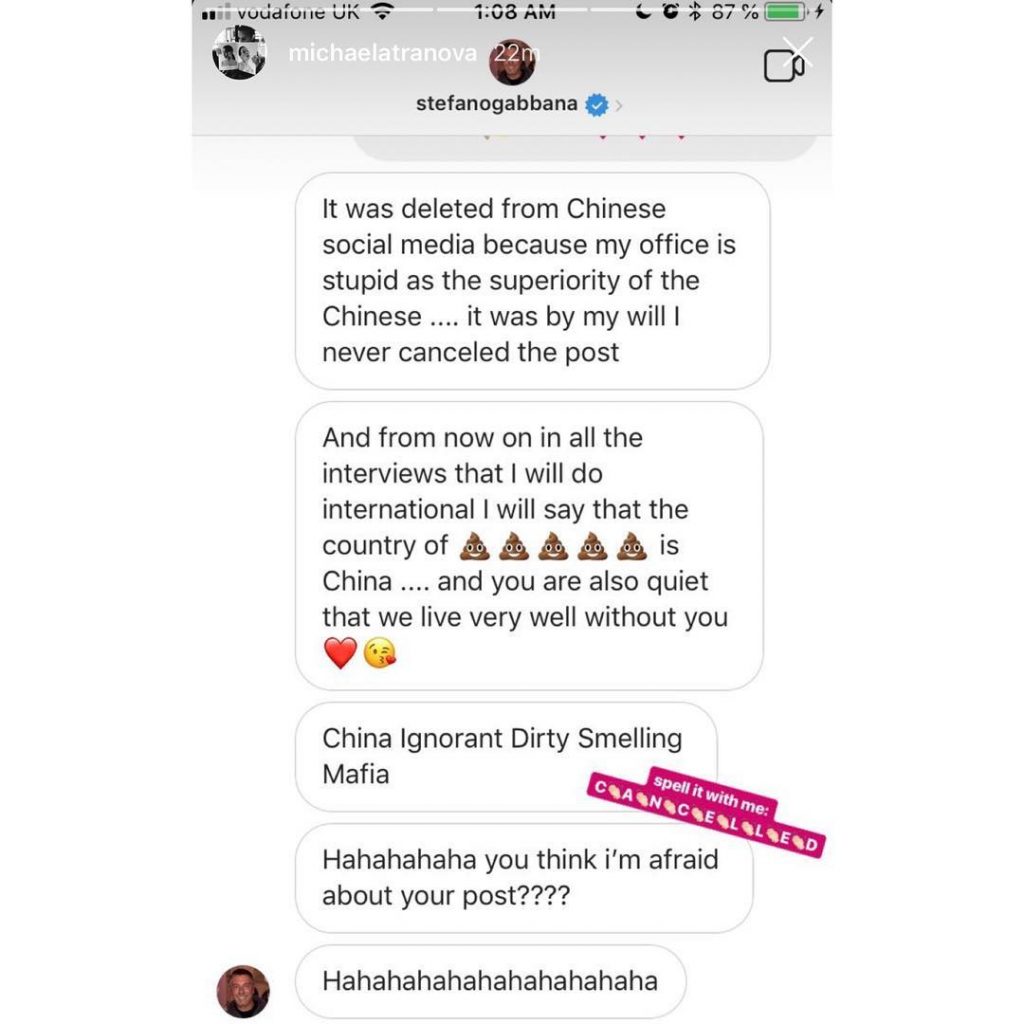
Photo: Website/ Herworld.com
The exposure of Stefano Gabbana’s racism online hate speech led to an increasing number of online hate speech posts by other social media users. Instagram’s comment area became a battlefield without smoke for people who stood by different positions. Some people who were supporters of Stefano Gabbana also posted offensive speeches toward China in order to stick up for Stefano Gabbana. People who wanted to protect their country were provoked by racism online hate speech also used negative words to strike back. Moreover, some online haters without any positions used this hot topic to post online hate speech to vent their negative emotions randomly.
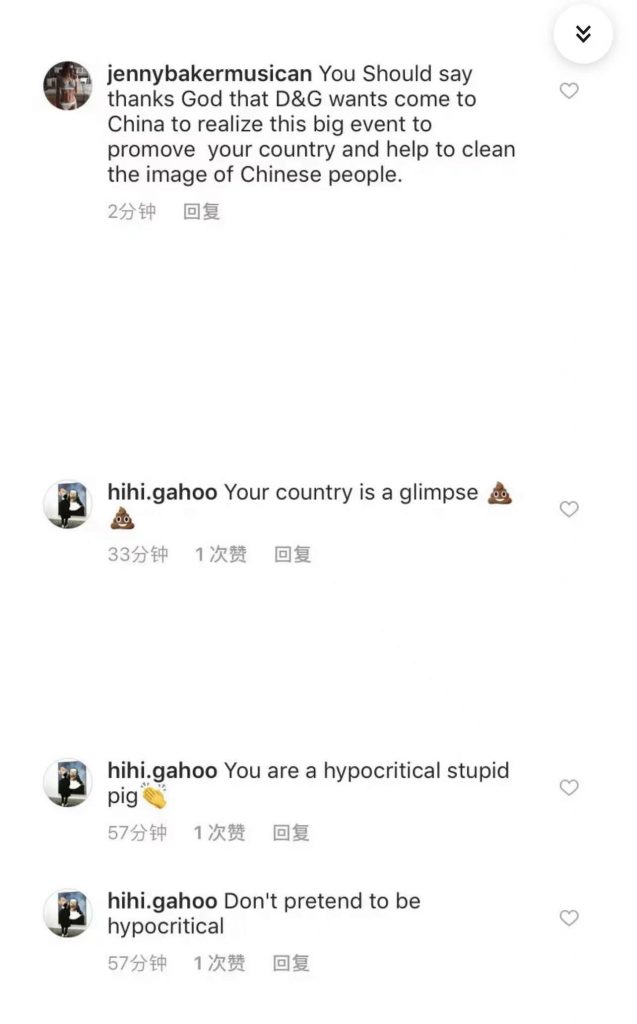
Photo: Zhihu/ source from Instagram
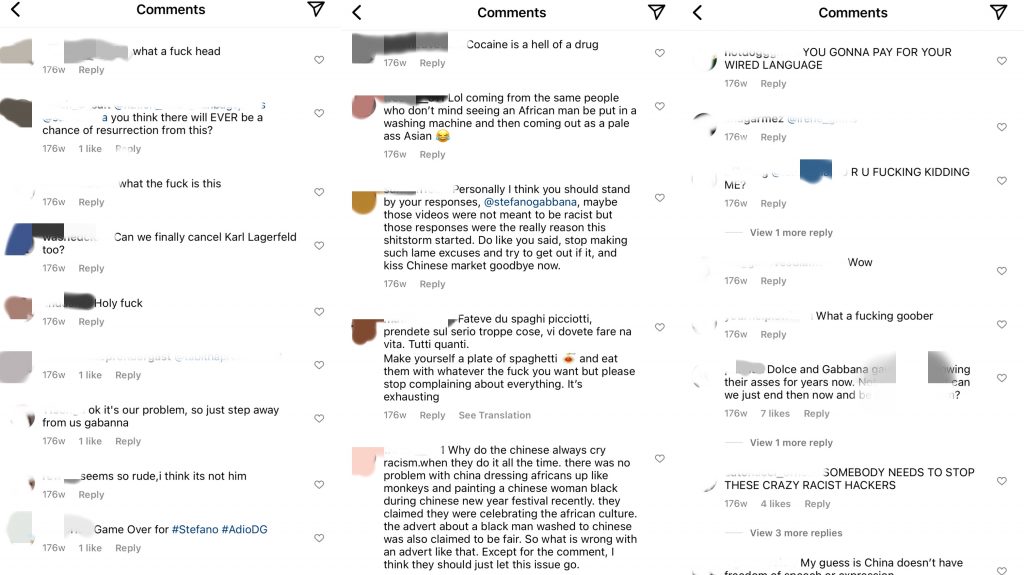
Photo: Instagram/ diet_prada
The influences of Stefano Gabbana’s online hate speech
In addition to the economic and reputational loss of its brand Stefano Gabbana’s online hate speech had negative influences on the aspects of the network environment, international relations, and social environment. Firstly, as a public figure with enormous influential power in the social media platform and society, Stefano Gabbana’s racism online hate speech led to a negative circle of online comments directly. It negatively influenced the network environment. To be specific, his offensive speech led to an online war between people with different positions. Based on the social and individual causes of online hate speech, people can be fanned by Stefano Gabbana’s hate speech and attack other people from a racist perspective. As a result, many who were upset by the racist remarks chose to respond by spewing hate speech on social media platforms. This behaviour resulted in the creation of an indirect “doom loop,” which was detrimental to the network environment. Secondly, Stefano Gabbana’s offensive speech toward China indirectly harmed international relations. Stefano Gabbana, the designer and co-founder of Dolce & Gabbana, represented this brand’s image. Meanwhile, Dolce & Gabbana was a famous Italian brand. Despite the fact that his hate speech did not represent the attitude of his country, it did have an indirect detrimental impact on how Italians were seen by Chinese people to a certain level. After exposing his online hate speech, many Chinese people refused to purchase in their stores. Thirdly, the case of Stefano Gabbana can lead to the problem of social security. There was a close relationship between social media influences and the social environment. According to Naganna Chetty and Sreejith Alathur, social networks are essential sources of information on racism. Learning, confronting, and addressing issues related to racism can all take place in the context of social networks (Chetty & Alathur, 2018). Social networks provide a forum for students to examine their own identities and the various methods of building and consuming networks that possess and shape society’s behaviour and race, among other topics of discussion (Chetty & Alathur, 2018). It indicated that people’s points of view can be affected by social media, including their perspectives on the problem of racism. Therefore, Stefano Gabbana’s racist hate speech might misguide people who did not have the right social values yet. An increasing number of people who do not have the right value for racism might cause social problems.
Solutions for preventing online hate speech
Nowadays, the proliferation of hate speech online and its amplification via digital platforms and social media have been noted as serious and developing concerns (Flew, 2021). In order to help users to protect themselves from online hate speech, many social media platforms began to discover more related tools for creating a healthy social platform.
Instagram’s solution
According to Instagram, they recently launched a new feature that enables users to manage many unpleasant comments in masse – either by bulk deleting them or bulk blocking the accounts that submitted them. Moreover, they also utilized artificial intelligence to warn users when they were about to submit anything potentially harmful (Instagram, 2021).
Twitter’s solution
According to Popular Science, the Twitter has launched a tool that alerts users before they tweet something that could be dangerous or disrespectful to other people (Hu, 2021).
The free speech vs the hate speech
Undoubtedly, online hate speech was harmful to society. However, the rationality for completely eliminating online hate speech was questionable. To be specific, the existence of online hate speech also indicated that people have rights for freedom speech. According to Terry Flew, “Article 19 of the UN International Covenant on Civil and Political Rights observes: 1. Everyone shall have the right to hold opinion without interference. 2. Everyone shall have the right to freedom of expression; this right shall include freedom to seek…ideas of all kinds…or through any other media of his choice (Flew, 2021). ” It indicated that people had the right to post any type of comments on social media, whether hate speech or not. In other words, it was contradictory to social media platforms’ policies toward hate speech. Therefore, social media platforms need to find a proper way to balance people’s right to freedom of speech and reduce the problem of hate speech.
Conclusion
After the analysis of Dolce& Gabbana’s online hate speech case on Instagram, the influences of online hate speech can be summarized into three perspectives: social issue, network environment, and racial relations, which were long-lasting and harmful. Most social media platforms were developing new features to prevent the issues of online hate speech, such as Instagram’s AI and Twitter’s alert tool. However, the contradiction between the right to freedom of speech and the issue of online hate speech was still existed and cannot be ignored. The government and social media platforms need to find a proper way to balance the need for freedom of speech and issues of online hate speech.
Reference:
Chetty, N., & Alathur, S. (2018). Hate speech review in the context of online social networks. Aggression and Violent Behavior, 40, 108–118. https://doi.org/10.1016/j.avb.2018.05.003
Commissioner, E. (n.d.). Hate speech report – esafety commissioner. Retrieved April 6, 2022, from https://www.esafety.gov.au/sites/default/files/2020-01/Hate%20speech-Report.pdf
FANG, J. O. Y., & THAM, S. E. A. N. (2018, November 22). It’s called The “chopstick” scandal and here’s what you need to know about the saga. Her World Singapore. Retrieved April 8, 2022, from https://www.herworld.com/fashion/dolce-gabbana-chopstick-scandal/
Flew, T. (2021). Regulating platforms. Polity Press.
Gagliardone, I., Gal, D., Alves, T., & Martínez, G. (2015). Countering online hate speech. United Nations Educational, Scientific, and Cultural Organization.
Harrison, G., & Lucassen, M. (2019, March 1). Stress and anxiety in the digital age: The dark side of technology. Retrieved April 7, 2022, from https://www.open.edu/openlearn/health-sports-psychology/mental-health/managing-stress-and-anxiety-the-digital-age-the-dark-side-technology
Hills, M. C. (2021, June 17). Three years after ad controversy, D&G is still struggling to win back China. CNN. Retrieved April 8, 2022, from https://edition.cnn.com/style/article/dolce-gabbana-karen-mok-china/index.html
Hu, C. (2021, November 22). Polite warnings are surprisingly good at reducing hate speech on social media. Popular Science. Retrieved April 8, 2022, from https://www.popsci.com/technology/nyu-researches-hate-speech-warnings-twitter/
Instagram. (n.d.). Tackling abuse and hate speech on Instagram: Instagram blog. Tackling Abuse and Hate Speech on Instagram | Instagram Blog. Retrieved April 8, 2022, from https://about.instagram.com/blog/announcements/an-update-on-our-work-to-tackle-abuse-on-instagram