Internet Era
Since the birth of the Internet era, people have begun to contact and use social media in various ways. They obtain information, express their views, and pursue hot events on different social platforms. With the emergence and popularity of mobile devices, people can access social media at anytime, anywhere, and under any circumstances.
According to the Digital 2020 reports from We Are Social and Hootsuite, more than 4.5 billion people will be using the Internet by 2020, and social media users will have surpassed 3.8 billion. In addition, the average person worldwide spends 6 hours and 43 minutes on the Internet (Kemp, 2020). This indicates that people spend about 30% of their day online, close to the time they should be sleeping. At the same time, the proportion of time spent on chat apps and social networking apps is also the highest (Kemp, 2020).
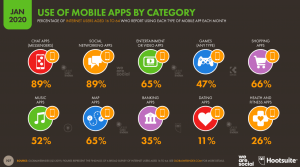
Fig1, Use of Mobile APPs by Category, Digital 2020 reports, 2020
There is no doubt that social media gives people more access to information and creates more opportunities to communicate with others and express their opinions. However, it also brings massive adverse effects. For example, they are being guided by wrong information, personal privacy disclosure, online harassment, etc. According to a study of 2251 respondents in 2021 who have personally experienced online harassment, up to 41% of users have experienced varying degrees of online harassment, including offensive name-calling, purposeful embarrassment, any form of severe harassment, physical threats. sexual harassment, stalking, and sustained harassment (Johnson, 2022).
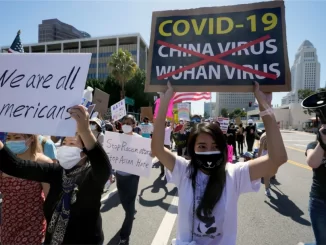
People are keen to discuss a hot event on social media, but there has never been a fair debate placed on social platforms. In the end, events often evolve into mutual abuse by people from different positions. People insult the other person’s age, gender, race, education, wealth level, and other characteristics, which is precisely caused by people’s deep-seated discrimination against others. This blog will analyze a recent famous case of racial discrimination – Trump was defined “COVID-19” as a “Chinese Virus”. When Trump’s remarks sparked a wave of online violence against Asians, it was only the beginning. Analysis of online aggression and its subsequent fermentation are examined in this study.
Online violence against Trump
On March 17th, 2020, Donald J. Trump, who was still the president of the United States at the time, posted a tweet on his personal account, claiming that “COVID-19” as a “Chinese Virus”. The tweet came in the early months of covid19, when the majority of people were unaware of the disease and the U.S. president made racially aggressive leading comments that exacerbated Asian prejudice. This daring declaration first attracted the anger of China’s Chinese population.
Not only has Trump’s remark enraged the majority of Chinese, but it has also united part of the anti-Trump camp. We will not discuss whether these online harassments, taunts, and intimidating statements have impacted the life of the originator of the statement —Trump. However, China, Chinese, ethnic Chinese, and even those who speak out for China, who were victimized by this comment, have indeed felt extremely severe online harassment.
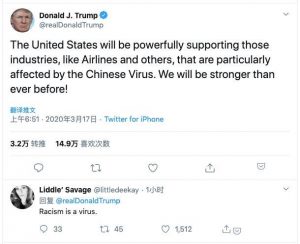
Fig 2, Screenshot of Trump’s tweet
Online harassment against China
While the tweet generated a lot of discussions, two related hashtags: #covid19 and #Chinesevirus, hit the trending list. About one-fifth of the #Covid19 hashtag was anti-Asian, while half of the #chinesevirus hashtag was anti-Asian. In the week beginning March 9th in 2020, when Trump hadn’t posted the tweet, the #covid19 hashtag was more popular than #chinesevirus (Hswen et al., 2021). People will even look for Chinese from among the posters and directly attack their Twitter accounts.
On the other hand, when uninformed people are wrongly guided to use the “Chinese virus” hashtag, the platform’s algorithm will default those users who are interested in this topic and begin to recommend more relevant content to users. These topics are full of many extreme and racial discrimination theories, so many nonracial discriminators are forced to get involved in this struggle, argue, or even abuse others, which may increase the probability of hate crime.
Today, two years later, many people are still using the #Chinesevirus to replace the #Covid19. Even though the Internet gives people more opportunities to know and communicate with people in another country or region, the discrimination and prejudice buried in people’s hearts have never disappeared.
Reasons for Online harassment
Along with the racist attitude, such leading comments are motivated by fear. When confronted with an unknown pathogen, early apportionment of responsibility to a particular nation, such as China, might successfully divert the seeds of enmity. Epidemics of infectious diseases provide an excellent chance to magnify the type of tension and prejudice that generates long-standing xenophobia. They appear to be rejecting the terrible virus but are using it to incite some hatred toward them(Shah, 2020).
Frequently, people’s overwhelming feelings and urges toward something cannot be vented directly to that item, necessitating the use of another carrier. In this case, the main body of the epidemic is the virus, which has caused trouble in people’s lives. Still, people’s strong emotions cannot be directly vented to the virus. The virus does not have anger, inferiority, and other emotions, will not refute, and cannot accept people’s criticism as an equivalent group. Therefore, Trump’s remarks find a scapegoat for people’s emotions and define the virus as a Chinese virus, let most people’s emotions have the object to vent – the Chinese, so as to achieve the political purpose of camp reunification.
The Internet has created opportunities for us to communicate with more people, which has led to the rapid development of antagonism and hate speech. Because in daily real life, scapegoats are often distant; that is, people like to find some people who are far away as scapegoats because the resistance of people around them will be more intense and obvious. Imagine that before the emergence of the Internet, people’s information exchange lagged. Even if people in one region had antagonistic feelings towards another group, it was difficult to spread and develop rapidly. It was also difficult to generate fierce debate because of the distance.
On social platforms, people cannot avoid such situations, but they can avoid the development speed and control the scale to prevent the influence on the neutral camp and hate crimes, which requires public figures always to review the neutrality of their statements to avoid misguiding the people. At the same time, social platforms also need to make corresponding countermeasures.
What should social platforms do?
Social platforms should also take corresponding responsibilities as the main carrier of people’s online communication, rather than blindly allowing the disorderly development of events and topics. Based on ensuring that they do not infringe on the dignity of another group, ensuring people’s right to freedom of speech is what every social platform should do. If those popular social platforms with massive users turn a blind eye to such events, it will lead to worse consequences.
As one of the most popular social platforms, Twitter permanently closed Donald Trump’s private account on January 8th, 2021, on the grounds that its tweets risked further incitement to violence(Fung, 2021).
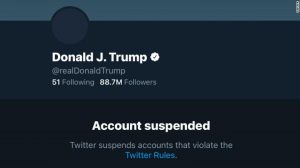
Fig 3, Trump’s Account suspended, 2021
The Twitter team investigated Trump’s two tweets on January 8th, 2021. Those who feared that Trump would label violent individuals as patriots and that his remarks about his decision not to attend Joe Biden’s inauguration ceremony would lead people to make incorrect decisions and behave in a violent manner, further intensifying the contradictions between people from opposing camps and leading to even more violence (Twitter, 2021).
In this incident, Trump called his supporters patriots. Naturally, the people in his opposite camp became traitors. He convinced his supporters that all their actions were to make the United States great again, regardless of the possible violence. Those were the same provocative words that Trump made when he called covid-19 as the Chinese virus, which sparked a firestorm of disagreements and hostility between the two sides.
According to the policy proposed by Twitter(2019), the Glorification of violence policy is interpreted as:
Glorifying violent acts could inspire others to take part in similar acts of violence. Additionally, glorifying violent events where people were targeted on the basis of their protected characteristics (including: race, ethnicity, national origin, sexual orientation, gender, gender identity, religious affiliation, age, disability, or serious disease) could incite or lead to further violence motivated by hatred and intolerance.
According to the above provisions, Twitter permanently banned Donald Trump’s account, which is the social platform’s effort to prevent online violence from turning into a real crime, and it is also their responsibility. It also confirms that the Twitter team is capable and willing to block Trump’s account. And when it comes to discrimination against the Chinese, Twitter did not do anything to show a warning against Trump’s inappropriate comments.
Twitter (n.d) has additionally drafted corresponding regulations for Hateful conduct, which are read as follows:
You may not promote violence against or directly attack or threaten other people on the basis of race, ethnicity, national origin, caste, sexual orientation, gender, gender identity, religious affiliation, age, disability, or serious disease. We also do not allow accounts whose primary purpose is inciting harm towards others on the basis of these categories.
Donald Trump’s tweet on the Chinese virus mentioned above is obviously hateful conduct against the Chinese people. Even if he did not specifically reference threats or violent tactics in his tweet, the message was clear. Referring to the background of the incident, people have a strong negative feeling about the impact of the virus on their lives. At this time, his speech on the Chinese virus was undoubtedly a hate speech, linking the Chinese people to the virus; it also directly led to the subsequent occurrence of many violent crimes against Asians.
But at this time, the Twitter team did not control the incident but classified it into the category of freedom of speech and allowed it to develop, which is undoubtedly a lack of responsibility. These hot spots breed violent tendencies and lead those who have violent tendencies to commit crimes. As a social platform, we should consider the long-term impact of each topic rather than blindly pursuing political correctness. The Twitter team’s different approach to two similar events for Trump similarly reflects its differentiation between US-based and foreign issues. I don’t think the official terms would reflect the exact opposite approach of the platform in different contexts for a different group of people.
Discussion
To summarize, we cannot entirely outlaw harassment speech, online violence, and other activities on social media; yet, as a platform party, they have the ability to manage and restrict these subjects. The contractual terms of the platform do not just restrict the user’s behavior but also govern the platform’s response to violations. As long as the platform has the capacity to ban an account immediately, it should also have the authority to issue a warning to the user beforehand. Individuals have more options to obtain fresh information and contact people on the other side of the planet due to social media platforms. Social media platforms must explore how to guarantee that their users are not misled by false information and that this does not result in poorer outcomes. For example, increasing the training of reviewers is a good idea. The majority of harassment speech, internet violence, and harassment are only discovered after a human screening process. The question of how to lessen the subjective judgment of reviewers while increasing their impartiality is a critical topic for social media sites.
Reference
Fung, B. (2021). Twitter bans President Trump permanently. CNN. Retrieved from https://edition.cnn.com/2021/01/08/tech/trump-twitter-ban/index.html.
Hswen, Y., Xu, X., Hing, A., Hawkins, J., Brownstein, J., & Gee, G. (2021). Association of “#covid19” Versus “#chinesevirus” With Anti-Asian Sentiments on Twitter: March 9–23, 2020. American Journal Of Public Health, 111(5), 956-964. https://doi.org/10.2105/ajph.2021.306154
Johnson, J. (2022). U.S. internet users who have experienced online harassment 2021 | Statista. Statista. Retrieved from https://www.statista.com/statistics/333942/us-internet-online-harassment-severity/#statisticContainer.
Kemp, S. (2020). Digital trends 2020: Every single stat you need to know about the Internet. TNW | Growth-Quarters. Retrieved from https://thenextweb.com/news/digital-trends-2020-every-single-stat-you-need-to-know-about-the-internet.
Shah, S. (2020). The Pandemic of Xenophobia and Scapegoating. Time. Retrieved from https://time.com/5776279/pandemic-xenophobia-scapegoating/.
Twitter. (2019). Our policy on Glorification of violence | Twitter Help. Help.twitter.com. Retrieved from https://help.twitter.com/en/rules-and-policies/glorification-of-violence.
Twitter. (2021). Permanent suspension of @realDonaldTrump. Blog.twitter.com. Retrieved from https://blog.twitter.com/en_us/topics/company/2020/suspension.
Twitter. Twitter’s policy on hateful conduct | Twitter Help. Help.twitter.com. Retrieved from https://help.twitter.com/en/rules-and-policies/hateful-conduct-policy.