
Online harassment on social media
Introduction
The Internet was initially designed to make the dissemination of information more accessible, but it has also become a way for malicious groups to harm people. The phenomenon of online harassment has emerged with the growth of the Internet, with victims ranging from teenagers to adults. It encompasses different forms of bullying, such as using the internet to harass, intimidate, abuse, incite, humiliate, threaten and stalk. These destructive acts are maliciously used to target different races, genders, ages, nationalities, religions, sexual orientations, social or economic statuses, etc. (Flew, 2021). Any act of feeling violated, dangerous and unsafe on the internet can be considered a form of cyber harassment. Due to the high speed of communication on the Internet, these online harassments are quickly spread around, which causes severe psychological damage to the victim and affect society and, even worse, the economy (Wang & Affoum, 2021). Because of the freedom available on the Internet, which gives everyone the right to express themselves freely, online harassment cannot be eliminated in its entirety but instead offers opportunities. Therefore, the governance of such issues by various platforms is crucial. Whether they addressed and controlled the platform immediately determines the extent of the harm done to the victim.
This blog will use a range of data to give the audience a more visual understanding of the threat posed by cyberbullying and the factors that contribute to it. Here I will focus on case studies around Instagram and Weibo in China, how the platforms have indirectly helped create a serious problem of online harassment, and critically analyse the management of the platforms. Another thing to think about is whether we are over-emphasising freedom of expression.
How severe is online harassment
(source: Djuraskovic, 2019 https://firstsiteguide.com/cyberbullying-stats/)
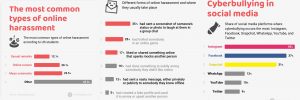
A survey conducted by the Pew Research Centre found that 41% of Americans have experienced online harassment (Vogels, 2021). Another survey showed that 45.3% of American students were attacked (Djuraskovic, 2019), mainly by using offensive threats and sending lewd photos without permission. The second-largest proportion was through the posting of comments. Attacks with words and language are like an invisible knife that can sometimes cause more severe damage. Through the statistics for 2019, bullying was targeted at women, with only about 6% of boys experiencing online bullying (Djuraskovic, 2019). We can see that women are still somehow on the vulnerable side of society, whether offline or online. We, therefore, need to think about the appropriate protection for young people and women in the Internet world. Teenager victim accounts for 43% (Djuraskovic, 2019). They are very active in social media and rely on Instagram and Facebook to keep in touch with friends and family.
Furthermore, according to data, up to 72% of Instagram users are teenagers. Instagram is also the most problematic platform for bullying with 42%, followed by Facebook with 37% (Djuraskovic, 2019). Bullies like to be active on social media because it is a rich source of information, and they can easily find targets to become “keyboard warriors”. It is essential to reflect on why these bullies like to target social media and whether it is because social media is not sufficiently regulated. 83% of young people have voiced their desire for more measures to address bullying on social media to major companies (Djuraskovic, 2019).
This is a case of a teenager who suffered bullying on Instagram. The 15-year-old girl, Yael, was attacked on Instagram day and night after an argument with her friend. The victim said, “Her friend blocked her and then refollowed her to send her harassing messages for days on end, posting messages about Yael on her account and mentioning Yael in her Instagram story with harmful images and words” (Lorenz, 2018). Yael felt very anxious because she could see the messages that tormented her every time she opened the app. She considered closing the account, but she did not want to cut off contact with her other friends. It is difficult for most people victimised online to not care about what people say about them. This does not make the bullies stop their inappropriate behaviour; they continue to humiliate you endlessly.
The emergence of these issues can be seen as a management problem for Instagram, as it provides a free platform for violators and a range of powerful and valuable features to oppress each other. Although the platform was created to create a friendly and helpful online community where people can safely and happily share their photos, videos and lives, the abuse of the platform seems to have become detached from the corporate culture (Lorenz, 2018). Instagram, for example, has a high-speed and massive distribution mechanism that allows offensive comments and images to be distributed at high speed within minutes. The broadcast of malicious messages cannot be stopped immediately in a short period. Although the platform has a reporting function, it takes time to remove the content, and by the time it is fully contained, irreversible damage has been done to the victim.
The fake account for harassment (source: Lorenz, 2018 https://www.theatlantic.com/technology/archive/2018/10/teens-face-relentless-bullying-instagram/572164/)
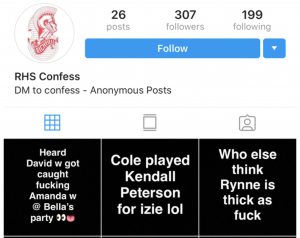
Another problem is that the anonymity of Instagram and the ability to set up a whole new profile without boundaries make it very difficult to find vandals. Teenagers take advantage of this by creating many separate accounts about hate to specifically and organically discredit a person. They will even recreate an account with many followers as a malicious hate page. The scary thing is that the platform doesn’t take action and delete the account until they check that it has constituted a substantially hurtful act, which is usually a lengthy process. According to research, one in ten fake Instagram accounts are flooding the platform, and the numbers are rising, with the majority serving online bullying. In response to this problem, companies are set up to find fake accounts. Cybertrace uses unique expertise to match the content posted on fake accounts with the writing styles of other potential counterfeit users who have a history of bad behaviour, allowing for faster and more accurate identification of missing bullies (Cybertrace, 2021). The existence of these companies shows Instagram’s lack of ability to address such issues. It is incumbent upon the platform to raise the threshold for creating and vetting accounts, thus filtering out users with bad intentions hidden behind them. Is it necessary to register with a real name when creating an account in the future? This does not mean that the right to anonymity is taken away; the registration of real names facilitates the platform administrators to review but not make public when necessary in the background, keeping the privacy between users.
Teenagers often do not understand how complex the platform is because their interactions on the platform are often hidden from their parents and teachers. As a result, Instagram has announced new features to counteract online bullying, filters to filter comments, algorithms to check photos for hurtful behaviour and camera effects that promote the use of kindness (Lorenz, 2018).
In addition, Australia released the Online Safety Act in July 2021. It has improved the efficiency of removing bullying content from 48 hours to 24 hours. The Act places a duty on the Commissioner to monitor and manage all acts of bullying and assist the Commonwealth in coordinating the online safety of Australians (Falor, 2022).

Another platform of the same type is in China – Weibo. Weibo Hot Search is a window to collect the most popular information today. It is supposed to be a function to spread news, social events and other valuable information. However, as the platform became more commercialised and accompanied by human manipulation and negligence on the part of regulators, Hot Search became a source of numerous problems. It became a gathering place for entertainment headlines and wrong facts and even a good place for online bullying. This is known as specific cultures of use (Matatoros-Fernandez, 2017), which could have played a significant role. But abusers used the platform’s features to hijack this infrastructure, resulting in a constant stream of online violence. Hot search allows all Weibo users to collectively follow the same message as they click on it, thus showing that it spreads unimaginably fast among users. When an online bully uses improper means to get negative news to the top of the hot search list, hundreds of millions of Chinese users view it at high speed, and the uncontrollable number of retweets and views makes some of the misguided and complicit in the online bullying, which spreads from Weibo to other social media outlets. The victim involved becomes the centre of public opinion, and the abuse fills all his social media accounts, causing great harm.
In 2022, a teenager subjected to online violence on Weibo committed suicide (James, 2022). The incident started when he posted a campaign on his Weibo page asking the media to help him find his family. Still, when he did, he was disappointed that his parents wanted to abandon him after reuniting with him and he asked them for a house, but they didn’t want to be responsible for him because they had a new family. The boy took to his Weibo account to explain this and said he just wanted a place to live. Through media coverage, the story made it to the top of Weibo, but what no one expected was that it would lead to a series of unsuspecting people who, in their subjective opinion, thought the boy was scheming. His tweets were flooded with malicious private messages and comments from internet spammers that eventually led to the victim’s death. Weibo decided to regulate the hot search function through a series of cyberbullying cases and discontinued the hot search module. Still, we cannot deny that the positive impact of hot search outweighs the negative, drawing the attention of society and the government to make a concerted effort to help solve social problems and incidents. It promotes the right of citizens to monitor organisations. This is why the module has been relaunched after a correction. Firstly, the platform should be strengthened to promote positive content, focusing on the news to eliminate hot searches that could cause harm online and reduce the chances of them appearing. At the same time, accounts with bad records should be filtered out, and Weibo should restrict them from appearing in the Hot search module for three months.
The responsibility for the governance of online bullying can be summarised as follows: firstly, platforms have a responsibility to balance social responsibility with the media to spread civilised behaviour in internet use. Secondly, to strengthen and improve the rules and regulations on management so that undesirables do not have the opportunity to take advantage of them. Thirdly, enhancing the algorithmic systems of the powerful platforms for content, using the lessons learned from the tragic cases that have occurred to allow the algorithms to learn, improve accuracy and maintain the safety and comfort of the platforms (Liu, 2020).
A new issue is reflected here – freedom of expression. There are different voices on this. While freedom of speech represents progress in the development of human thought, freedom was never meant to serve the malicious. The human rights granted by freedom of expression reflect the excellent building brought to society. However, with the proliferation of hate speech and online abuse, the absolutism of freedom of expression has been challenged (Flew, 2021). So far, we have been unable to give an absolute answer. We can only rely on law and regulation to constantly strike a balance.
Conclusion
Online harassment damages relationships between users in various ways. This has become a massive problem for social media in general. This problem has caused great harm to users, life distress, psychological suffering and even life-threatening situations, fuelling distrust of the platform, which has gradually created an unsafe and uncomfortable social environment and has led to a series of governance issues on the platform. An analysis of one of the platforms with the highest rates of online harassment in Western countries and China, respectively, reveals that bullies are using the features given by the platforms to find ways to engage in destructive behaviour. Although the platforms do not ignore this and take measures, they only remain effective for a while, so platform governance is still a topic that needs to be learned, repeatedly improved and given high priority.
References list:
- Cybertrace. (2021). Fake Instagram accounts and online harassment. Cybertrace. https://www.cybertrace.com.au/2021/11/15/unmasking-fake-instagram-accounts-stopping-online-harassment/
- Djuraskovic, O. (2019). FirstSiteGuide team. FirstSiteGuide. https://firstsiteguide.com/cyberbullying-stats/
- Flew, T. (2021). Regulating platforms. Cambridge: Polity, pp. 91-96.
- Falor, S. (2022). Explained: What Australia hopes to achieve with its unique Online Safety Bill. The Indian Express. https://indianexpress.com/article/explained/explained-australia-online-safety-bill-7738771/
- James, G. (2022). Chinese teenager’s suicide puts cyberbullying and unethical journalism in spotlight. SupChina. https://supchina.com/2022/01/24/chinese-teenagers-suicide-puts-cyberbullying-and-unethical-journalism-in-spotlight/
- Lorenz, T. (2018). Teens Are Being Bullied “Constantly” on Instagram. The Atlantic; The Atlantic. https://www.theatlantic.com/technology/archive/2018/10/teens-face-relentless-bullying-instagram/572164/
- Liu, S. (2020). The Value, Problems and Improvement of Weibo Hot Search. Www.rmlt.com.cn. http://www.rmlt.com.cn/2020/1113/598864.shtml
- Matatoros-Fernandez, A. (2017). Platformed racism: the mediation and circulation of an Australian race-based controversy on Twitter, Facebook and YouTube, Information, Communication & Society 20(6), pp. 930-946.
- Vogels, E. (2021). The State of Online Harassment. Pew Research Center. https://www.pewresearch.org/internet/2021/01/13/the-state-of-online-harassment/
- Wang, S., & Affoum, N. (2021). Cyber harassment: A growing concern in the age of COVID. Worldbank. https://blogs.worldbank.org/developmenttalk/cyber-harassment-growing-concern-age-covid