Introduction:
With the advent of the digital age and the network’s renewal and iteration, the digital age and network have become increasingly interwoven into people’s daily lives, and people have become reliant on the network. For digital communication technology such as the Internet, smart phones, and devices that connect wireless networks have become commonplace in modern society.However, they may not realize that many of their personal user information has been leaked, which has become a part of big data analysis, while still enjoying the benefits and convenience brought by the digital age and the network.As now-days, the rapid advancement of digital communication technology has not only improved the government’s and some large enterprises’ abilities to monitor, intercept, and gather data. (Zhang, 2018) On the other hand, the scale and length of monitoring are no longer constraints. Simultaneously, as the cost of digital technology and information storage falls, so do the financial barriers to monitoring operations. It can be claimed that the government and huge corporations today have a greater ability than ever before to undertake quick, invasive, and targeted extensive monitoring of its people and users. When such issues arise, people begin to worry about if their privacy has been infringed, or if they are concerned that their property may be stolen or lost if their personal information is compromised. (Cristina, 2020)
This blog will discuss the issues and threats that users will face if their personal information is mistakenly disclosed due to big data and the digital age’s influence. The government and businesses are working hard to acquire user data in order to obtain more information and do better data analysis. (Pew research center, 2017) This does not rule out the possibility that the government or businesses will inadvertently divulge users’ personal information, causing them undue inconvenience. Such as more than 500 million Facebook users’ personal information, including phone numbers, e-mail addresses, and other details, has been exposed. (Aaron, 2021) According to Pew research center, even Facebook founder Mark Zuckerberg’s phone number was leaked. In addition, this blog will also discuss about the treats to privacy in this digital age affected by Facebook with lost in their users’ personal information privacy. (Pew research center, 2017)
This is an example of how users will be threatened if their information is leaked. Approximately half of all Americans do not trust the federal government or social media platforms to keep their personal information safe. Several national athletes were violated, and doping agencies leaked their personal information just a few years ago, and the most notable issues were some violations, such as how they were attacked by hecklers, e-mails about members of the Democratic Committee were released, and several national athletes were violated, and doping agencies leaked their personal information. Furthermore, the US intelligence service was found to have cooperated in the cyber hacker attack on the DNC from 2016 to 2017 in order to affect the presidential election outcome. According to a survey performed by the Privacy Research Centre, the majority of Americans believe that the government and large corporations do not have adequate security mechanisms in place to protect their personal privacy information, and even most people feel that their personal privacy and even data have been leaked by large companies. (Pew research center, 2017) The privacy research centre also conducted a survey of more than 1000 people in 2016 about whether their habits and attitudes towards using the Internet can ensure that their personal information can be protected. After doing research, it was discovered that the majority of those who completed the questionnaire and interviews were victims of data leakage, theft, and fraud, resulting in property losses. Most of the interviewees were all agreed that as the digital age progressed, people lost faith in various software institutions, believing that these institutions could not guarantee that their personal data would not be misused. Furthermore, many users are not adhering to digital security best practices in their daily lives, and a sizeable majority believes that large cyberattacks will become a regular occurrence in the future.
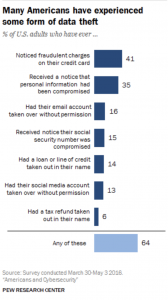
For most people, personal information and privacy are very important and is a serious private problem. According to the survey, the majority of users were informed that their account information had been compromised. The poll also revealed that there are various types of Internet theft. The majority of adults in the United States had experienced at least one type of theft, accounting for 64%. As shown in the above figure, many people have been subjected to such experiences. They are accused of credit card fraud, see some sensitive information leaked, someone takes over their email without their permission, and someone tries to invade their social account. All the victims encountered fraud and harassment after divulging personal privacy data. For example, up to 41% complained about being cheated on credit cards after divulging personal privacy, 35% received similar sensitive information because the account password was leaked, 14% of respondents complained about someone used their name for applying loans in banks and even 6% complained that someone had used their information to fill out tax returns, etc.(Pew research center, 2017) They encounter these threats because they inadvertently disclose their personal privacy information in this digital age. In addition to these data, people aged 50 or over in the United States are skeptical about whether their personal information can be protected. As they are also trying to use the Internet with the change of time in the world, and have entered the digital age, but many people of their age do not have a deep understanding of the Internet and how they going to protect their personal privacy cautiously.

Despite their reservations about whether the organisations and institutions with which they engage can sufficiently protect their personal information, a sizeable portion of the public confesses that they do not always follow cybersecurity best practices in their own digital life. In this era, most of the information written by adults or managed by their own passwords. Only a few people use password management software to manage their personal details or passwords. However, some people, on the other hand, said that they would share their accounts and passwords with their families, while others said they would use similar passwords for different software or accounts, and still others said they would use simple passwords rather than complex ones because they are easier to remember. The survey also found that Americans have a weak sense of prevention in using mobile phones. The survey pointed out that most people do not set passwords before accessing mobile phones. What is more serious is that some people connect to unsafe public networks in public places. It also shows that while using unsafe public networks, they are using online banking and operating some sensitive business matters. Due to this kind of behaviours usually happens, people have suffered the leakage of privacy, so that personal information is stolen and used by others. (Radi, 2020) Especially among the people aged 30 to 60, it is said that they have experienced many problems similar to those mentioned above, as well as many privacy leaks and data theft. In other words, if users’ personal property is at risk, privacy is compromised. In this digital age, big data and online personal information breaches are common, and the problem of information security is more relevant than ever. Criminals are increasingly using people’ personal information, either to sell directly for illicit gains or to participate in criminal acts such as telecommunications fraud, illegal debt collection, and even abduction and extortion. Criminals gather people’s leaked personal information through a variety of sources, filter and analyse user attributes, then commit precise crimes.(United Nation, 2014)
Additionally, Facebook is another example that can be demonstrated the threats to privacy well in this digital age. In the case of Facebook’s privacy disclosure, it can be fully explained that Facebook’s disclosure of users’ privacy data has led to many threats. Users of a hacker forum released the privacy information of nearly hundreds of millions of Facebook users, including various information of users, such as account ID, full name, location, profile, birthday, and even some users’ e-mail information. (Aaron, 2021) These data come from more than 100 countries and more than 50 billion personal account privacy, with 32 million users in the United States, followed by 11 million users in the UK and 6 million users in India. Furthermore, Facebook was analyzed by Cambridge. Facebook actually mastered them on the users’ account, analyzed them through their daily browsing records, and then put advertisements on the users of Facebook, and sent information about the presidential campaign to the users by mastering the users’ data, So as to unconsciously affect the user’s thinking and judgment on the presidential campaign, and achieve the purpose of subtle influence and manipulation of the presidential campaign. The events described above show that the election is no longer fair, nor is it a debate on values, nor is it a debate among political circles. (Yabing, 2021) The debate on the podium is no longer important. Instead, it may evolve into an invisible information war. It is indisputable that when the national presidential election, the media and major information platforms will certainly be used, and big data will also play an important role in this era. However, this is no longer as simple issues as infringing on personal privacy and information. In order to win the election, illegal means are used to master personal privacy information and imperceptibly change the wishes of voters to manipulate the election results, which is obviously harmful to the existing society. If the information held by the company or individual is illegally or maliciously leaked, it will directly harm the user’s personal information and privacy, and even lead to social security problems, furthermore, it will obstruct the use of information technology and software, as well as the path to social and economic development, indirectly. Big data observation pointed out if some lawless elements and large companies use the user’s personal privacy data on influence all kinds of public opinions, political information and social security, and even affect the country’s military war or significant decision, it means that these terrible actions will be no less than the use of nuclear weapons.(Big data observation, 2018)
In conclusions, in this digital era, the continuous updating and iteration of information network has brought convenience to people’s life and work, and also has obvious help for national departments to master big data to track crimes. However, it is undeniable that there are advantages and disadvantages. The leakage of personal privacy has led to the threat of users’ personal property. Large companies use big data to coerce users’ thoughts, in addition, the rapid development of the digital age also poses a serious threat and impact on the security of many countries and companies. These issues arise as a result of flaws in relevant rules and regulations, as well as a lack of disincentive for offenders. They’re also a contributing factor in Facebook privacy leaks, as well as one of the main causes for the frequency with which they occur in users’ privacy lost.
Reference:
Aaron, H., (2021). 533 million Facebook users’ phone numbers and personal data have been leaked online. Retrieved from the Insider website: https://www.businessinsider.com/stolen-data-of-533-million-facebook-users-leaked-online-2021-4
Big data observation. (2018). Retrieved April 2, 2022, from http://www.ciotimes.com/bigdata/159080.html
Cristina, C. (2020, October 28). Facebook sued over Cambridge Analytica data scandal. Retrieved from https://www.bbc.com/news/technology-54722362
Pew research centre, (2017, January 26). Americans’ experiences with data security. Retrieved from https://www.pewresearch.org/internet/2017/01/26/1-americans-experiences-with-data-security/
Radi, P., & Irina, S. (2020). Challenges of digital age for privacy and personal data protection.
Retrieved from https://www.aimspress.com/article/doi/10.3934/mbe.2020286?viewType=HTML
United Nation. (2014). Privacy in the digital age: Human rights offline should also be protected online. Retrieved from https://news-un-org.translate.goog/zh/audio/2014/07/305552?_x_tr_sl=zh-CN&_x_tr_tl=en&_x_tr_hl=zh-CN&_x_tr_pto=wapp
Yabing, L., Krishana, p., Balachander, K., Alan, M. (2011). Analyzing facebook privacy settings: user expectations vs. reality. The ACM SIFCOMM conference on internet measurement conference reviews Pages 61–70 https://dl.acm.org/doi/pdf/10.1145/2068816.2068823
Zhang, X. (2018, April 6). Facebook user data breach alert [Blog post]. Retrieved from https://theory.gmw.cn/2018-04/06/content_28233003.htm