In the internet environment, privacy is used on the basis of free online services to capture the big data on personal information without any consent of the users. Shoshana Zuboff coined a term “Surveillance Capitalism”, according to which the human behaviour is monitored by a smart device, which predicts what a user is going to do in the next few days or sooner. (Zuboff, 2019). This shows that a user is not aware of this extraction of data and the companies are taking utmost advantage of the collected information. The brands which are active on social networking platforms, stock and pile up every minute ongoings of a user to generate maximum profits. The aim of the blog is to showcase that how companies are using the data of their consumers for their own profit motive by exploiting the personal information through modern communication. The primary thesis that will be forwarded is that threats to privacy in digital age has become a common thing for companies to adopt to boost their profit motive. The blog will focus on the Facebook Cambridge Analytica scandal, followed by how the companies are adopting algorithms and surveillance capitalism methodology to improve their market hold in the economy.
Well, we all have heard about the Facebook scandal with Cambridge Analytica. In this blog, I am going to share about how these social media platforms work and exploit the personal information by threating the privacy of its users. Big tech giants like Facebook, aid a platform to the business hubs to increase their profit motive while hindering the privacy of the individuals. The legal reality lies in the fact that social media platforms have belong to the companies that create them, and so have complete power on how it runs (Suzor, 2019). Facebook sets the rules for participation and provide us with a space to communicate and connect with our closed ones. Tech giant Facebook, launched a service named Beacon, which gave the advertisers to monitor the movements of the users without any consent (Zuboff 2019). Facebook continued to track the users through the personal information provided in their official accounts and moulded it for the sole benefit of the company. You must have heard about the famous Cambridge Analytica Scandal. In the year 2016, Facebook collected personal information of its consumers with improper data practices to boost its profit motive (Wong 2019). Cambridge Analytica is a data analytics firm, which worked for the 2016 election campaign of the US President Donald Trump. In an undercover operation by Britain’s Channel 4 News, senior executive including CEO Alexander Nix, confessed on camera suggesting to help win political candidates around the world (Meredith, 2018). Phew! That is a whole lot of information. Isn’t it? Digging in further, Cambridge Analytica received information of billions of active users from the platform of Facebook and hoarded it to use for targeted voting. All the messages were customised according to a strategy called as psychographic marketing to match the personality traits of the users.
Facebook quizzes were used to identify users on the basis of the Big Five personality traits, to measure their openness, conscientiousness, extraversion, agreeableness and neuroticism. Christopher Wylie, the whistle-blower of Cambridge Analytica scandal, reveals that large scale data harvesting for political purposes using Facebook quizzes were done. Up to 87 million Facebook users had personal data harvested without consent through a “This is your digital life” online quiz (Gibney, 2018). Now that is interesting. Have you ever played a quiz like this on Facebook before? If your answer is yes, then you might gear up with your personal data on the app. Moving on, clients included the presidential campaign of Donal Trump and Vote Leave in 2016 Brexit referendum. These would be used to micro target voters with specific messages e.g., a US voter with a high level of neuroticism may be more concerned about the threat of China. With all these controversies soaring high each and every day, the Chairman of a Parliamentary Committee summoned Mark Zuckerberg to describe the historical failure to the lawmakers in the United Kingdom. Zuckerberg on his support said, the information was retreived by Cambridge Analytica legally. Facebook further claimed that Kogan had ‘lied’ to the platform and violated its privacy policies by transferring the personal data of the users. Zuckerberg banned the Kogan app and ordered other parties to destroy the data as well. He further added that his senior executives will continue to work on ground level to get all the facts checked properly. The Facebook scandal is vital as it gave the users a reality check on how their data is being harvested by companies for their own profit motive.
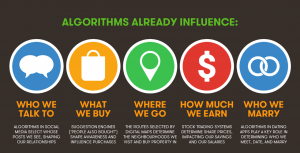
Do you know what the so called “algorithm” is? Algorithms are just a set of rules that are established for calculation, data processing and automated reasoning. It is a process that aligns informative elements of data by an automatic statistical assessment of generated data signals to get maximum outputs. In simple terms, algorithm is a way of sorting posts technically based on relevancy or users’ previous engagement activities. Algorithm is a soft term, artificial intelligence is being used track down the activities of huge populations every day (Walker, 2018). Algorithms became immensely effective from 2005 as more and more data were available for processing (Mark, 2019). Social media platforms nowadays are based on this algorithm selection wherein, the engagement activities of a user come to influence the agenda framing and settings allocated by applications. Algorithms matter because authority is increasingly expressed algorithmically (Pasquale, n.d.). Earlier, the decisions were made based on the reflections of human, and now everything is being made automatically. The more time a user spends on Facebook by scrolling the feed, the more data is mined by the company as per its strategy. Facebook relies on two similar strategies- one being the advertising part, and the other being customer surveillance. Algorithms provide a more personalized feed to the users (Golino, 2021). The main motto of brands in modern life is not to learn from others; rather sell the beliefs of its users as a product to the advertisers for maximizing the revenue (Mark, 2019). Facebook worked with this algorithm theory to extract the information of the users by providing them a personalized experience through its content. Thus, it can be said that our lives are purposely being tracked. Every time we tap “Like” on Facebook, we are giving away our personal data.

Coming to more complex term in the blog is ‘Surveillance capitalism’. What is it and why is it becoming a real problem for users? Surveillance Capitalism primarily means that companies are commodifying the personal data of users for their own profit. It has been a useful tool for small and big businesses, as it invades the privacy of the users who may not want their private experiences to be owned by the company. Surveillance capitalism takes human experience as free raw material and translates it into behavioural data (Zuboff, 2019). It shows that digital platforms like Facebook and search engine Google, have become pioneers in collection of data of the users. The tech giant Facebook monitored and surveyed the purchases of the consumers, without any sort of legal permissions. The exploitation of users for incorporating private data is a matter of concern as it would lead to cybercrimes. Surveillance capitalism works by giving free services to people and in exchange track the record of their daily life pattern irrespective of any consent. Companies like Facebook, tune its marketing process by last year sales and analyse to incorporate it in the current year.
The age of Surveillance Capitalism has become the new basis for predicting the ongoing market trends for targeted advertising. The click-through rates have become a powerful tool of advertising as it notes down the behavioural pattern of its users (Naughton, 2019). This proves that it has been adopted by every business hub, and has become a typical model to accumulate as much information as possible. Nowadays, companies work by giving services in free to a large number of people and in return enables devices to track the everyday life pattern of its users. As per the companies, one should pay the heavy price of threatening the privacy in exchange of getting knowledge from digital platforms. Nevertheless, surveillance capitalism can be beneficial for startups, as it would give the owner an insight on the behavioural pattern of the targeted audience and promote their business in a manner to attract the attention of the users (Harper, 2021). This study has its own limitations as excessive collecting of information would lead to hindering the personal space of the users. Hence, it can be stated that surveillance capitalism uses predictions of its consumers as a raw material which is free of cost to drive the sales.
The concept of “selling eyeballs to advertisers” is very much familiar with the view of audience as a commodity. As the people are more exposed to Internet of Things, social networking sites are used as primary tool to gather tonnes of data which is accessible through various devices used for surveillance purposes (Zuboff 2019). The commodification of users aids a platform to the companies to higher their sales revenue and at the same time invading the private space of the consumers. Users are considered as commodities and a used as a sales propaganda by the brands. The brands which are highly active on social networking sites pay for spot advertising and this space is used to buy the daily patterns of the users who are engaging with the content. Users are determined as an exchange value to increase brand awareness. Media audiences who indulge in watching online streaming of content, are in technical terms working for the companies by engaging with their content in their leisure time (Kang and McAllister 2011). This proves that users are unaware of this silent stealing of their personal information and are unknowingly helping them to raise their business. This also implies that while one is watching a video on Facebook feed, she or he is unintentionally helping the brand by giving away private information. Mark Zuckerberg of Facebook had complete control over what would become a primary means of communication around the globe, and with it all the data concealed in the networks. Due to the economics of surveillance capitalism, Facebook emerged as an advertising mafia and a killing field for truth. This led Mr. Zuckerberg to stand down and commit to the bystander role. After all these controversies, Facebook launched some humble initiatives which promised more transparency and a limitation to inauthentic behaviour. To prove its consistency, Facebook took a political shift towards Biden administration by indefinitely blocking the account of Donald Trump. The tech giants in accordance with the advertising agencies have changed the scenario of how the users are presented in online records and are known as a ‘neutral technology’.
The blog argued that companies nowadays are using personal data and information of users which is imposing a threat to the private lives in this digital age. Facebook has gathered immense data of its users through advertising and customer surveillance which led to the scandal of Cambridge Analytica. Algorithms are adopted by companies as a tool to sell predictions. Surveillance capitalism is extensively being used to boost their revenue by gathering their personal information without consent. Facebook is considered to be the leading one in gathering of personal data of the audiences, and is accompanied by different social media platforms and applications. Thus, it can be concluded that this digital capture of information of the users and exploitation of the behavioural patterns by the companies, is a serious threat to privacy which is adopted by companies to boost their profit motive.
References
Gibney, E. (2018). The scant science behind Cambridge Analytica’s controversial marketing techniques. Nature. https://www.nature.com/articles/d41586-018-03880-4
Golino, M.A. (2021). Algorithms in Social Media Platforms. Institute for Internet & Just the Society. https://www.internetjustsociety.org/algorithms-in-social-media-platforms
Harper, J. (2021). Taking the ‘capitalism’ out of ‘surveillance capitalism’. AEI. https://www.aei.org/technology-and-innovation/taking-the-capitalism-out-of-surveillance-capitalism/
Kang, H. and McAllister, M.P. (2011). Selling You and Your Clicks: Examining the Audience Commodification of Google. TripleC.
Mark, A. (2019). Automated Culture in Automated Media. London: Routledge.
Meredith, S. (2018). Here’s everything you need to know about the Cambridge Analytica scandal. CNBC. https://www.cnbc.com/2018/03/21/facebook-cambridge-analytica-scandal-everything-you-need-to-know.html
Naughton, J. (2019). The goal is to automate us’: welcome to the age of surveillance capitalism. The Guardian. https://www.theguardian.com/technology/2019/jan/20/shoshana-zuboff-age-of-surveillance-capitalism-google-facebook
Pasquale, F. (n.d.). The Black Box Society. Harvard University Press.
Suzor, N. (2019). ‘Who Makes the Rules?’. In Lawless: the secret rules that govern
our lives. Cambridge, UK: Cambridge University Press. pp. 10-24.
Walker, T. (2018). ‘Surveillance capitalism’ — Facebook just one example of profiteering off our data. Green Left. https://www.greenleft.org.au/content/surveillance-capitalism-facebook-just-one-example-profiteering-our-data
Wong, J.C. (2019). Document reveals how Facebook downplayed early Cambridge Analytica concerns. The Guardian. https://www.theguardian.com/technology/2019/aug/23/cambridge-analytica-facebook-response-internal-document
Zuboff, S. (2019). ‘The Age of Surveillance Capitalism’, PublicAffairs, New York.