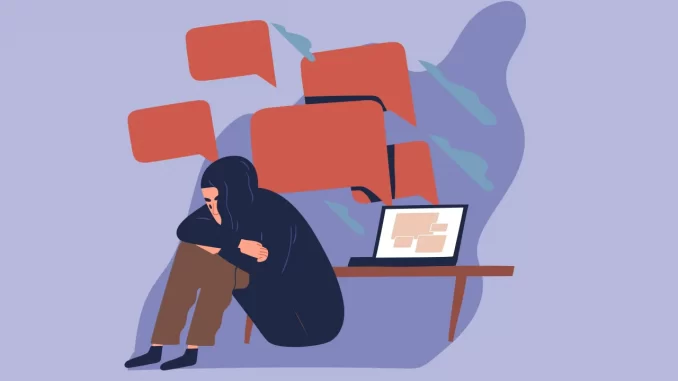
The booming Internet provides a platform for the public to express their opinions freely. The anonymity, convenience, openness and interactivity of network communication enable people to express their opinions freely online, objectively improve the degree of citizens’ freedom of speech and promote the supervision of public opinion and the process of national democratization. However, the freedom of the Internet is being abused. Some people irresponsibly publish or spread all kinds of negative information on the Internet. Hate speech, extreme remarks and superstitious ideas are widely spread on the Internet, which is difficult to prevent, causing a bad impact on the society.
In Media and races, the author surveyed some problems on individual level, but also try to explain it on higher level. In ways that individuals learn about other people and social groups, aside from their own, it is widely varied, including through schools, books, peers, family and direct contact. Direct contact may provide the most salient and therefore influential means of learning about other people geographically and social boundaries often prevent interpersonal interaction. Consequently, alternate sources of information can be very important in shaping our attitude and beliefs, although unfortunately not always in an accurate way or in a manner that encourages social harmony. The notion that media may play a role in creating or sustaining prejudice has attract research attention since early in the 20th century, when studies of numerous reactions to cinematic portrayals sprang, numerous scholars have recognized that media portrayals likely play important roles in effecting how viewers think about and respond to different racial and ethnic groups. Much of the research on media and racism in previous decades has tend to be focused on the nature of themselves. Provided evidence for the existence of stereotype, typical media content, studies that have explored that the effects of such content on viewers have often tend to be employed self report techniques. Then the whole book took many examples, to illustrate some concepts such as media and the formation of stereotypes and cultivation and social reality judgments.
The mass media and racism talks about the story in 1970. The minority actions by the far left against the national front were condemned in historical terms by commentators and politicians(Thackara,1979). Erstwhile they moderates with each other in denouncing racism system and its parasites, and the labour party authors in government of the anti-immigration policies and legislation that have contribute to the most to the rise of racism, devote an entire political broadcast to an attack on the national front. In our stereotype, the refugees or the immigrants are always poor and messy. However, in today’s society, some of the low-level job can be their occupation. And in a sense promote the social development.Sometimes we need to reflect on whether we are unnecessarily prejudiced against immigrants.
Racism, hate speeches and social media is a systematic review and critique. This article adopts statistical methods which is different from the above articles. This articles maps and discusses a recent developments in the study of racism and hate speeches in the sub-field of social media research. It systematically examine 104 articles and addressed three main questions. The article illustrates that there is a need for more thorough interrogations of how user practices and platform policies could shape the contemporary racism(Matamoros-Fernández,2021). It reminds me of Facebook(Meta). Social media usually adopts some methods to grip the mouth of some people who is propagating some improper remarks on how the government operates and the some scandals and ground-breaking news. In fact, admittedly, in every country there are politically negative information every day on the social platform. But as a social media, the software itself act as a filter the information first in order to achieve political aims. For instance, Facebook by tracking user activity, enabled marketers to exclude users with what they called an African American or hispanic ethnicity. And tick-tock has faced criticism. It suspended a viral video raising awareness of Chinese prosecution Uighurs however as a genuine Chinese, I must clarify that all Chinese, neither minority nor majority we are brothers and sisters together. The prejudice comes from no where and it is totally rumor.I have read in the media that some Western countries are slandering Xinjiang, saying that China is engaged in “forced labor” and “genocide” against the Uighur minority, and some malicious foreign scholars, such as the “lie maker” German scholar Zheng Guoen, are hyping up “top secret documents” related to Xinjiang by the Chinese government.Why is Cheng’s description so different from my real life? Don’t Zheng And I live on the same earth?
Another support for the impact of hate speech is from the article racism and mass media which mainly analyse and discuss the mass media examine through survey data and response of white Britain’s to immigration by coloured ethnic groups. A study was on the belief and attitudes that what the adolescents think matters the result of the survey. It’s within my expectation. And this study of prejudice point the finger at some entertainment media and racism in the British press. Racist speeches thrive on social media, including through comfort tactics such as the weaponization of Memes. Reddit in fact also gives rise to toxic sub cultures(Oliver,2007).
The editorial media exploitation, racism system and health Take some TV series, for example, such as the BBC comedy show Harry and Paul. It sparked media controversies in the UK and around the world for inciting stereotype to racial discrimination, vulgarity and violation of human rights when it portrayed a Filipino domestic worker in the episode four of the series. And this incident raises the issue concerning the media role in framing social issues and how it affects the wider determinants of psychological health. In fact, we cannot deny the existence of stereotypes, but we can avoid the influence or we can mitigate the influence of it(Vida,2009). This psychological literature called to bring issues of power and social injustice from the background to the foreground. And we can find that numerous studies have shown that the media contribute to the marginalization of Asian, this stigmatize on Asian of ethnic minority and cultural groups through the way they’re being portrayed.
The harm of hate speech spreads into our daily life. The article Sport, racism, social media revealed that Resistance to abuse may at some time have been hurled, across the sports stadium or scrawled on a wall. But in today’s social media world, it can be published to millions from almost anywhere in an instant. Combining analysis of social media content with in-depth interviews with athletes, fans, campaigners and officials, including extensive case studies of soccer, boxing, and the NBA and cricket(Farrington,2017). The book provides important new insights on a familiar but ever changing story. It is essential reading for any student, researcher, a media professional, administrators or policymakers with an interest in sport, new media and the issues of racism in wider society. And chapter four race and racism in the digital world is the most insightful part I have ever read.
The article Media, Racism and Public Health Psychology is a new topic. From this article I have found the mechanics of the generation of the hate speech and online harm. It takes the cases of New Zealand capital, but also ordinarily found in everyday life, such as in the case of casual racism in everyday social media communication. This article response to another article which argument that racism is defined through it’s constant evaluation and contestation in mediated communication through its debatability. I have a deeper understanding of how the media makes the influential part from mechanism. The media works through politics, institutions, and public culture, for instance, it take it takes is an internationally renowned carnival at the Belgium city . In this great carnival parade they hosted caricatured Jewish orthodox characters, including some as the ants. As the images went viral on social media and mass media is spread shock and protest against the carnival anti-semitism. This event vividly captures and contradictorily narratives that surround debates around racism and most significantly the discrimination and hate argues versus the freedom of speech. This is not racism.I don’t think racism and freedom of speech should be confused. Sometimes the performances of public culture and speech arts that claim or deny recognition of certain groups of certain people is racism, then it’s constantly debated, but its meaning became become detached from systems of power. And in equality, it paradoxically becomes both ubiquitous and unrecognizable as a system of ideas and actions to be documented and tackled. Racism and the press mainly focus on the emphasis on the press itself and uses some statistical methods on the texts. Examples are drawn mainly from British and Dutch newspapers, but data from other countries are also revealed. The book is the fruit of a decade of research into the questions of racism and the press important for ethnic studies, mass communications and media studies, sociologists and linguistics.
The literature Media, racism, and public health psychology mainly focus on the outcome or bad impact on psychological conditions of the people being discriminated. International literature has established that racism contributes to ill health of migrants and ethnic minorities and indigenous peoples. As we are aware, the racism original is not only some colonial factors or based on historical unilateral recognition but not the cultural attitudes of a small group. This article added that this hindered change in such structures will regard institutional institutional racism as both driving the process of colonization and as a continuing consequence of those processes. And the psychologists have sought to engage and discipline in producing real change in resist resist and other unjust social orders. And institutions have attended to the discursive and social foundations of the social order. Authors have identified patterns of trade mission, settlement war and legislative control in which indigenous law education, political practices, and language was supplanted by those of the colonies as so it’s a gradual process. This is a historical factor. The presumed superiority will suffice to demonstrate how the institute was established at the whim and to the benefit of the settlers.
The media plays an irreplaceable key role in shaping the views and perspectives of individuals and the public. In recent years, however, militant groups have used new media, especially the Internet and social media, to spread hate speech and extremist ideas(Nairn,2006). We should call on all countries and all media practitioners to take concrete actions to effectively monitor, regulate and regulate reporting to avoid the continued spread of statements that incite intolerance, discrimination, stigma and prejudice. There are consequences for words used in politics, in the news and on social media. History has repeatedly shown that the prevalence of hate speech creates a hostile social climate that fosters prejudice, discrimination and violence.We call on the public, especially young people, to raise awareness of the dangers of hate speech and to lead by example by avoiding words that incite intolerance, discrimination, stigma and prejudice.
References:
- Winston (EDT). “Racism, Ethnicity and the Media in Africa.” Ecquid Novi African Journalism Studies 2(2016).
- Thackara, John. “The mass media and racism.” Media, Politics And Culture. Palgrave, London, 1979. 108-118.
- Oliver, Mary Beth, Srividya Ramasubramanian, and Jinhee Kim. “Media and racism.” Communication and social cognition: Theories and methods (2007): 273-294.
- Kulaszewicz, Kassia E. “Racism and the media: A textual analysis.” (2015).
- Hartmann, Paul, and Charles Husband. “Racism and the mass media.” (1974).
- Matamoros-Fernández, Ariadna, and Johan Farkas. “Racism, hate speech, and social media: A systematic review and critique.” Television & New Media 22.2 (2021): 205-224.
- Vida Estacio, Emee. “Media exploitation, racism and health.” Journal of Health Psychology 14.2 (2009): 155-157.
- Farrington, Neil, et al. Sport, racism and social media. Routledge, 2017.
- Georgiou, Myria. “Racism, postracialism and why media matter.” Ethnic and Racial Studies 43.13 (2020): 2379-2385.
- Van Dijk, Teun A. Racism and the Press. Routledge, 2015.
- Nairn, Raymond, et al. “Media, racism and public health psychology.” Journal of Health Psychology 11.2 (2006): 183-196.