
Introduction
The internet and social media have had a significant impact on modern society. While internet technology has brought much convenience to people’s lives, many concerns about data misuse have also arisen in the era of big data. Social media platforms collect data from their users in order to better explore their preferences and increase user retention, and take notes when we are chatting with friends on WeChat or clicking likes on TikTok. They are even crunching data about our friends and family. We are being monitored by big data constantly, and our data is shared by all online websites. Algorithms help these platforms and online merchants analyse users’ data to find their target audiences, as firms are all profit-driven agencies. Attention can be described to wealthy in the internet age while platforms can easily catch people’s attention and predict the content users want to view by analysing large amounts of their data. There are thus concerns about the misuse of personal data.
Personal data breaches are now a matter of public concern, as user data has become a tool for firms looking to make a profit. It is disconcerting that people’s personal and private information seems to be exposed to all social media platforms while companies often protect personal data as data-based systems become increasingly widespread (Marwick & Boyd, 2018). Social media platforms can use our data to do whatever they want. Members of the public may expect to see some response from the legal and regulatory spheres with regards to the way data and advanced data analytics are used (Goggin et al., 2017).
This blog will mainly focus on ways social media platforms misuse our personal data in order to affect our decisions. The ways Facebook constantly gathers and misuses data will be discussed to identify how powerful data is, and how firms are able to collect and use this data. After analysing the extent and cause of the problem, possible ways to address user concerns will be discussed in order to further develop social media platforms.
Facebook’s capacity for collecting data
Facebook has always been suspected of listening to the private conversations of its users, as it often displays adverts corresponding to recent conversations. However, the truth is more complicated than we imagine, as their algorithms can predict people’s actions precisely.
When conspiracy theories concerning Facebook microphone tracking began to gain traction in 2016, Facebook responded by indicating that they show ads based on people’s interests and personal information, and do not track conversations. An experiment confirmed Facebook’s claim. Wandera, a mobile cyber-security firm, put the “phone-snooping” notion to the test, according to Haridy (2019). They placed a phone with user permissions for all apps in a room playing pet food ads, yet found that no apps displayed pet food adverts. It thus appears social media platforms are not eavesdropping on their users in order to provide tailored adverts to consumers. Massive and real-time data is a precise tool that allows social media platforms to target specific audiences. In today’s culture, the use of mobile phones and the internet is unavoidable, and all actions people make through them will generate data. It is thus easy for social media platforms to use this data to learn about every user. The system can track users at every moment; they know who your friends are, who you stay with, and all your texts even if you never actually send them (Haridy, 2019). It is a terrible thing that Facebook can continue to gather information without their users knowing about it. Moreover, according to Dvorak (2022), if you create a Facebook account you have consented to Facebook recording all of your on-site activities, as well as data outside the website.
Advertising makes up the bulk of Facebook’s income, as online merchants can easily target their audiences with the help of these platforms. Once social media platforms understand user’s motivations, making money seems to be easy for them. Facebook even created an online shop where users can buy things without leaving the website. From this we can see personal data is very significant and powerful in the online world. Personal data can be obtained by these platforms easily and used without proper authorisation, which is an issue of concern for many people. The following example involving the Facebook–Cambridge Analytica data scandal discusses these concerns.
Facebook scandal
Digital disruption has ramifications for people’s ability to engage with their surroundings, as we can now access new information and interaction channels. However, individuals and governments have little control over the way social media platforms collect data (Goggin et al., 2017). Facebook holds a huge amount of personal data which provides users with much convenience, but could cause issues if used inappropriately.
In 2018, Facebook was found to have disclosed data on up to 87 million Facebook users to a researcher at Cambridge Analytica, a company which worked on the US presidential campaign of Donald Trump. This scandal made Facebook the Centre of a growing storm. During the 2016 election, the president of Cambridge Analytica reached out to the Trump campaign and later became a senior adviser to Trump (Chang, 2018). Cambridge Analytica builds personality quiz app on Facebook that allowed it to collect data on users. In addition, the report said, the company use these data to provide target users with political advertising to infect their mind. By coincidence, Donald Trump and Ted Cruz’s campaigns each paid the business more than $5 million(Chan, 2019). It is obvious that personal data is thus not safe when under the control of such platforms. They can acquire incredibly specific data from users on their hobbies, views, political orientation, personal family and social networks, location and frequently visited areas, and purchasing patterns (Goggin et al., 2017). With this information, agencies can influence people’s thoughts subconsciously during elections.
According to Stewert (2018), Facebook acts unscrupulously, covers this up, and then apologizes when its actions are exposed to the public. The documentation of the suit from an app developer named Six4Three states that Zuckerberg and his team discussed ways to monetize user data, and Facebook considered “whitelist” deals with several corporations to provide them with access to user data. This lawsuit confirms people’s concerns about the potential misuse of personal data were actually valid. There are many more examples of Facebook actually selling user data. The NYT analysis contains hundreds of pages and dozens of interviews showing they shared user’s personal data with more than 150 companies. (Facebook’s Data-Sharing Deals Exposed, 2018.) For example, in order to personalize their results, Microsoft’s Bing search engine was able to access the names of nearly all Facebook users’ friends without their approval. Many similar scandals have already been revealed to the public, testifying that the problem of misusing personal data is not just an idle concern, but actually exists.
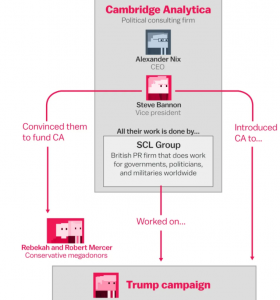
(Image from Chang(2018) The Facebook and Cambridge Analytica scandal, explained with a simple diagram)
This scandal definitely damaged public trust in Facebook, and Zuckerberg quickly responded by apologising and declaring that the company had already taken steps to prevent this from happening again. In 2011, Facebook promised FTC that they would not share user’s data without their permission and insisted they collect and use data appropriately. However, the Facebook scandals in 2018 alone demonstrate that data misuse is widespread and pervasive.
Social media platforms are profit-driven agencies, and realize information is more powerful than we can imagine. They use complicated algorithms systems which are difficult for ordinary users to understand. Even before the scandals discussed above, users were concerned about the way these platforms threaten their privacy. Once the scandals broke and Facebook’s actions were revealed, the public found data was much powerful than they imagined As Karppinen (2017) mentions, what we can do is determined by a few search engines and content platforms, as well as their algorithms, which can follow user behavior, govern personal data, and give preference to or even prohibit particular contents. Human are naturally to be worried when things out of their control. Moreover, these companies subtly influence our decisions with vast amounts of data. How the systems work is uncharted territory for most users. The failure of these platforms to properly manage their personal data has angered many users.
In the digital era, users are the most ignorant group. Increasing awareness of the threats and drawbacks of big data collection and analysis does not appear to be causing a decrease in the usage of digital platforms. (Goggin et al., 2017) Conspiracies cannot be hidden forever. Facebook’s example has led the public to denounce how social media platforms approach data security. Currently, the topic of data governance and personal privacy in the digital age has become a significant problem, and public concerns about the misuse of personal data need to be addressed urgently.
Possible ways to reduce public concern
Internet companies have repeatedly assured the public that they will not misuse users’ information and will operate transparently. Facebook’s data policy on their website outlines the company’s regulations regarding the kind of information they collect, how they use and share this data, how they respond to legal requests, how they try to prevent harm, and details of how they transfer data as part of their global service (Facebook, n.d.). The policy may alleviate user’s concerns to some extent, as firms have strict self-imposed rules regulating how they use data. . Furthermore, misuse of data will be significantly reduce when users can take dominance to their personal data. Firms are resolved to implement self-governance and offer users a fully compliant and transparent system. Users will not need to worry about data security as long as companies actually do what they say.
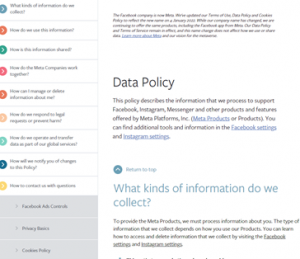
(Image from Facebook official website)
However, self-governance is not enough while Internet companies are bound by their profit-seeking motive. Calls for strengthen regulation by individuals and governments are also necessary. Selective stakeholder engagement- platform that gives consumers alternatives for controlling their data and/or privacy settings based on third-party (involving NGOS) governance (Flew, 2019). Individual users may have no power to confront with platforms, but formal organizations will help users protect their personal data. The creation of strict regulatory standards and punishments for social media platforms that act illegally is also a significant factor in relieving people’s concern. Once the law can regulate companies efficiently, misuse of data will be prevented.
The most likely option for such regulation seems to be a co-regulatory framework, which is linked to soft law methods of enactment and enforcement (Flew, 2019). When data misuse can have significant effects, each party seems to have responsibility to enforce greater regulation of data use that can actually eliminate user concerns.
Conclusion
Allegations that companies are misusing their personal data is always disturbing to users. While people enjoy the convenience brought by big data, they also worry about whether their personal data secure. This blog uses the example of Facebook gathering user data to comprehensively analyse them and subtly affect their thoughts. Moreover, there is evidence that platforms actually can manipulate users’ choices and behaviours using massive data. Concerns about the use and abuse of data actually exist, as firms use data to analyse their users and extract valuable information from them. They use their information to seek an easy profit, and most users are unaware of the way their data allows internet companies to achieve their goals secretly.
However, scandals eventually exposed this fact to the public, which began to increase people’s awareness of personal data security and acted as a warning to social media platforms. Misuse of personal data is a serious problem in the digital era, and privacy issues may change the overall development of society when the way this is used data can actually change our decisions. The companies themselves cannot be relied on to prevent the misuse of data, so multi-party supervision seems to be a more reasonable approach for governments to take. The digital era is a period of chaotic and rapid development, and individuals, NGOS, governments and firms must work together to deal with the issues that have arisen with the expansion of the internet. Concerns about the misuse of personal data still exist, but i believe they will gradually relieve in the future.
References
Chang, Alvin . (2018). The Facebook and Cambridge Analytica scandal, explained with a simple diagram – Vox. Retrieved April 7, 2022, from Vox website: https://www.vox.com/policy-and-politics/2018/3/23/17151916/facebook-cambridge-analytica-trump-diagram
Chan, R. (2019). Cambridge Analytica Whistleblower on How the Firm Used Facebook Data. Retrieved April 7, 2022, from Business Insider website: https://www.businessinsider.com/cambridge-analytica-whistleblower-christopher-wylie-facebook-data-2019-10
Dvorak, C. (2022). What Data Does Facebook Collect? | Reviews.org. Retrieved April 2, 2022, from Reviews.org website: https://www.reviews.org/internet-service/what-data-does-facebook-collect/
BBC News(2018). Facebook’s data-sharing deals exposed. Retrieved April 2, 2022, from BBC News website: https://www.bbc.com/news/technology46618582#:~:text=Facebook%20has%20long%20maintained%20that,People%20You%20May%20Know%20facility.
Facebook. (n.d.). Retrieved April 3, 2022, from Facebook website: https://www.facebook.com/policy.php
Flew, T. (2019). Platforms on Trial. International institute of communication. 46(2), 18-23. https://eprints.qut.edu.au/120461/
Goggin, G., Vromen, A., Weatherall, K. G., Martin, F., Webb, A., Sunman, L., & Bailo, F. (2017). Digital rights in Australia. Digital Rights in Australia, The University of Sydney
Haridy, R. (2019, September 6). Facebook isn’t eavesdropping, but the truth is more disturbing. Retrieved April 3, 2022, from New Atlas website: https://newatlas.com/computers/facebook-not-secretly-listening-conversations/
Karppinen, K. (2017) Human rights and the digital. In H. Tumber & S. Waisbord (Eds.), The Routledge Companion to Media and Human Rights (pp. 95-103). Routledge
Stewart, E. (2018). Facebook scandals 2018: the year, explained – Vox. Retrieved April 3, 2022, from Vox website:https://www.vox.com/technology/2018/12/21/18149099/delete-facebook-scandals-2018-cambridge-analytica
Picture references
Chang, Alvin . (2018). The Facebook and Cambridge Analytica scandal, explained with a simple diagram – Vox. Retrieved April 7, 2022, from Vox website: https://www.vox.com/policy-and-politics/2018/3/23/17151916/facebook-cambridge-analytica-trump-diagram
Facebook. (n.d.). Retrieved April 3, 2022, from Facebook website:https://www.facebook.com/policy.php