The 21st century is an era of information explosion, and the Internet has become the main channel for us to obtain all kinds of information.The online platforms have become an essential part of our daily lives. With the advancement and development of global internet technology, users can not only conduct simple information searches on the internet, but also activities such as shopping, travelling and even recruitment can be done through internet. In the process of internet platform, users’ actions and information dissemination, whether active or passive, are stored and remembered by big data. As the Chinese media Dazhong Daily mentioned in “Ethical concerns in the era of big data”, big data technology is a continuation of information technology, which was a cause of concern and anxiety when the information society was first proposed and emerged. Any science and technology is a double-edged sword, and the benefits and risks always go hand in hand. Therefore, while users enjoy the convenience of the Internet data era, there is also the risk of information privacy leakage(Zhao,2016).
As people’s lives and the internet become more and more inseparable, the exposure of private information makes it possible that everyone is experiencing an online privacy breach. Have you ever received a constant stream of spam messages? Have you experienced a barrage of unwanted phone calls? Is your email inbox overflowing with countless sales emails? If you’ve experienced any of these, then your personal information may have been compromised. In 2015 there was a shooting in California, USA, which left several people dead and injured, and the police found an Iphone at the scene. The FBI then asked Apple with a search warrant for everything they could find out about the phone, only to be forcefully refused. Although Apple’s attitude towards the incident has been controversial, it is behind this move that Apple is doing its utmost to protect the privacy and security of its users from being violated.
Why are people increasingly concerned about their privacy in today’s society?
The right to privacy is a fundamental human right, which means that an individual is entitled to a certain amount of private information space and is protected by law, and that no one may publicly disclose or disseminate the private information of another person without the subject’s permission. The right to privacy was first introduced in 1980 by American private law scholars Samuel D. Warren and Louis D. Brandeis, and with the continued development of the internet and big data, the scope of privacy is not limited to physical information. The right to privacy online is the “right of others to refrain from collecting, obtaining, using and transmitting personal data and information about oneself online without one’s consent or authorisation”. In other words, the right to online privacy is an extension of the traditional right to privacy in the online information sector, and is a form of personal privacy in the online world. As Weber mentions in Internet Governance, citizens’ behaviour on the Internet is also subject to legal regulation, then citizens’ rights when using the Internet should also be protected by law.
Yet although online privacy and security are increasingly of concern to various organisations, incidents regarding privacy breaches are still occurring. This is due to the fact that more and more social media platforms are posting basic or even more private information about individuals, such as job applications and sexual orientation, on social media platforms to facilitate communication, but this can also easily lead to leaks of user information. The leakage of a large amount of user information on various online platforms not only threatens citizens’ privacy and personal safety, but also easily becomes an aid for individuals and organisations to commit crimes.
Online privacy leaks under COVID-19
Zoom is currently the most used online video conferencing office platform in Europe and the United States. It provides a video communication platform that enables users from all over the world to communicate online in real time with voice and video. As the emergence of the new crown epidemic has sent demand for video conferencing skyrocketing, the cloud video conferencing app Zoom has seen a surge in users as a result. At one point, Zoom’s daily activity exceeded 200 million, according to publicly available information, compared to just around 10 million at the end of December 19. This is why Zoom’s share price rose by more than 100% between January and March 2020, in a global economic climate where stock markets are in the doldrums and the economy is not looking good. The huge number of users is not only home school students and teachers, but also employees of prestigious companies and hormone workers. With the sudden growth in users, it was clear that zoom had no strategy in place to deal with the sudden growth in users, and as a result, there were constant revelations of privacy and security breaches. The Boston office of the Federal Bureau of Investigation (FBI) issued a warning about Zoom , saying that users are cautioned not to conduct public meetings or share links widely on the site due to multiple previous incidents of unidentified individuals hacking into school online courses.
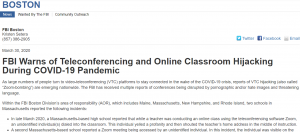
(FBI issues warning on ZOOM use)
However such a reminder didn’t stop things from getting worse. According to several foreign media reports, including The Washington Post, Zoom has a serious privacy and security breach, with a former NSA researcher breaking the news that “15,000 Zoom videos were searched at once in the open cloud storage space, including one-on-one therapy sessions; the latest training videos for company employees; which also had the names and phone numbers of attendees ; videos of small company meetings; private video content such as internet lessons for primary school children.” The leaked videos, on the other hand, were downloaded by users and distributed on major video and social media platforms. At the same time during the Singapore online classes, it was hacked, the online platform was used to spread large-scale pornography, personal login information was maliciously recorded, camera and sound barrel permissions were recklessly made public, and user IP addresses were leaked …… in a series of security performance issues.
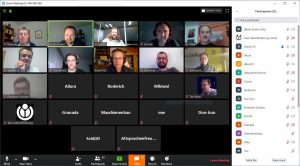
(ZOOM privacy video leak)
Such revelations, while not what zoom was hoping for, have opened zoom up to increasing questions from all sides of the world. As a result SpaceX asked employees to stop using Zoom immediately in an email sent to them on 28 March; At the same time, NASA had also banned its employees from using Zoom. on 8 April, Google disabled Zoom, the video conferencing software on employees’ laptops, citing security reasons; The British Prime Minister has also stated that zoom will only be used at non-state secret meetings.The company’s CEO, Yuan Zheng, also mentioned in his apology that due to inadequate preparation, the company’s current protection of user privacy and security of the software falls far short of its expectations and requirements for the platform.Therefore, in the face of the plunge in stocks, how to improve the security of users’ private information and appease the negative sentiment and mistrust of the market towards online platforms is something that Zoom needs to improve in the coming period.

(The British Prime Minister uses zoom for meetings)
The dangers of online privacy breaches
The leak of information from zoom has not only caused damage to the rights of citizens, but has also had a significant impact on the company’s business and national politics. Therefor we can discern that the protection of privacy and security is not only an expression of the rights of citizens, but also an extension of national sovereignty in the internet. In the UK, in 2009, a German killer used the personal information and daily status of the victim and his girlfriend posted on online social media platforms to analyse and summarise their location and movements to locate the victim and kill him; In April 2016, a Krowdthink survey revealed that 93% of the UK population was at risk of location information leaks, and that their movements were not only in the hands of wireless carriers, but also in the records of various taxi-hailing apps. 2021 Chinese taxi-hailing app DIDI was taken off the Chinese app shop due to alleged national security information leaks. The leaked information, easily put up for sale on the dark web by hackers or organisations with ulterior motives, allows you to know personal information about anyone, even the President of Turkey, for just a small amount of bitcoin. This information was made public on the internet in a massive information leak in Turkey in April 2016.
(Hacking the dark web to sell information)
Gemalto mentioned that according to the survey, the total number of data breaches in the first half of 2016 increased by 15% and globally, a whopping 974 data breaches have been exposed in the first half of 2016, with a total of more than 55.4 billion data breach records. In addition, according to 2019 FBI IC 3 data, there were over 460,000 corporate and personal cybersecurity incidents worldwide, bringing in over $3.5 billion in losses, with EBC/EAC scams bringing in the most losses at over $1.7 billion. According to data published in ForgeRock’s 2019 Consumer Identity Information Breach Report, more than $1.2 trillion was lost to US organisations as a result of over 5 billion pieces of private data being exposed online. In Russia in 2022, cybercrime caused losses of up to 90 billion roubles due to cyber privacy security breaches, according to the Russian newspaper Kommersant. The report also points out that the number of crimes committed using information and communication technologies will continue to rise in 2022 due to COVID-19, and that the global losses from future fraud caused by cyber information leaks will increase every year and can be expected to reach up to $1.05 billion in 2025. And due to the impact of COVID-19 in 2020, the number of online privacy information leaks in 2020 far exceeds that of 19, with the use of video conferencing software and remote software all becoming major platforms for privacy and security leaks.
Global Governance for Online Privacy and Security
Such appalling data has to be taken seriously by organisations and governments around the world. In the age of big data, where cases of online privacy breaches are common, who should take responsibility for protecting the privacy and security of users?

(Linked user privacy information leakage)
On a user level, users should always be aware of the potential damage that online platforms can cause to their privacy. In the 2020 LInked leak of 500 million users’ privacy, Linked said that the information posted by hackers on the dark web was not private. That is to say it was information that was actively posted by users or made public on the online fear platform. Many users therefore download apps without realising that these apps may actually be collecting personal information that may have been exposed in the data breach. Users should be more aware of the protection of their private information, learn the ability to manage and dispose of private information, use privacy permission settings and other means to maintain the security of their personal information, and immediately take legal action to defend their legal rights if they are infringed(Zhang,2016).
From a company perspective, companies should anticipate risks and improve the privacy and security of their users from a technical perspective. For example, in the case of the zoom privacy breach, the main concern was the lack of end-to-end encryption in video calls. The company should strengthen control measures, increase awareness among internal staff, and set up a CPO (Chief Privacy Officer) to manage user privacy, etc. In addition, privacy features can be divided so that users can decide for themselves what information can be released publicly and transparently, which is a trend in the development of personal privacy protection in the era of big data.
At the national level, due to the open and interconnected nature of the Internet, network information security cannot be the responsibility of just one country or one organisation on its own. How to regulate and protect activities within the Internet under the trend of globalisation is something that every country should be concerned about(Mueller,2022). The United States, as the first country to establish a regulatory authority for online privacy, has a model of governance that is well worth learning from. It is important to establish a comprehensive legal system to protect the legal rights of citizens and businesses in the event of information leakage, thereby increasing the cost of online privacy crimes. In addition, in today’s Internet platform, the dissemination of private information is no longer restricted by geographical boundaries, and the protection of online privacy is a common problem faced by countries around the world, so it is important to break down barriers and strengthen cooperation between countries to improve global capacity to deal with online privacy and security risks.
Conclusion
Due to the sudden outbreak of COVID-19, more issues and flaws in online privacy and security have been exposed compared to the previous ones. However, while addressing the issue of information leakage under the epidemic, neither companies nor countries should stop there. The discussion on the governance of online privacy crimes should not be limited to the period of the epidemic, but needs to extend beyond it.
References
2021 ForgeRock Consumer Identity Breach Report. (n.d.). Retrieved April 7, 2022, from ForgeRock website: https://www.forgerock.com/resources/2021-consumer-identity-breach-report
Allegretti, A. (2020, March 26). Coronavirus: Cabinet talks held on Zoom days after software was banned by Ministry of Defence. Sky. Retrieved from https://news.sky.com/story/coronairus-cabinet-talks-held-on-zoom-days-after-software-was-banned-by-ministry-of-defence-11963889
CountryVPNs. (2020, April 1). Some teleconferences as well as classrooms are vulnerable to cyberattacks, says FBI. Retrieved April 7, 2022, from Country VPNs website: https://www.countryvpns.com/blog/teleconferences-prone-to-cyberattacks/
H. Weber, R. (n.d.). Shaping Internet Governance: Regulatory Challenges. In SpringerLink (pp. 1–23). Retrieved from https://link.springer.com/book/10.1007/978-3-642-04620-9
Krowdthink. (n.d.). The Privacy Advantage 2016 – Wojciech Wiewiorowski. Retrieved April 7, 2022, from SlideShare iOS website: https://www.slideshare.net/Krowdthink/the-privacy-advantage-2016-wojciech-wiewiorowski
Martin, S. (2021, July 19). Valaki „szórakozásból” kiszivárogtatta 700 millió LinkedIn-felhasználó személyes adatait. PC World Hungary. Retrieved from https://pcworld.hu/pcwlite/valaki-szorakozasbol-kiszivarogtatta-700-millio-linkedin-felhasznalo-szemelyes-adatait-297057.html
Mueller, M. (2022, March 28). Internet Governance Project. Retrieved April 5, 2022, from Internet Governance Project website: https://www.internetgovernance.org/
Mujezinovic, D. (2022, February 2). Uber Suffered Major Breaches: Take These Steps to Secure Your Account Now. MUO. Retrieved from https://www.makeuseof.com/uber-breaches-steps-secure-account/
Shacklett, M. (2015, November 23). 3 ways to address looming big data privacy and security issues. Retrieved April 7, 2022, from TechRepublic website: https://www.techrepublic.com/article/3-ways-to-address-looming-big-data-privacy-and-security-issues/
Someone leaked the personal information of 700 million LinkedIn users out of “entertainment.” (2021, July 19). Retrieved April 7, 2022, from Tek Deeps website: https://tekdeeps.com/someone-leaked-the-personal-information-of-700-million-linkedin-users-out-of-entertainment/
Tag:darknet markets explained – Ports DB. (2020, May). Retrieved April 7, 2022, from Ports DB website: https://www.portsdb.org/tag/darknet-markets-explained/
Zhang, R. (2016). Exploring the importance of personal information security in the era of big data. China New Communication, (20), 42.
Zhang, X. (2019). Trust and risk perception: An empirical study of factors influencing privacy and security in social networks. Modern Communication (Journal of Communication University of China), (02), 153–158.
Zhao, P. (2016). A study on online privacy and security based on social media platforms. Journal of Chengdu Administrative College, (06), 26–28.