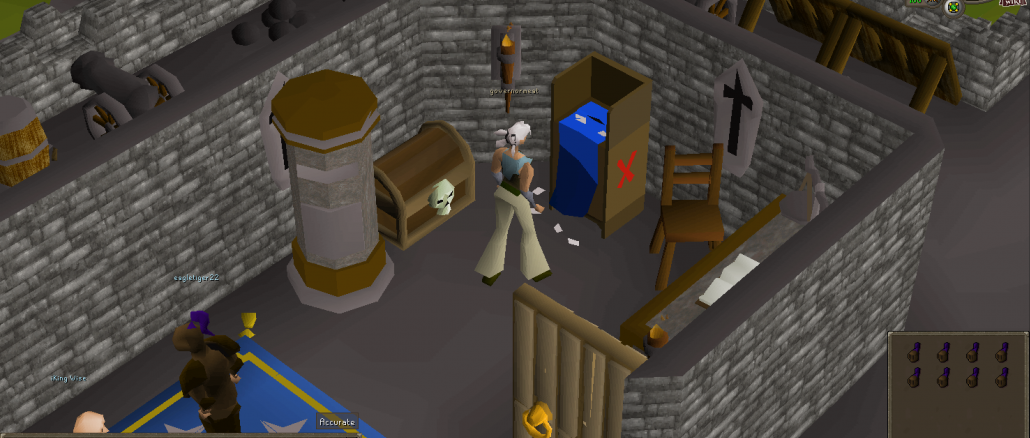
Ask any self-identified gamer about RuneScape and, most likely, you’ll hear endless praise about “the best MMO of all time,” regularly ranked with legacies like World of Warcraft and League of Legends. But dig a little deeper and you’ll realize that they’re not talking about RuneScape 3, British developer Jagex’s modern online role-playing fantasy game — what they actually love is Old School RuneScape (“OSRS”), a version of the game as it existed in 2007, complete with boxy polygon graphics, text-based questing, and simple point-and-click mechanics. Old School RuneScape, run concurrently by Jagex alongside their significantly fancier and more contemporary RuneScape 3, meets and often exceeds the larger title in number of active players.
To the non-gamer, this might seem contradictory. Why would players engage with an old and outdated version of a game when the shiny new edition is just as easily accessible? After decades of development and updates, wouldn’t the newest version be the best? The (incredibly dedicated) RuneScape player community would answer the second question with a unified NO, much to the disappointment of Jagex, who continue to try to woo OSRS die-hards into playing RuneScape 3, with little success. Old School RuneScape, released in 2013 after a community-wide poll, is lauded by its players as the ostensibly “best” version of the game, and it is defended ferociously by that community.
And the answer to the first question is found within the community itself. Self-titled “RuneScapers” felt progressively disenchanted with updates and changes to the main RuneScape, and by the early 2010s lamented how far it had strayed from its original ethos. Waxing nostalgic about the game at its perceived peak, community sentiment agreed that the version of RuneScape which was live during 2006 and 2007 was the crowning jewel. Discussions on Jagex RuneScape forums often critiqued the game in reference to this era, and in a rare turn of events for the video game industry, the developers listened to these critiques and crafted a solution they hoped would foster community engagement and collaboration between players and developers. In 2013, Jagex CEO Mark Gerhard posted to the RuneScape website with a multi-question poll, asking: if we restored an old version of the game, would you play it?
The response was overwhelmingly positive. Over 400,000 users gave their extremely excited feedback, and Jagex made short work of their promise. The August 2007 version of RuneScape was released in February of 2013 as Old School RuneScape, a fully-functioning “old school” MMO, just as it was remembered by its fans. Due to its inception as a combined effort between developers and users, Gerhard promised that Jagex was “committed to making Old School RuneScape an exclusively community driven service” (Gerhard, 2013b):
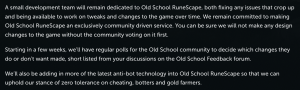
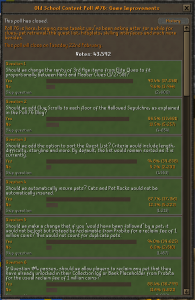
And this attention to the desires of the community has continued to be the foundation of the OSRS philosophy. No changes or updates to the game are made by the development team without a dedicated poll, and even further, polls must win by over 75% of the votes in order for those changes to be implemented. Polls are hosted in-game and also on RuneScape forums, and the developers insist on ease of accessibility and participation in these polls. Polls occur regularly, and have relatively high democratic involvement, accruing tens of thousands of votes, no matter how banal the content:
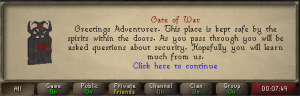
On top of that, Jagex is steadfast in their battle against bots and gold farming/market manipulation, two of the most common community complaints. MMOs like RuneScape often run into difficulties with players creating “bots” (fake accounts) or “scripts” (pieces of code) which abuse the game’s base code to farm in-game currency and valuables or annoy and harrass other players. World of Warcraft is notorious for these issues, and a simple JavaScript game like Old School RuneScape would be a prime target, if not for Jagex’s dedication to community engagement. OSRS servers have extensive anti-botting software baked into their system, and when that fails, there is a well-maintained and rapidly responsive abuse reporting system that Jagex promotes across all of its platforms. The developers are so concerned with user safety and abuse prevention that there’s even a dungeon unironically called the “Stronghold of Security” which forces you to answer abuse-related questions to advance within the game:
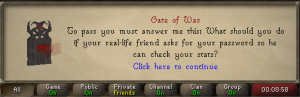
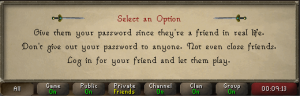
Jagex has a wider definition of what constitutes “abuse” in OSRS than many other MMOs today, and any abuse users encounter, whether it be botting/scripting, user-to-user harassment, or otherwise poor sportsmanship, can be reported in-game and will be investigated summarily. “Abuse,” in the OSRS universe, constitutes both abuse of the game by users, and abuse towards or between users. The standard of safety is high, and bans are common.
Old School RuneScape’s very existence and Jagex’s attitude towards community involvement are a rare example of successfully executed co-governance of online platform space. While the question of if online spaces ought to be governed has been largely answered, how that governance will operate in the real world is difficult to imagine, especially when considering massive international corporations that span multiple industries and continents (Gorwa, 2019). What Old School RuneScape offers us is a glimpse into utopian platform governance, a near-perfect example of a healthy relationship between user and platform company; while it may not be seamless, OSRS has been live for almost a decade, with continued and passionate community engagement all along the way.
In this respect, Old School RuneScape is an ideal case study for Lorna Woods’ and William Perrin’s duty of care approach to platform governance (Woods & Perrin, 2022). Rather than treating, from a legal perspective, platforms and the content they host as published “media,” Woods and Perrin argue that it is better to use the analogy of “architecture and spaces,” treating platforms and the online sphere as a place. As in real life, public and quasi-public spaces (like workplaces and movie theatres) need certain safety regulations to be met in order for them to be deemed viable for use. Just as a library would need fire extinguishers and marked exit paths, platforms could be required to maintain certain safeguards in order to operate. Thus regulation of platforms by governing bodies “should not target content directly but focus on the design of the service, its business model, the tools the platform provides for users, and the resources it devotes to user complaints and user safety, as each of these aspects influences information flows across the platform” (ibid., p. 94-95). This platform-specific duty of care therefore places risk management and preemptive safety as the primary approach to governance. This duty does not require that platforms protect users from all forms of harm, but that “sufficient care” has been taken in order to prevent harm before it occurs.
While this formulation was originally written as a guideline for social media companies like Facebook, Twitter, or Reddit, Woods and Perrin admit themselves that it may be applicable to a wider array of platforms. They list two vague qualifications for a platform to be considered under this duty, which are that the platform supports system-wide multiway communication and that the platform publicly displays user-generated content. OSRS does qualify by both metrics, as it contains a large messaging system for users in-game (multiway communication) and Jagex incorporates user-generated content into the game regularly. This may slightly stretch the definition as Woods and Perrin have described it, but it is nonetheless a useful tool to compare OSRS to various other platforms across the internet. OSRS obviously differs greatly from social media, since it’s a video game, but in many ways it is as much a social “place” as any other platform. Thus, if we are to approach platform governance as regulation of space, OSRS and social media are both spaces in their own right.
Woods and Perrin cite three significant points of influence which are most of concern when considering platform governance underneath this duty of care: 1, the point at which a user engages with the platform; 2, the mechanisms by which content is disseminated; and 3, the mechanisms by which recipient users engage with content (ibid., p. 96). Additionally, they stress that the enforcement of community standards, while not an issue of platform architecture, is key to upholding the duty of care at all stages. Old School RuneScape and its developers make a concerted effort to create and enforce safety measures at all three points, and especially to maintain community standards more widely in post. In line with Woods’ and Perrin’s analysis that the content of the platform is not what needs to be regulated, OSRS places safety before gameplay, introducing safety measures within the code of the game, as well as in-game reminders, emails, and dual-factor authentication. Abuse reporting, while effective due to Jagex’s guarantee to make it so, is OSRS’s last resort for reducing harms in the online space. The first point of contact, when a user encounters the OSRS account creation screen, is already well-prepared to handle abuse by preventing bot- and script-running from the get-go. These safety standards are integrated deep within the OSRS game code as well as the community as a whole, and there is strong community antipathy for rule-breakers and abuse.
Let’s compare Old School RuneScape to another platform to flesh this out. As stated above, OSRS and the social media website Reddit are both “spaces” within the outlined duty of care, and share more similarities than OSRS and other platforms. Reddit’s content generally centers “around geek interests—technology, science, popular culture… and gaming,” and, like RuneScapers, Reddit users often value “a sense of collectivism and individualism within the communities of which they are a part” (Massanari, 2017, p. 331-332). Reddit is one of the most popular social media for fans of video games, including OSRS (which has its own dedicated and active subreddit), thus these platforms dovetail enough for analysis in this respect.
Like Old School RuneScape, Reddit users and the platform itself pride themselves on the self-determining, community-based governance they purport to employ. Anyone can sign up, anyone can create posts or subreddits, and identity is largely anonymous. Content on Reddit is implicitly moderated by users through the “karma” system, which calculates a post “score” based on user votes, and explicitly moderated by mostly volunteer moderators, who work for a specific subreddit and moderate posts based on community rules. Ideally, this would result in a perfectly democratic online environment, where one person gets one vote and can use that vote to express their opinion. Meta-moderation from the Reddit developers or corporate administration is derided by users as paternalistic at best.
However, unlike Old School RuneScape, Reddit fails at every significant point of influence to uphold standards of safety outlined in Woods’ and Perrin’s duty of care. Reddit, like OSRS, also has a substantial problem with bots, which frustrates users and volunteer moderators alike, but there is very little the platform has done to combat this issue. Individual moderators must approach it on a subreddit-by-subreddit basis, which is mostly ineffective. And while Reddit as a platform and many moderators and users verbalize their desire to uphold and enforce community safety standards, in practice there is very little done to achieve this goal site-wide. Reddit administrators, the employees paid to maintain the entire website, are “loathe to intervene in any meaningful way in content disputes, citing Reddit’s role as an impartial or ‘neutral’ platform for discussion” (ibid., p. 339). Reddit moderators, unpaid volunteers assisting with a single or handful of subreddits out of their own interest, can try to fix these issues on their own, but are limited to the few tools provided to them by the administrators, which generally only allow post/comment deletion and single-user bans from a specific subreddit. Abuse and harassment is still rampant on Reddit, regardless of the rules communities have put in place. Lack of enforcement and minimal enthusiasm to engage from the platform company and the administrators prevents utopian ideals of online community from manifesting in the Reddit space, no matter how hard individual users try.
It should be noted, of course, that harassment and abuse do still occur within the world of Old School RuneScape. It is impossible to completely rid our online spaces of harm. However, OSRS is an excellent example of what our online spaces could be: community-focused, community-fostered environments for fun and friends, made in direct collaboration with platform developers. OSRS is a small community compared to the larger internet space, and its size is part of what has made it successful. But it has already done so much more than many other platforms to combat online harms, and these are the kinds of spaces we should be populating and propagating. If it can be done in a video game, it can be done in real life.
REFERENCES
All images are my own.
Gerhard, M. (2013a, February 15). 2007 – Old School RuneScape… You Vote!. RuneScape.com. https://secure.runescape.com/m=news/2007—old-school-runescape-you-vote
Gerhard, M. (2013b, March 1). Old School RuneScape: Poll Results In!. RuneScape.com. https://secure.runescape.com/m=news/old-school-runescape-poll-results-in
Gorwa, R. (2019). What is platform governance? Information, Communication & Society, 22(6), 854–871.
Hafer, L. (2013, February 22). Runescape community guarantees the return of “old school” servers. PC Gamer. https://www.pcgamer.com/runescape-community-guarantees-the-return-of-old-school-servers/
Massanari, A. (2017). #Gamergate and The Fappening: How Reddit’s algorithm, governance, and culture support toxic technocultures. New Media & Society, 19(3), 329–346.
Old School RuneScape Wiki. (2019, June 8). Old School RuneScape. Old School RuneScape Wiki; Fandom. https://oldschoolrunescape.fandom.com/wiki/Old_School_RuneScape?so=search
Woods, L., & Perrin, W. (2022). Obliging Platforms to Accept a Duty of Care. In M. Moore & D. Tambini (Eds.), Regulating Big Tech. Oxford University Press.