Introduction:
As big data becomes more and more widely used and influential in daily life, more and more organizations rely on big data analysis to complete their daily operations, and big data has revolutionized the digital environment.
Many things are a double-edged sword, and big data as well. While bringing unprecedented convenience and personalized services, it is also constantly bringing new concerns about personal privacy issue. Although everyone knows that in the big data environment, everybody is “naked” and no secret, few people know how big data makes use of personal information to analyze and push services, and how to use personal privacy to a certain extent.
This Blog will introduce how big data operates in daily life and analyze the concerns about privacy issues in behind
What is Big Data Privacy?
What is Big Data Privacy? Briefly introduction is, Big data privacy refers to the rational management of big data to reduce risks and protect sensitive data. Because big data consists of large and complex data sets, many traditional privacy processes cannot handle the scale and speed required.
To protect big data and ensure that it can be used for analysis, a privacy protection framework needs to be created that addresses the volume, speed, diversity and value of big data as it is moved, processed, analyzed and shared across different environments(Informatica. n.d.)
Based on the data collected, concerns about the potential disclosure of personal privacy on the Internet have been one of the most common questions about the Internet and digital media. The Pew Research Center has been asking Americans about various aspects of their online environment since The 1990s. In first survey, The Pew Research Center found that 54% of respondents were concerned that “computers and technology are being used to invade your privacy.”
In 2018, data from The Pew Research Center showed that 91% of respondents “agree or strongly agree that consumers no longer have control over The collection and use of personal information by companies,” and only 9% are “very confident” that social media companies will protect their data(Flew, T. 2021).
Moreover, according to the data provided by the Australian government in 2020, privacy is one of the main concerns of 70% of Australians, and nearly 90% of them want to have more choice and control over their personal information. Of those surveyed, 62% were concerned about companies tracking users’ locations through mobile phones or web browsers, and 66% were generally reluctant to provide biometric information. Respondents expressed a higher degree of discomfort with providing data for commercial analysis than with providing data for government use(Lonergan. 2020).
Why does Big Data know what we want?
As can be seen from the above, the concern about privacy in the big data environment is not groundless, privacy issues in the big data environment are far more complex than we believe, but what is closest to our daily lives is why big data always knows what we are thinking.
Imagine if every time you think about buying a product or want to eat a certain food, you open an app on your phone (social media like Instagram and Tik Tok) and get pushed to the corresponding product or food advertisement 80% of the time.

(Instagram ad)
Sometimes you wondering, is our daily conversation being bugged? In fact, the answer is not. In the big data environment, such accurate recommend service basically does not rely on eavesdropping, which requires a lot of human labor, and the efficiency of eavesdropping is also very low,then how does big data know our thoughts?
To understand how big data can accurately understand our thoughts, we need to first understand the business model of the platform.
A lot of people don’t realize is that data collection is at the heart of a platform’s business model, because its use generates detailed information about users — their interests, preferences, tastes and behaviors. This data can then be made available to third parties through application programming interfaces (API), providing detailed information about aggregated user behavior and metrics to further develop applications and services on the platform.
Ownership structures and business models of Internet companies vary, but the “free to use” model, in which software is freely available to users in exchange for easy access to their personal information, is common. The algorithmic process of automatically directing user input into desired output and connecting users to content, products and advertising is also at the core of the platform’s business model(Flew, T. 2021).
In simple terms, when you start to using certain software (Free apps), your personal information has been used to Internet companies acquire and optimization algorithm of information, one of them will be based on the analysis of your personal information, then push corresponding to fit your personal habits and commodity advertisement, advertising and merchandise is from third party suppliers or sponsor, Once you start spending based on their third party sponsor, they can make money, and this is just one of the most common business models to make money from big data.
API can be understood as a channel, responsible for the communication between one program and other program.Under such circumstance ,it’s not surprising why big data can understand our ideas, sometimes you just chat with your friends on social media apps, speak through input method do you want to buy something or want to eat some food, while the other Internet companies can through the API collected keywords from the input method you mentioned goods or food , and then immediately respond to other apps you might be using and send you relevant ads the next time you open them.
This situation is actually very common. For software providers, open APIs and allow other applications to use them freely intend to form an ecosystem, so that the software can exert the greatest value, at the same time, other companies can’t see the code, which will not cause the disclosure of trade secrets.But for the majority ordinary users, they don’t know how these thing work.
Now, you might have a new question come into your brain, when do I give Internet companies free access to my personal information?
To answer this question, we have to mention one thing that is very common but often overlooked: service terms.

You may have noticed that when we first use certain software, we all have to click “agree” to the terms of service to use it, most of the time we just blindly click “agree” and start using it without really reading the terms of service. You can’t really blame the user for this, as all terms of service are complex and vague, often offering users an all-or-nothing choice. They test users’ patience with long, awkward and complex sentences.
According to the 2017 Deloitte survey of 2,000 U.S. consumers, 91% of people agree to terms of service without reading them. For 18 to 34-year-olds, the proportion was even higher: 97 % (Guynn, J. 2020). These terms of service allocate substantial powers to operators of digital platforms and online services and give platform operators absolute discretion to write and enforce rules as they see fit(Flew, T. 2021)
The apps we use every day belong to their operator, and all too often, few people read these terms of service, which are written in dense legalese and the average user has no chance to negotiate them. They are almost always cautious, without any promises, and the company that owns the application reserves almost absolute discretion(Suzor, N. P. 2019).
It is in this way that we unwittingly give Internet companies the right to use our personal information “reasonably and legally”. The ambiguous concept of privacy in terms of service also leads to a number of problems.
In 2020, Taobao, China’s largest shopping site owned by Alibaba, launched Taoyouquan(Taobao purchase history sharing applet), which shares your shopping history in Taobao’s built-in social applet so other users can see what you’re buying.

(Taoyouquan screenshoot)
To users’ frustration and fear, the default setting of Taobao’s new “Taoyouquan” function was turned on, and many users were “forced” to share their shopping history without their knowledge, even though 95% of them didn’t want to. The reason is most likely that after a certain update, Taobao conveniently updated their terms of service, including the default opening of “Taoyouquan”.

(Taoyouquan screenshoot)
Almost all users complain about the feature, if you search the keyword “Taoyouquan” on China’s largest search engine Baidu, you will see many complaints about this feature and questions about how to shut it down.
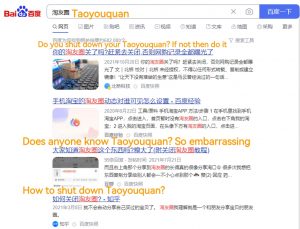
Users are understandably concerned about the exposure of their personal shopping history, as actions taken by businesses and other organizations as a result of big data analytics could infringe on the privacy of those involved and lead to embarrassment and even job losses.Reports have shown that some retailers have used big data analytics to predict intimate personal information such as the due date of pregnant shoppers.
Back in 2015, once upon time Spotify update leaded the discussion of this similar issues.Spotify updated its terms in 2015 to, among other things, agree that Spotify collects your photos, location, contacts, and more. Spotify CEO Daniel Ek and Minecraft creator Markus Persson got into a Twitter battle over the update. Persson doesn’t think Spotify should be able to access photos on users’ phones.
Ek later clarified why Spotify updated the policy. If you want to add custom images to one of the playlists, you can give the Spotify app access to your photos and select a photo in your camera roll. At least according to Ek’s statement, they guarantee Spotify won’t upload all your camera film without permission, like Facebook and Google. According to Ek’s statement, Spotify collecting your microphone and contacts, in order to give Spotify access to the microphone to execute voice commands and invite friends to sign up for Spotify(Lomas, N., & Dillet, R. 2015).
Both of these incidents reflect the excessive collection of user privacy by Internet companies, which has led to public concerns about personal privacy, and from the above statement, we can have a clear understanding that the common means of big data is to collect and use our personal information “step by step” through APIS and terms of service.
Conclusion
In the era of big data, it is inevitable and understandable for personal information to be used by Internet companies.
The right to privacy has been recognized as an innate human right, although it is limited in practice by other competing rights, obligations and norms. Big data is rapidly integrating and changing our lives, but the privacy issues that come with it are worrying(Flew, T. 2021).
Big data is rapidly integrating and changing our lives, but the privacy issues that come with it are worrying. The widespread use of big data has brought about great changes in the concept and scope of privacy. Compared with traditional privacy issues in the early days of Internet development, privacy issues in the era of big data are characterized by data and personalization. The emergence of the ethical issue of privacy protection in the era of big data does not happen overnight, it is the evolution of the ethical issue of privacy protection in the early stage of the original Internet development.
Big data privacy is a matter of customer trust. The more data you collect about your users, the better you can learn about their current behavior, the more you can infer their future behavior, and ultimately gain insights into their lives and preferences. In this context, it is more important for internet companies to be transparent with their customers about how they handle the user data they collect, how they store it, and how they comply with privacy and data management regulations and take steps to protect their customers(Informatica. n.d.)
A common situation is that Internet companies use ordinary users who are not familiar with the operation of big data as “blind spots” to take advantage.Protecting user privacy and security requires the joint efforts of many parties.In addition to improving relevant laws and regulations, I think it is appropriate to popularize the basic common sense of big data with ordinary users, so that they can have enough basic knowledge to protect their private information.
References List:
Flew, T. (2022). Privacy and security. In Regulating platforms (pp. 72-79). Polity.
Goldstein, J., & Ghazi, A. H. (2020, March 4). Terms of service. npr. https://www.npr.org/2020/03/04/812264543/episode-976-terms-of-service
Guynn, J. (2020, January 28). What you need to know before clicking ‘I agree’ on that terms of service agreement or privacy policy. USA TODAY. https://www.usatoday.com/story/tech/2020/01/28/not-reading-the-small-print-is-privacy-policy-fail/4565274002/
Informatica. (n.d.). Big data and privacy what you need to know. https://www.informatica.com/au/resources/articles/what-is-big-data-privacy.html
Lomas, N., & Dillet, R. (2015, August 21). Terms and conditions are the biggest lie of our industry. TechCrunch. https://techcrunch.com/2015/08/21/agree-to-disagree/
Lonergan. (2020). Commissioner’s foreword. In Australian community attitudes to privacy survey 2020 (p. 4). https://www.oaic.gov.au/engage-with-us/research/australian-community-attitudes-to-privacy-survey-2020-landing-page/2020-australian-community-attitudes-to-privacy-survey
Shacklett, M. (2015, November 23). 3 ways to address looming big data privacy and security issues. Techrepublic. https://www.techrepublic.com/article/3-ways-to-address-looming-big-data-privacy-and-security-issues/
Suzor, N. P. (2019). Who makes the rules? In Lawless: The secret rules that govern our digital lives (pp. 10-24). Cambridge University Press.